
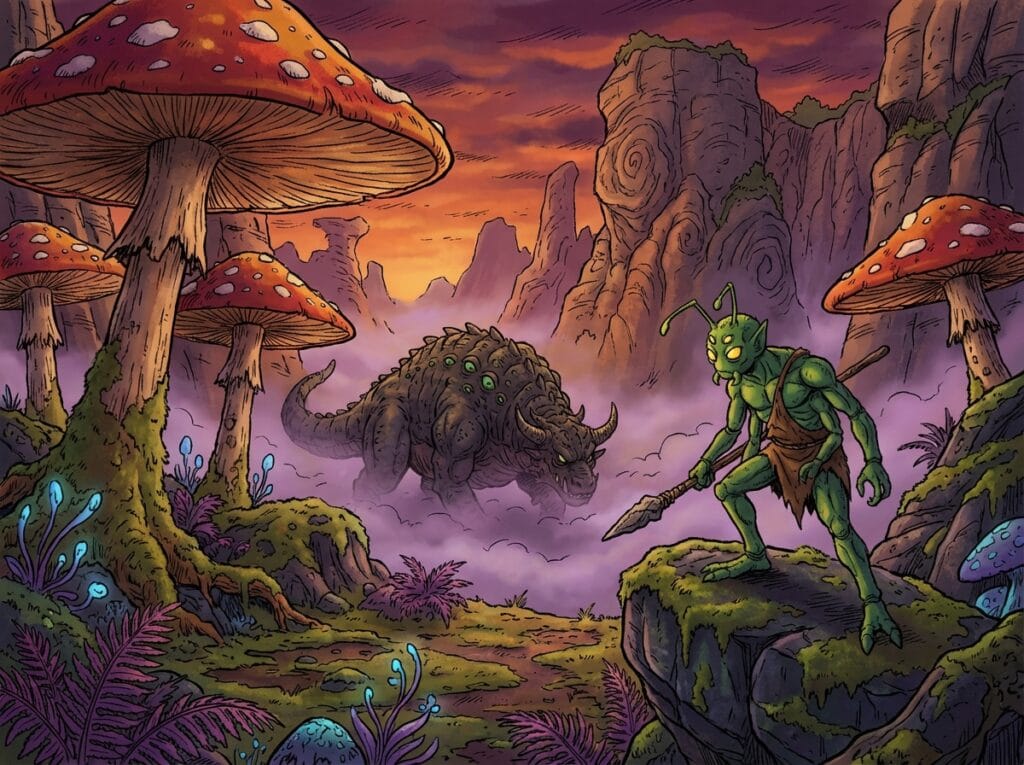
Deep in the wilderness of Universe 10 lies Planet Babari, a world defined by its savage terrain and even more ferocious inhabitants. This primordial planet serves as a grim example of how life can thrive through sheer brutality and survival of the fittest. It is a place where nature remains untamed, and the law of the jungle dictates every interaction between its towering, insect-like residents.
The importance of this world reaches far beyond its rugged terrain, as it played a pivotal role in the dark transformation of the apprentice Supreme Kai, Zamasu. Watching the mindless violence of the local tribes convinced the divine observer that mortals were inherently flawed and beyond redemption. This single, isolated sphere became the catalyst for a cosmic conflict that would eventually threaten the stability of every timeline in the multiverse.
Key Takeaways
- Planet Babari serves as the primary catalyst for Zamasu’s descent into villainy, as the native population’s mindless violence convinced him that mortals are inherently flawed and beyond redemption.
- The Babarians remain trapped in a stagnant evolutionary cycle of tribal warfare and aggression, showing no progress toward civilization even after a thousand-year jump into the future.
- The planet’s prehistoric environment and harsh ‘survival of the fittest’ landscape directly foster the hyper-aggressive culture and four-armed physiology of its native species.
- The conflict on Babari highlights a fundamental ideological divide between the Supreme Kais, pitting Gowasu’s policy of patient non-intervention against Zamasu’s desire for violent divine justice.
Vital Statistics of Planet Babari
| Universe | Universe 10 | | :— | :— | | Ruler/Governing Body | None (Primitive Tribes) | | Native Race(s) | Babarians | | Current Status | Active |
Planet Babari is a rugged and untamed world located within the vast reach of Universe 10. The landscape is defined by massive, prehistoric vegetation and jagged rock formations that dwarf the planet’s violent inhabitants. Because the native Babarians are still in a primitive stage of evolution, there is no formal government or planetary ruler to maintain order. The environment is harsh and unforgiving, forcing the local species to live in a constant state of tribal warfare. This chaotic atmosphere serves as a backdrop for one of the most significant philosophical turning points in the series (Dragon Ball Super episode 52).
The planet’s atmosphere and gravity are suitable for humanoid life, though the sheer scale of the flora makes it a dangerous place for the unprepared. Giant, insect-like creatures roam the skies, and the native population possesses a natural ferocity that makes them incredibly aggressive toward outsiders. During a thousand-year jump into the future using a Time Ring, the environment remained largely unchanged, showing that the civilization had failed to progress toward peace. This stagnant state of violence deeply affected Zamasu, fueling his belief that mortals are inherently destructive and unworthy of protection (Dragon Ball Super episode 53).
The ethical dilemma surrounding Planet Babari highlights the strict non-interventionist policy held by the Supreme Kais. While Gowasu hoped that observing the Babarians would teach his apprentice about the importance of patience and the natural flow of time, the experience backfired. Zamasu’s decision to personally execute a Babarian who attacked them marked his first major step toward abandoning his role as a creator. This world remains a chilling reminder of how the observation of a developing species can lead to radical shifts in a deity’s perspective (Dragon Ball Super episode 54).
Environmental Conditions and Primitive Landscapes

Universe: Universe 10 Ruler/Governing Body: Gowasu (Supreme Kai of Universe 10) Native Race(s): Babarians Current Status: Active
Planet Babari is defined by a harsh and prehistoric landscape that reflects the violent nature of its inhabitants. The surface is dominated by dense, overgrown forests and jagged rock formations that provide little comfort to those who walk its grounds. These towering stone structures and thick canopies create a claustrophobic environment where danger can hide behind every corner. The atmospheric conditions are heavy and support a world where only the strongest can survive the constant threat of the elements. This rugged terrain serves as the backdrop for the primitive Babarian race as they struggle through their early stages of evolution Dragon Ball Super episode 52, Teacher and Student Reunited: Gohan and Future Trunks.
The environment plays a direct role in the aggressive behavior seen in the native life forms. With gravity and climate conditions that favor physical strength over intellect, the planet has become a breeding ground for constant conflict. Massive, dinosaur-like creatures roam the wilds, forcing the humanoid Babarians to develop a culture centered entirely around combat and survival. The lack of peaceful meadows or calming vistas ensures that the species remains locked in a cycle of brutality. This savage setting is what led Zamasu to question the value of protecting such a chaotic world during his observation with Gowasu Dragon Ball Super episode 52, Teacher and Student Reunited: Gohan and Future Trunks.
Observing this planet from the heavens provides a clear look at the ethical dilemmas faced by the Supreme Kais. The thick, swirling clouds and dark colors of the planet suggest a world that is still cooling and forming its ultimate identity. While the landscape is beautiful in a raw and untouched way, the constant bloodshed occurring beneath the trees creates a sharp contrast. It is a place where the beauty of nature meets the ugliness of unchecked violence, making it a pivotal location for the ideological shift of the apprentice Zamasu. The primitive state of the world acts as a mirror for the gods to reflect on their role in the development of mortal life Dragon Ball Super episode 52, Teacher and Student Reunited: Gohan and Future Trunks.
The Babarians and Their Savage Culture
Universe: Universe 10 Ruler/Governing Body: None (Anarchy) Native Race(s): Babarians Current Status: Active
The Babarians are a primitive and hyper-aggressive species defined by their unique four-armed physiology. This physical structure allows them to overpower prey and rivals with ease, making them natural-born brawlers in a world where strength is the only law. They possess large, muscular builds and distinct avian features, including orange skin and crests on their heads. Their culture is entirely devoid of social order, as they spend their lives in a constant state of violent tribal warfare. These creatures do not build cities or develop technology, preferring to live in the wreckage of their harsh environment Dragon Ball Super episode 53, Unmask the Identity! Off to the Tenth Universes Sacred World of the Kais!.
Watching the Babarians from the Sacred World of the Kais, Zamasu and Gowasu used the Time Rings to observe the species one thousand years into the future. Despite the passage of a millennium, the race failed to evolve into a peaceful civilization and instead remained trapped in a cycle of mindless bloodshed. This lack of progress deeply disturbed Zamasu, who viewed their savagery as proof that mortals are inherently flawed and unworthy of protection. Gowasu attempt to teach patience and observation backfired, as the sight of the Babarians killing one another only fueled Zamasu’s growing hatred for all mortal life. This encounter served as a pivotal moment in the series, setting the stage for the dark history of an apprentice Kai Dragon Ball Super episode 53, Unmask the Identity! Off to the Tenth Universes Sacred World of the Kais!.
Zamasu and the Ethical Dilemma of Intervention

| Universe | Universe 10 | | :— | :— | | Ruler/Governing Body | Gowasu (Supreme Kai) | | Native Race(s) | Babarians | | Current Status | Active |
Planet Babari serves as a pivotal setting for the ideological shift of the apprentice Kai, Zamasu. While observing the planet from the Sacred World of the Kai, Zamasu views the native Babarians as nothing more than mindless savages who thrive on senseless violence. To provide a deeper perspective on the necessity of patience, Gowasu uses a Time Ring to take Zamasu one thousand years into the planet’s future. They find that even after a millennium of evolution, the Babarians remain locked in a cycle of primitive warfare and tribal aggression Dragon Ball Super manga chapter 17.
This stagnant development acts as a catalyst for Zamasu’s growing disdain for mortal life and the established cycle of divine observation. He argues that the gods are failing in their duties by allowing such violent species to exist without intervention. Gowasu maintains that the role of a Supreme Kai is to watch and protect the balance of life rather than interfering in the natural growth of a civilization. However, seeing the Babarians continue their brutal ways only reinforces Zamasu’s belief that mortals are inherently flawed and beyond salvation Dragon Ball Super manga chapter 17.
The environmental conditions of Planet Babari reflect the harsh and unforgiving nature of its inhabitants. The landscape is filled with jagged rock formations and a prehistoric atmosphere that mirrors the constant state of conflict on the surface. While the gravity and climate are not specifically detailed as being extreme for warriors, the planet’s lack of social progress serves a narrative purpose rather than a physical challenge. For Zamasu, the planet becomes the ultimate proof that the Project Zero Mortals is the only way to achieve true justice in the multiverse Dragon Ball Super manga chapter 17.
The Philosophical Divide of Planet Babari
Universe: Universe 10 Ruler/Governing Body: Gowasu (Supreme Kai) Native Race(s): Babarians Current Status: Active
Planet Babari serves as the tragic turning point where the philosophical divide between Gowasu and Zamasu became irreconcilable. While Gowasu viewed the violent, dinosaur like Babarians as a primitive species that deserved time to evolve and learn, Zamasu saw only a cycle of mindless aggression that stained the beauty of the cosmos. This fundamental disagreement on the value of mortal life sparked the dark transformation of Zamasu from a promising student into a genocidal threat. The planet stands as a silent witness to the moment the seed of the Zero Mortals Plan was planted, forever changing the fate of multiple timelines within the Dragon Ball timeline.
The legacy of this prehistoric world is defined by the ethical dilemma it presented to the gods of Universe 10. By observing the Babarians’ brutal tribal warfare, Zamasu concluded that the Kai’s policy of non intervention was a failure that allowed evil to flourish. His decision to take justice into his own hands and execute a Babarian during their scouting mission marked his first step toward ultimate villainy. Ultimately, Planet Babari is not just a footnote in the history of Universe 10, but the very catalyst for the chaos that eventually required the intervention of the Omni King himself, long before the Tournament of Power reshaped the multiverse.
Frequently Asked Questions
1. Where is Planet Babari located?
Planet Babari is situated deep within the wilderness of Universe 10. It is a primordial world characterized by massive prehistoric vegetation and jagged rock formations Dragon Ball Super episode 52.
2. Who are the primary inhabitants of this world?
The planet is home to the Babarians, a primitive race of towering, insect-like humanoids. These creatures live in a constant state of tribal warfare and lack any formal government or civilization Dragon Ball Super episode 52.
3. Why is Planet Babari significant to the story of Zamasu?
Zamasu observed the mindless violence of the Babarian tribes and concluded that mortals were inherently flawed. This experience served as the catalyst for his decision to eradicate all mortal life across the multiverse Dragon Ball Super episode 52.
4. What is the environment like on the planet?
The landscape is rugged and untamed, featuring giant flora and a harsh atmosphere that forces a survival of the fittest lifestyle. While the gravity is suitable for humanoids, the predatory wildlife makes it extremely dangerous for visitors Dragon Ball Super episode 52.
5. Does Planet Babari have a ruler?
There is no central ruler or governing body on Planet Babari because the inhabitants are still in a primitive stage of evolution. Power is determined solely by physical strength and the law of the jungle Dragon Ball Super episode 52.
6. Is Planet Babari still active in Universe 10?
The planet remains active and continues to exist in its primordial state within Universe 10. It stands as a grim example of nature remaining untamed by divine or mortal intervention, eventually leading to the rise of Goku Black Dragon Ball Super episode 52.