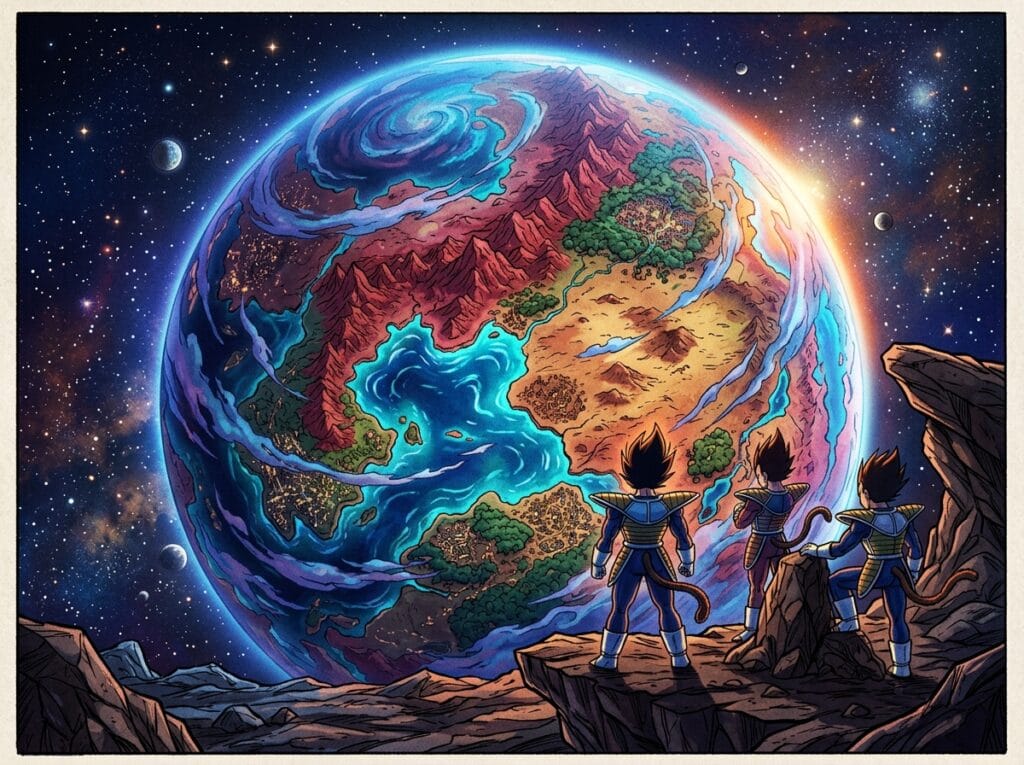
Planet Sadala’s lore begins with a mystery at the center of Saiyan history: two different worlds share the same name. Universe 7’s Sadala was the ancient homeworld destroyed before the main Dragon Ball story, while Universe 6’s Sadala remains a thriving Saiyan society. This split shows how one species can develop along very different paths.
I find Sadala especially fascinating because its Saiyans challenge the usual image of a warlike race driven by conquest. Through King Sadala, the Sadala Army, and warriors such as Cabba, Caulifla, and Kale, Universe 6 presents a culture shaped by duty, defense, and community. Their world adds depth to Saiyan history and shows what might have been possible for Universe 7’s Saiyans.
Key Takeaways
- Planet Sadala refers to two separate worlds: Universe 7’s ancient Saiyan homeworld was destroyed, while Universe 6’s Sadala remains a thriving Saiyan civilization.
- Universe 7’s Saiyans migrated from Sadala to Planet Plant, conquered the Tuffles, and renamed the world Planet Vegeta; the exact timing and cause of Sadala’s destruction remain unknown.
- Universe 6’s Saiyans developed as organized protectors rather than conquerors, with King Sadala and the Sadala Defense Force providing government and military structure.
- Cabba, Caulifla, and Kale demonstrate that Saiyan identity includes multiple paths—duty, ambition, friendship, and personal growth—showing that culture and history shape the race beyond biology.
Universe 7 Sadala Before Its Destruction
Planet Sadala was the original homeworld of the Universe 7 Saiyans, long before they settled on the world associated with the Tuffles. The series confirms that the Saiyans eventually left Sadala and migrated to Planet Plant. They later conquered the Tuffles and renamed the planet Planet Vegeta. This history makes Sadala an important part of Saiyan lore because it shows that Planet Vegeta was not their true beginning. I also think it is important to separate confirmed events from details the story has not explained.
Very little is known about Sadala’s appearance or the way its Saiyan society functioned. The anime and manga have not established its exact geography, cities, political structure, or the daily lives of its ancient inhabitants. They have also not given a definite date or fully confirmed cause for the planet’s destruction. Because of this, I treat detailed descriptions of ancient Sadala’s culture as speculation unless the series directly supports them.
The name Sadala can cause confusion because Universe 6 has its own Planet Sadala, which still exists during Dragon Ball Super. That surviving world is home to Saiyans such as Cabba, Caulifla, and Kale, whose people generally serve as defenders rather than conquerors. The two planets show how the same species developed along very different paths in alternate universes. For me, that contrast is one of the most interesting parts of Sadala’s lore, even though Universe 7’s original world remains largely mysterious.
Universe 6 Sadala And Its Saiyan Society

Planet Sadala is the Saiyan homeworld in both universes, but its history differs between them. In Universe 7, Sadala was destroyed long before the main story, forcing its Saiyans to settle on Planet Plant, later renamed Planet Vegeta after they conquered the Tuffles. Universe 6 preserves a living version of Sadala, which gives me a clearer idea of what Saiyan culture might have looked like before that violent change in history. Its survival makes the planet an important part of Saiyan lore and a window into the race’s early roots.
Universe 6’s Saiyans are still powerful fighters, but they are presented as protectors rather than conquerors. King Sadala rules the planet, while the Sadala Defense Force, also called the Sadala Army, gives the society a more organized structure than the scattered warrior culture associated with Universe 7’s Saiyans. Cabba’s role as a soldier shows how strength can serve the community. Caulifla and Kale also show that Saiyan identity is not limited to one official military path. I first see this contrast clearly when Cabba introduces his home and people during the Universe 6 conflict, Dragon Ball Super episode 32.
Cabba Caulifla And Kale On Sadala
Universe 6 Sadala is the living branch of Saiyan history, unlike the destroyed Sadala associated with Universe 7. I see this planet as an important contrast because its Saiyans developed within an organized society instead of building their identity around conquest. King Sadala rules the planet, while the Sadala Defense Force protects its people and hunts criminals. Cabba represents this path clearly as a disciplined criminal hunter whose strength is tied to loyalty, duty, and protecting others, as shown in Dragon Ball Super episode 32.
Caulifla and Kale show that Saiyan identity on Sadala is not limited to military service or royal authority. Caulifla is ambitious and fiercely independent, leading through confidence and raw talent. Kale begins as a timid fighter whose loyalty to Caulifla helps unlock her enormous power. Together, they show how strength can come from ambition, friendship, and personal growth as well as formal training. Their different choices make Universe 6 Sadala feel like a true living homeworld, where Saiyans follow several paths instead of repeating the history of their Universe 7 counterparts.
Sadala’s Role In Saiyan History

Planet Sadala is the starting point for the Saiyan story in both universes, but its fate differs sharply between them. In Universe 7, Sadala was the ancient Saiyan homeworld before the race moved to Planet Plant, a world inhabited by the Tuffles. After the Saiyans conquered Planet Plant, they renamed it Planet Vegeta, which became the home of the race seen in the main Dragon Ball story. This migration explains why Planet Vegeta is important to Saiyan history without being their original homeworld. In Universe 6, Sadala still exists, allowing me to see a living version of Saiyan society rather than only ruins and memories.
The contrast between the two planets also shows how differently Saiyan culture developed across the universes. Universe 7’s Saiyans became known for conquest, warfare, and the destruction of other worlds, while Universe 6’s Saiyans serve as defenders who protect their people and fight threats. Cabba, Caulifla, and Kale show that Universe 6 Saiyans still possess the race’s combat talent, but their society is not built around the same cycle of conquest. King Sadala and the Sadala Army also suggest a structured civilization with a government and organized defense force. I find this comparison valuable because it separates Saiyan biology from the historical choices that shaped each universe’s culture.
Even with these clues, important parts of Sadala’s lore remain unknown. The series has not provided a confirmed population, exact size, physical measurements, or complete account of the planet’s ancient history. We also do not know the full reason Universe 7’s Sadala disappeared, beyond its destruction before the main story and the Saiyan migration that followed. These gaps leave room for future stories to explain what caused the move, how early Saiyans lived, and whether the two versions of Sadala once shared more than their name.
Sadala’s Legacy in Saiyan History
Planet Sadala fills a major gap in Saiyan history by identifying the race’s original homeworld before its migration to worlds taken from the Tuffles. In Universe 7, ancient Sadala was eventually destroyed, and the surviving Saiyans settled on Planet Plant before taking control of it and renaming it Planet Vegeta. This history shows that Saiyan culture did not begin with conquest alone, even though warfare later became central to the identity of Universe 7’s Saiyans. I see Sadala as an important foundation for understanding how their society changed over time.
Universe 6 Sadala offers an even clearer contrast because the planet still exists and remains home to an organized Saiyan population. Its Saiyans serve as defenders rather than conquerors, with characters such as Cabba, Caulifla, and Kale showing how the same species can develop different values in another universe. The surviving planet also leaves room to explore Saiyan traditions, government, military history, and the legacy of King Sadala. For me, Universe 6 Sadala remains one of Dragon Ball Super’s most promising unexplored locations, with the potential to reveal more about the Saiyans’ original culture and history.
Frequently Asked Questions
1. What is Planet Sadala in Dragon Ball lore?
Planet Sadala is the original homeworld of the Saiyans in Universe 7, but it is also the name of the living Saiyan homeworld in Universe 6. This shared name can be confusing, so I treat the two planets as separate worlds with different histories.
2. What happened to Universe 7’s Planet Sadala?
Universe 7’s ancient Saiyans eventually left Planet Sadala and migrated to Planet Plant. They later conquered the Tuffles, took control of the planet, and renamed it Planet Vegeta. The exact cause and date of Sadala’s destruction have not been fully confirmed.
3. Was Planet Sadala the original Saiyan homeworld?
Yes, Planet Sadala was the original known homeworld of the Universe 7 Saiyans. Planet Vegeta came later, after the Saiyans settled on Planet Plant and defeated the Tuffles. This makes Sadala an important part of Saiyan history that existed before the main Dragon Ball story.
4. Is Universe 6’s Planet Sadala still alive?
Yes, Universe 6’s Planet Sadala still exists during Dragon Ball Super. It is home to an organized Saiyan society that focuses more on protecting its people and defending others than on conquest. This version of Sadala shows a very different path for Saiyan culture.
5. How are the Saiyans of Universe 6 different from the Saiyans of Universe 7?
Universe 6’s Saiyans are generally shown as protectors who serve their communities, while Universe 7’s Saiyans became known for conquest and violence. Their differences suggest that Saiyan behavior is shaped by history and society, not only by biology. Cabba, Caulifla, and Kale each show different sides of this living Saiyan culture.
6. Who is King Sadala?
King Sadala is the ruler associated with Universe 6’s Saiyan civilization. His presence, along with the Sadala Army, shows that this world has an established government and military structure. The series has not revealed every detail about his reign or the full history of the royal family.
7. What do Cabba, Caulifla, and Kale reveal about Planet Sadala?
These warriors show that Universe 6’s Saiyans are not all the same. Cabba represents the disciplined, duty-driven side of the Sadala Army, while Caulifla and Kale highlight the power and independence found outside its formal ranks. Together, they show how broad and varied Saiyan society can be.
8. What remains unknown about ancient Planet Sadala?
The series has not clearly established the planet’s geography, cities, political system, or everyday life during the era of Universe 7’s ancient Saiyans. It has also not provided a definite explanation for the planet’s destruction. I therefore treat detailed claims about ancient Sadala’s culture as speculation unless the anime or manga confirms them.