
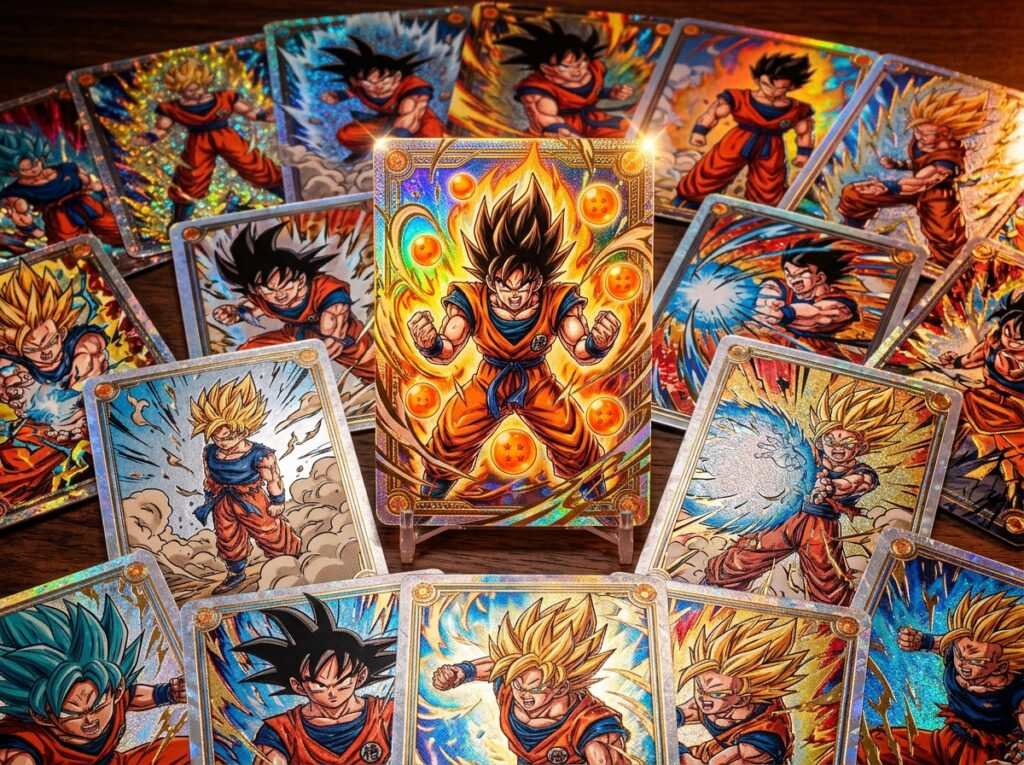
A rare Dragon Ball card can be worth far more, or far less, than its artwork suggests. The symbol in the corner often provides the answer. I created this Dragon Ball card rarity guide to help you identify what each mark means, compare cards accurately, and avoid confusing similar releases. First, I identify whether I have a Masters card, a Fusion World card, or a card from a separate arcade-based series, because each product uses a different rarity system.
Once I know the game, rarity labels such as C, UC, SR, SCR, and GDR become much easier to understand. I explain the common hierarchy, special treatments, and the difference between a card’s rarity and its actual market value. This makes it easier to sort a collection, evaluate a pull, or decide which cards deserve closer attention.
Key Takeaways
- Identify the game first—Masters, Fusion World, Super Divers, or Super Dragon Ball Heroes—because each uses different rarity systems, card numbering, and release structures.
- In Masters, the common rarity progression runs from C and UC through R, SR, SPR, SCR, and special rarities such as GDR, while Fusion World follows its own hierarchy and treatments.
- Rarity alone does not determine market value; print availability, character popularity, artwork, playability, condition, special treatments, and collector demand all significantly affect price.
- Before buying, selling, or valuing a card, verify its exact game, set code, card number, version, and condition, then compare recent completed sales rather than relying on asking prices.
Introduction to Dragon Ball Card Rarity
I start every Dragon Ball card rarity guide by identifying the game because “Dragon Ball cards” can describe several separate products. Dragon Ball Super Card Game Masters is the original competitive game, while Dragon Ball Super Card Game Fusion World is a newer game with different rules, sets, and rarity symbols. Dragon Ball Super Divers and Super Dragon Ball Heroes belong to separate arcade and digital card systems. Cards from these games are not interchangeable, so checking the product name, set code, and card number helps me avoid mistakes before estimating rarity or value.
Once I confirm the game, I look at the rarity marking printed on the card. In Masters, the typical progression may include C, UC, R, SR, SPR, SCR, and GDR, although specialty rarities do not always fit into one strict value ladder. Fusion World uses its own symbols and card treatments, so I never assume that an SR or alternate-art card means the same thing in both games. Foil patterns, stamped details, textured finishes, and special artwork can also distinguish a regular version from a more desirable parallel or chase card.
Rarity is only one part of a card’s market value. I also consider the set’s print run, how difficult the card is to pull, its tournament or character popularity, condition, and whether collectors are actively seeking that release. A limited promotional card may be more valuable than a common card from an older set, while a widely printed rare may remain affordable despite its age. By comparing the exact game, set, rarity symbol, foil treatment, and recent sales, I can build a more accurate picture of what makes a Dragon Ball card collectible.
Masters Rarity Symbols and Hierarchy

In the DRAGON BALL SUPER CARD GAME Masters card pool, the standard rarity ladder generally runs from C, or Common, and UC, or Uncommon, through R, or Rare, and SR, or Super Rare. SPR, or Special Rare, cards usually feature more elaborate artwork or foil treatments and are often more desirable than regular SR cards. SCR, or Secret Rare, cards are typically major chase cards with much lower pull rates. SLR, or Special Leader Rare, and GDR, or God Rare, can be even harder to find, with GDR cards commonly treated as the top chase rarity in sets that include them.
I use that hierarchy as a starting point, not as a guaranteed value chart for every release. Specialty labels such as ST, CR, and SPR_S can represent starter, campaign, signature, alternate-art, or other set-specific treatments, so they do not always fit neatly above or below the main rarities. A specialty card may be scarcer than a higher-sounding rarity, or it may have a different role and print run instead of being a direct upgrade. Checking the individual set list and card number helps me understand what a symbol means before I compare prices.
Rarity is only one part of a Masters card’s value. Character popularity, competitive demand, condition, and print-run size also matter. For example, a popular SCR in near-mint condition may attract more interest than an obscure GDR, while a playable SR can sell steadily because players want copies for their decks. I also look for alternate artwork, stamped finishes, event promos, and early-set cards because these details can create demand beyond the printed rarity symbol. When using this Dragon Ball card rarity guide, I treat the symbol as a clue about scarcity, then confirm the card’s actual pull rate and recent sales.
Fusion World Rarities and Set Pulls
Fusion World uses a different rarity system from Masters, so I treat each game as its own collecting category. Fusion World cards commonly use codes such as C for Common, UC for Uncommon, R for Rare, SR for Super Rare, and SCR for Secret Rare, while leader cards have their own leader designation. Some sets also include special rarity labels or premium versions, so the exact hierarchy can change from one release to another. A Fusion World card cannot be used in Masters, and a Masters card cannot be used in Fusion World, even when both feature the same character. For a dependable Dragon Ball card rarity guide, I always confirm the game logo, set code, card number, and rarity printed on the card.
Special treatments can make a card more desirable without changing its basic gameplay role. Foil finishes, textured surfaces, stamped designs, promotional markings, and alternate-art illustrations may appear as separate entries in an official set list. Alternate-art cards often keep the same card number or base rarity reference, but the checklist will show whether the version is a parallel, reprint, or special treatment. Leader cards deserve extra attention because they can have standard and alternate-art versions, and their value may depend heavily on character popularity and artwork. I compare the card image and numbering carefully instead of assuming every shiny version has a higher rarity.
I understand pull patterns by checking the official product page and complete set list for the specific release. I look for the number of cards in the set, the listed rarity categories, the odds for premium or alternate-art cards, and any stated booster or display guarantees. A box may contain expected slots for higher-rarity cards, but those patterns do not mean every box includes the same characters or chase cards. Set value usually comes from scarcity, demand, condition, and artwork together, not from the rarity code alone. When recording a collection, I separate base cards, leaders, alternate arts, and promotional versions so I do not mistake similar-looking cards for interchangeable releases.
Chase Cards, Print Runs, and Market Value
Chase cards are valuable because they combine limited supply with strong collector demand, but rarity alone does not reveal a card’s print run or price. I first confirm whether a card comes from DRAGON BALL SUPER CARD GAME Masters or DRAGON BALL SUPER CARD GAME Fusion World because these are separate games and their rarity symbols do not always mean the same thing. In Masters, the scale commonly runs from C and UC through R, SR, SPR, SCR, and special rarities such as GDR, while Fusion World uses its own structure. Serial-numbered cards, tournament promos, and cards with unusual foil patterns often have greater scarcity than regular cards, especially when the set does not disclose an exact production total.
Market value also depends on factors beyond the symbol in the corner. A popular character, memorable artwork, sought-after set, or competitive card can attract buyers even when the card is not the rarest pull. Condition matters just as much because clean corners, sharp edges, strong centering, and a bright surface usually make a card more desirable than a heavily played copy. I also check whether the foil pattern is a true parallel or simply a standard finish because a shiny appearance does not automatically make a card a chase card.
To compare rarity with real prices, I identify the exact card number, version, language, set, and condition before reviewing several recent completed sales. I separate raw cards from professionally graded copies, remove unusually high or low outliers, and compare sales from roughly the same time period. Then I note how often the card appears, whether serial numbers or promotional restrictions limit supply, and whether demand is rising or falling for its character and set. This method gives me a more reliable value range than assuming every SCR, SPR, or foil card deserves the same price.
Identifying Cards Across Dragon Ball Games
I start any Dragon Ball card rarity guide by identifying the game before judging a card’s value. Masters cards usually show the DRAGON BALL SUPER CARD GAME logo, while Fusion World cards clearly include the FUSION WORLD name and use a different card layout. Dragon Ball Super Divers and Super Dragon Ball Heroes cards belong to separate arcade and digital systems, so their logos, card backs, numbering, and design details will not match either tabletop game. A set code and card number can confirm the release. Fusion World codes often begin with “FB,” while Masters releases commonly use codes such as “BT” or “EX,” although formats vary by set. I also check the rarity mark because labels such as C, UC, R, SR, and SCR do not carry the same meaning across every Dragon Ball card game.
The card layout provides several useful clues when the logo is hard to read in a listing photo. I compare the position of the character name, energy or cost information, rules text, set code, collector number, and copyright line with known cards from the same game. Masters includes a wider range of rarity and alternate-art treatments, while Fusion World uses its own numbering and rarity system, so I never assume that a shiny finish automatically indicates the same rarity in both games. Divers and Heroes cards may emphasize arcade-related information and use different symbols or design elements that are not part of the Masters or Fusion World systems. Checking all of these details together is safer than identifying a card by its artwork alone, especially when the same character appears in several releases.
Before I buy, sell, store, or research a card, I record its game, set code, card number, rarity mark, and treatment, such as foil, alternate art, or a special stamp. This prevents common mistakes, such as listing a Fusion World card as a Masters card or treating a Heroes card as a standard trading card game release. I also compare the exact number and version with a reliable set checklist because similar artwork can appear in starter products, booster sets, promotional releases, and reprints. For storage, separating each game and labeling boxes by set makes later sorting much easier. These simple checks help me evaluate print scarcity and chase-card potential without confusing one game’s rarity hierarchy with another’s.
Conclusion to the Dragon Ball Card Rarity Guide

I use the rarity symbol as the first clue when reviewing a Dragon Ball card, but I never treat it as a complete value guide. In Masters, common symbols include C, UC, R, SR, SPR, SCR, and special labels such as GDR, while Fusion World uses its own structure and card treatments. Masters and Fusion World are separate games, so their cards are not interchangeable, and the same symbol or visual effect may not carry the same meaning. Special art, Secret Rares, gold designs, textured finishes, and limited promotional cards can all be more desirable than a basic rarity ranking suggests.
A chase card usually stands out because of a combination of scarcity, character popularity, artwork, playability, and collector demand. A powerful leader or tournament staple may be sought after for gameplay, while an iconic character with a striking special-art treatment may attract collectors even when it has little competitive use. Print runs and product availability also matter because cards from a short-printed set or difficult-to-find release can command more attention. I therefore compare the card’s rarity, set, version, and recent demand instead of assuming that every high-rarity card has the same market value.
Before judging a card, I confirm that I am using the correct checklist for its exact game and set, especially when the card could belong to Masters, Fusion World, or a separate Dragon Ball card system. I then inspect centering, corners, edges, surface quality, and any dents or scratches because condition can change the value of even a rare card. Finally, I check completed and recent market sales instead of relying only on active asking prices, which may not reflect what buyers are actually paying. This process gives me a more accurate view of a card’s rarity, condition, and current value.
Choose the Right Dragon Ball Card Set
I use a Dragon Ball card rarity guide as a starting point, but I always confirm which product I am collecting first. Masters, Fusion World, and the separate arcade card systems have different rarity symbols, card pools, and release patterns, so their cards should not be compared as if they belong to one game. In Masters, the common progression may run from C and UC through R, SR, SPR, SCR, and special rarities such as GDR, while Fusion World uses its own structure. Rarity can suggest scarcity, but it does not guarantee that a card will be valuable or difficult to find.
To judge a card’s set value, I look beyond the symbol and consider print availability, character popularity, artwork, condition, and current collector demand. Chase cards, alternate-art versions, Secret Rares, and limited promotional releases often attract more attention than standard cards, especially when they feature iconic characters or memorable scenes. I also compare prices for graded and ungraded copies because corners, centering, surface quality, and overall condition can significantly affect value. By checking the set number, reading the rarity label carefully, and tracking market changes, I can make more informed collecting decisions.
Frequently Asked Questions
1. Why do I need to identify the Dragon Ball card game first?
I first identify whether the card comes from Dragon Ball Super Card Game Masters, Fusion World, Super Dragon Ball Divers, or Super Dragon Ball Heroes. Each game uses different sets, symbols, numbering systems, and rarity labels, so the same symbol may not mean the same thing across products.
2. Where can I find a Dragon Ball card’s rarity?
I check the rarity symbol printed on the card, usually near the card number or in a corner. I also compare the set code, card number, product name, foil pattern, and artwork to confirm that I am looking at the correct version.
3. What do C, UC, R, SR, SCR, and GDR mean?
In Dragon Ball Super Card Game Masters, C usually means Common, UC means Uncommon, R means Rare, SR means Super Rare, SCR means Secret Rare, and GDR means God Rare. These labels generally become scarcer as they progress, but special versions such as SPR cards may not fit into one simple value order.
4. Are Dragon Ball Masters and Fusion World rarities the same?
No. Masters and Fusion World are separate games with different rules, sets, card numbering, symbols, and card treatments. I never assume that an SR, alternate-art card, or foil card has the same rarity or market value in both games.
5. Does a higher rarity always mean a Dragon Ball card is worth more?
No. Rarity is only one part of a card’s value. Character popularity, artwork, condition, print demand, set age, tournament use, and current collector interest can make a lower-rarity card worth more than a less popular high-rarity card.
6. What are parallel, alternate-art, and special-treatment Dragon Ball cards?
These are versions that use different artwork, foil patterns, stamped details, textures, or other visual upgrades compared with the regular card. I compare the card with an official checklist or reliable card database because a special treatment may be a parallel version rather than a completely different rarity.
7. How can I tell whether a Dragon Ball card is from an arcade-based series?
I look for the product name, set code, card numbering style, and design details that identify Dragon Ball Super Divers or Super Dragon Ball Heroes. These arcade and digital card systems are separate from Masters and Fusion World, so their cards should not be ranked or priced using the same rarity chart.
8. What should I check before estimating a Dragon Ball card’s value?
I confirm the game, set, card number, rarity symbol, artwork version, and condition before checking prices. I then compare recent sales for the exact card because listings for similar-looking releases can give a misleading value estimate.

