The World Martial Arts Tournament guide you need starts with one question: what makes this Dragon Ball competition so important? Known as the Tenkaichi Budōkai, it brings Earth’s strongest fighters together to test their skill, strength, and strategy. I’ll explain its rules, setting, major tournaments, and most memorable champions.
Whether you are new to Dragon Ball or revisiting the series, the tournament’s history shows how its fighters and battles shaped the story. You’ll find clear explanations of the preliminary rounds, arena matches, tournament records, and key developments across the franchise.
Key Takeaways
- The Tenkaichi Budōkai is Dragon Ball’s foundational martial arts competition, bringing together major fighters, rivalries, techniques, and story-changing conflicts on Papaya Island.
- Its preliminary rounds and single-elimination bracket reward strength, strategy, timing, and creativity; fighters can lose through a knockout, surrender, ring-out, or serious rule violation.
- The 21st, 22nd, and 23rd tournaments chart Goku’s growth and escalating rivalries with Jackie Chun, Tien Shinhan, and Piccolo Jr., transforming the event from a local contest into a stage for major threats.
- Later tournaments connect the competition to the Majin Buu storyline and introduce future potential through Goku’s meeting with Uub, proving that the tournament remains a vehicle for character development even as Dragon Ball’s power scale expands.
World Martial Arts Tournament Introduction
The Tenkaichi Budōkai, usually translated as the World Martial Arts Tournament, is Dragon Ball’s most famous Earth-based fighting competition. Held on Papaya Island, the event brings skilled fighters together to compete for the title of world champion. I see it as more than a series of matches because it introduces key characters, rivalries, techniques, and turning points throughout the story. Its blend of serious martial arts and surprising comedy also captures the spirit of early Dragon Ball.
The tournament follows a clear structure, with preliminary rounds leading to the main bracket and final matches held in the outdoor arena. Fighters must follow rules such as avoiding weapons and accepting defeat, although powerful techniques and unusual abilities often test the limits of fair competition. In this guide, I will explain the tournament’s history, rules, notable fighters, and most important matches in an easy-to-follow format. I will also show how each major edition develops the characters and raises the stakes.
Although later Dragon Ball competitions receive more attention, the World Martial Arts Tournament remains essential to the franchise’s foundation. It gives heroes and villains a public stage where strength, strategy, discipline, and personal goals collide. Major battles involving Goku, Krillin, Piccolo, and other fighters reveal how their abilities and attitudes change over time. By following the tournament from one event to the next, I can better understand how it shapes Dragon Ball’s story and its expanding martial arts world.
Tournament Rules And Format

I view the Tenkaichi Budōkai as a two-stage competition. Fighters first face preliminary matches, where the field is reduced to a smaller group of finalists, usually eight in the classic tournaments. Those finalists enter a single-elimination bracket, so each match becomes more important because one loss ends a fighter’s run. The bracket creates clear rivalries and gives viewers a simple way to follow the path toward the championship. It also leaves room for surprise upsets, unusual disguises, and clever fighters who win without relying only on strength.
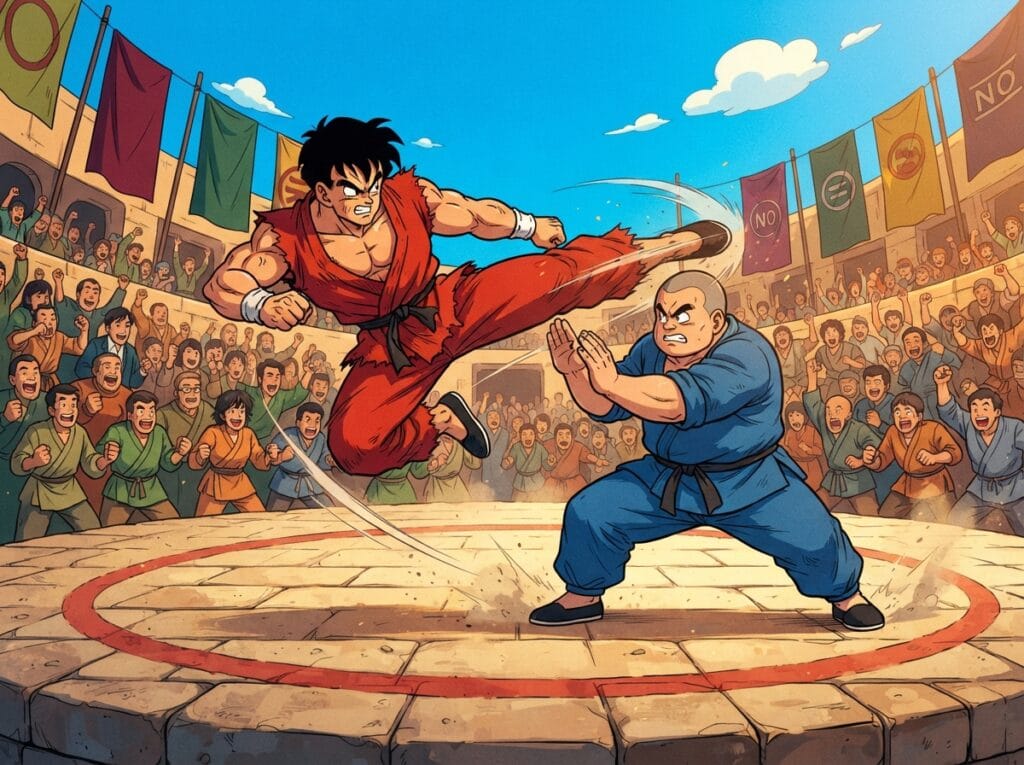
A fighter normally loses by being knocked unconscious, surrendering, or leaving the marked fighting area, which is known as a ring-out. The arena’s boundary is therefore part of the strategy, since positioning an opponent near the edge can be as useful as landing a powerful attack. Referees may also declare a disqualification for breaking tournament rules, using unfair equipment, or continuing an attack after the match has effectively ended. Killing an opponent is generally forbidden, and a fighter who ignores the referee risks losing even after gaining the upper hand. These limits keep the matches focused on winning the contest rather than simply destroying an opponent.
The rules create a flexible balance between martial arts skill, smart planning, comedy, and spectacular techniques. Early bouts may be decided by footwork, feints, timing, or a humorous trick, while later matches reveal energy attacks and abilities far beyond ordinary human fighting. Even powerful competitors must respect the ring, watch for openings, and avoid careless attacks that could send them outside the boundary. I find this contrast central to the tournament’s appeal because a smaller or less intimidating fighter can still succeed through preparation and creativity. As the Dragon Ball story grows, the same basic format makes the rising power of its fighters feel exciting without removing the importance of strategy.
Major Tournament Timeline
The 21st World Martial Arts Tournament marks the Tenkaichi Budōkai’s first major chapter in Goku’s growth. I see it as a friendly but demanding contest where Goku, Krillin, and other students of Master Roshi test their training against skilled fighters. Goku reaches the final against Jackie Chun, who is secretly Master Roshi and wins to teach his students that another challenge always awaits. The tournament still feels lighthearted, but its matches establish Goku’s rivalry with Krillin and show that experience can overcome raw talent.
By the 22nd tournament, the competition has become more intense and personal. Tien Shinhan and Chiaotzu enter as members of the Crane School, creating a direct contrast with Goku and his friends, while the fighters face dangerous techniques and unfair tactics. Tien defeats Goku in the final, but their rivalry begins to shift toward mutual respect, especially after Tien rejects his teacher’s cruel methods. The event also leads into the threat of King Piccolo, showing how the tournament can serve as the starting point for a much larger crisis.
Three years later, the 23rd tournament brings the biggest change in the early timeline when Goku faces Piccolo Jr. in the final. Piccolo enters to continue his father’s revenge, turning a championship match into a battle for Earth’s safety, while Goku relies on his training and new maturity to win the title. The 25th tournament returns after the long gap following the fight against Cell, but its lighter opening quickly gives way to serious danger when Spopovich attacks Videl and Babidi’s plot draws Goku and Vegeta away from the arena. I use these editions to track the tournament’s progression, from a local martial arts contest to a stage where rivalries, world-changing battles, and major threats collide.
Best Fighters And Matches

Goku stands out because the tournament charts his growth from a gifted child into a disciplined martial artist. His battles with Krillin show how friendship can develop through competition, while his match against Jackie Chun reveals that experience and strategy can overcome raw talent. Jackie Chun, secretly Master Roshi, enters to keep his students humble and teaches them that winning is less important than continuing to improve. These early matches make endurance and technique as important as strength.
Tien becomes significant when he challenges Goku with superior training, then begins changing after seeing the damage caused by ruthless ambition. Piccolo Jr.’s final against Goku raises the stakes further, combining careful technique, resilience, and the personal conflict left by King Piccolo. In the later tournaments, Vegeta brings a much higher level of power and shows how the competition has changed from a local martial arts showcase into a meeting place for fighters with world-shaking abilities. His presence also adds character drama because pride and rivalry often matter as much as the official result.
Mr. Satan offers a different kind of importance because he is a skilled public fighter, but he cannot match the hidden power of Goku, Vegeta, or Piccolo. His success shows how fame, timing, and the audience’s limited understanding can shape a champion’s reputation. When I compare the major matches, the tournament’s central lesson becomes clear: endurance keeps a fighter standing, technique creates openings, and character growth determines how power is used. Together, these competitors show the changing power scale of Dragon Ball while preserving the tournament’s original focus on discipline, courage, and self-improvement.
How To Follow The Tournament Story
I recommend starting with the three classic World Martial Arts Tournaments in Dragon Ball: the 21st, 22nd, and 23rd. These events show how the rules, rivalries, and level of combat develop alongside Goku, Krillin, Tien, Piccolo, and other key fighters. Pay attention to the tournament’s basic structure, including preliminary rounds, ring-outs, and the final matches that determine the champion. The 23rd Tournament is especially important because it closes the original Dragon Ball story with Goku facing Piccolo in a battle that leads directly into his adult life.
Dragon Ball Z then returns to the tournament setting with the 25th World Tournament, but the event is interrupted by the larger threat surrounding Majin Buu. I treat this appearance as a continuation of the tournament’s history rather than a complete competition because several fighters leave the arena before the finals can properly unfold. After finishing that arc, continue to the 28th World Martial Arts Tournament, which takes place near the end of the original Dragon Ball Z storyline, about ten years after Buu’s defeat. This later event is quieter than the classic tournaments, so its importance comes more from character development than from a long series of matches.
The main point to watch for in the 28th Tournament is Goku’s interest in a mysterious young fighter named Uub. Goku recognizes that Uub is the reincarnation of Majin Buu, but he also sees his kindness and enormous untapped potential. Rather than treating Uub as only an opponent, Goku wants to train him and help him become a powerful martial artist. Their meeting turns the tournament into a bridge between the original story and the future of Earth’s defenders, as Goku leaves with Uub to begin his training at the end of Dragon Ball Z, episode 291, “Goku’s Next Journey.”
World Martial Arts Tournament Conclusion

The Tenkaichi Budōkai is built around a simple format: fighters survive the preliminary rounds, enter an eight-person final bracket, and win by knocking out an opponent, forcing a ring-out, or making them unable to continue. Serious rule violations, including killing an opponent, can lead to disqualification, while weapons and outside help are generally forbidden. I find these limits important because they keep the matches focused on skill, timing, endurance, and creative techniques rather than unlimited destruction. The tournament takes place at its familiar Papaya Island arena, where the world champion earns fame, prize money, and the title of strongest fighter under the heavens.
The tournament’s major eras show how quickly Dragon Ball’s fighters evolve. The 21st World Tournament introduced Goku’s rivalry with Jackie Chun, the disguised Master Roshi, while the 22nd featured Goku against Tenshinhan and revealed the growing influence of disciplined martial arts. The 23rd became a turning point when Goku faced Piccolo Jr., combining a personal grudge with a battle that helped shape Earth’s future. Later events shifted toward the 25th Tournament, with defining matches such as Goten versus Trunks, Videl versus Spopovich, and Goku’s long-awaited meeting with Uub at the 28th Tournament.
For me, the Tenkaichi Budōkai remains one of Dragon Ball’s strongest storytelling devices because its clear rules make every exchange easy to follow and every victory meaningful. The arena creates natural tension by limiting movement, rewarding clever tactics, and giving underdogs a believable chance against stronger opponents. It also brings rivals, friends, comic relief, and new heroes together in one shared setting, even as the series expands into battles involving planets, gods, and entire universes. Larger competitions can raise the scale, but the World Martial Arts Tournament keeps the focus on personality, technique, and the simple question of who can stand when the match ends.
Understand the World Martial Arts Tournament
The World Martial Arts Tournament, or Tenkaichi Budōkai, is more than a series of fights in Dragon Ball. I find it easiest to understand by following its basic format, from the preliminary rounds to the public arena matches, while remembering that ring-outs and serious rule violations can decide a battle. Its history also shows how the event changes over time, from early contests that highlight martial arts skill to later tournaments shaped by superhuman abilities. Reviewing major matches involving Goku, Jackie Chun, Tien, Piccolo, and other key fighters helps explain why the tournament remains central to the franchise.
This guide provides a clear way to compare each tournament’s rules, competitors, results, and lasting impact. I also recommend paying attention to the balance between strategy and strength because clever techniques often matter as much as raw power. The Tenkaichi Budōkai connects Dragon Ball’s character development with its larger story, revealing rivalries, new abilities, and changing ideas about what it means to be the strongest. With its history and most important matches in view, the World Martial Arts Tournament becomes easier to follow and appreciate across the franchise.
Frequently Asked Questions
1. What is the World Martial Arts Tournament in Dragon Ball?
The World Martial Arts Tournament, also called the Tenkaichi Budōkai, is Dragon Ball’s famous Earth-based fighting competition. I view it as more than a battle event because it introduces important fighters, rivalries, techniques, and story turning points. The tournament takes place on Papaya Island, where competitors fight for the title of world champion.
2. How does the World Martial Arts Tournament work?
Fighters first compete in preliminary matches to qualify for the main tournament bracket. The remaining competitors face each other in arena matches until only two fighters reach the final. A fighter usually loses by leaving the ring, being unable to continue, or giving up, although the series often tests these rules with unusual techniques and powerful abilities.
3. What are the main rules of the tournament?
The main rules require fighters to compete without weapons and accept defeat when they can no longer continue. A competitor can lose by stepping outside the ring, being knocked out, or surrendering. The rules appear simple, but flying, energy attacks, transformations, and other abilities often make each match more difficult to judge.
4. Where is the World Martial Arts Tournament held?
The tournament is held on Papaya Island, which includes the main arena and the surrounding facilities used by fighters and spectators. The open arena gives every match a clear stage and makes ring-outs an important part of the competition. This setting also helps create the balance of comedy, crowd excitement, and serious martial arts that defines the event.
5. Who are the most important World Martial Arts Tournament champions?
Important champions include Jackie Chun, Tien Shinhan, Son Goku, and Mr. Satan. Jackie Chun represents Master Roshi’s effort to keep young fighters humble, while Tien and Goku show how the tournament helps rivals grow into stronger martial artists. Mr. Satan’s public victories also show how reputation and entertainment can shape the world’s view of a champion.
6. Which World Martial Arts Tournament editions matter most?
The 21st, 22nd, and 23rd tournaments are the most important early editions because they introduce major rivals and lead to major changes in Goku’s life. The later 25th tournament connects the event to the Majin Buu conflict, while the 28th tournament highlights the next generation of fighters. I recommend studying each edition in order because the competitors and stakes develop with the wider Dragon Ball story.
7. Why is the World Martial Arts Tournament important to Dragon Ball?
The tournament gives Dragon Ball a public stage for testing skill, strength, strategy, and discipline. It turns training goals into personal challenges and lets characters settle rivalries through structured matches instead of random battles. I also find it important because many of the series’ strongest character moments happen before, during, or immediately after these competitions.
8. What should I focus on when using a World Martial Arts Tournament guide?
Start with the tournament structure, rules, location, and major champions, then follow the key matches in chronological order. Pay attention to how each fighter uses movement, technique, strategy, and personal motivation, not just raw power. This approach makes it easier to understand how the Tenkaichi Budōkai shaped Dragon Ball’s characters and raised the stakes across the franchise.

