
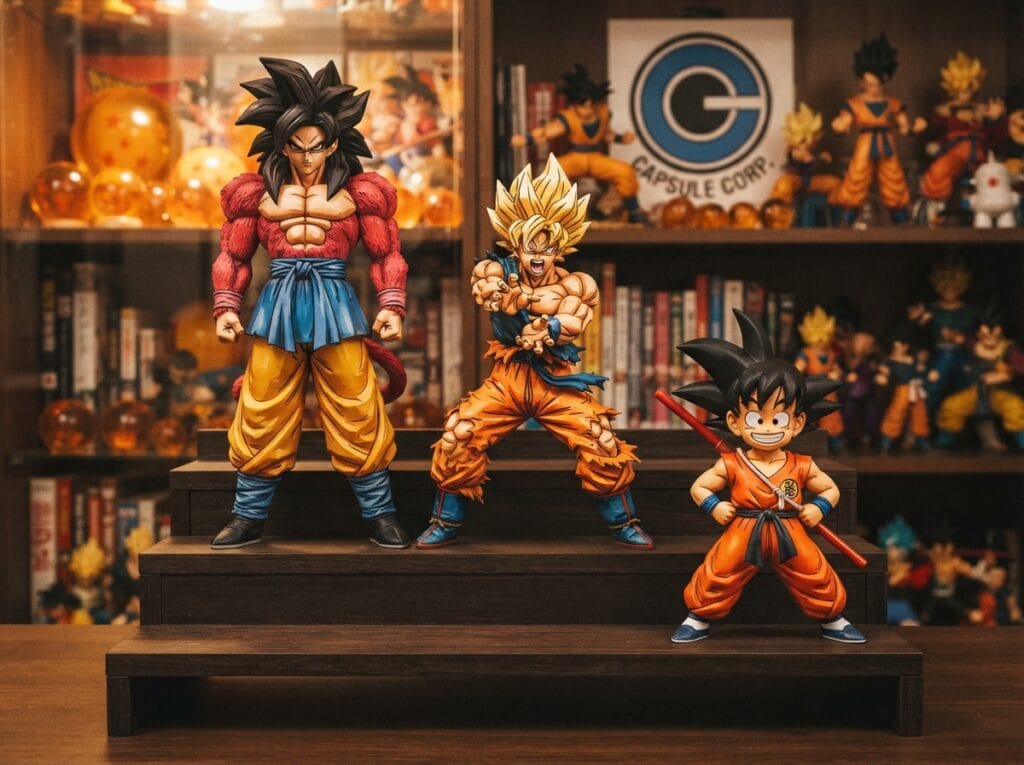
Dragon Ball figures do not follow one shared scale. Many listings give a figure’s height rather than a ratio showing how it compares with the character it represents. Figures from different product lines may not match when displayed together. For a clear size reference, BANDAI TOYS lists its Dragon Ball Z Funko POP Goku at approximately 13 cm tall, with a price of ¥1,980 including tax. That number describes the figure’s height, not its scale ratio.
A larger display piece shows why measurements need context. TAMASHII WEB lists S.H.Figuarts Shenron at approximately 280 mm tall when displayed on its dedicated stand, with a Japanese retail price of ¥12,100. For shelf comparisons, check more than a scale label or character name. Note the stated height, width, and depth, and whether a base or effect parts add to the footprint. This matters when combining articulated figures, prize figures, and statues in one display.
Key Takeaways
- We treat a listed height as a physical measurement, not proof of scale: TAMASHII WEB lists S.H.Figuarts Vegeta at about 135 mm tall, but that measurement does not establish a shared scale.
- Dragon Ball figures vary in size. Banpresto’s SOLID EDGE WORKS Goku figures are approximately 23 cm tall, according to the Dragon Ball Official Site.
- We recommend checking each figure’s height, width, and depth, and confirming whether a measurement includes a stand, base, or effect parts before planning a shelf display.
- A general market example of a Son Goku statue is 55 cm tall at 1/4 scale and 37 cm tall at 1/6 scale in the regular edition.
What Does Dragon Ball Figure Scale Mean?
Dragon Ball figures do not all share one scale. A scale label is a ratio between a model and the object it represents, while many product listings give only the figure’s height. The ratio describes how large the model is compared with its subject. For example, a 1/4-scale model represents its subject at one quarter of its size.
A height measurement answers a different question: how tall or long is the figure itself? A listing might say a figure stands 135 mm tall without giving a ratio to the character’s represented size. The number helps show the figure’s physical dimensions, but it does not tell you whether it matches another figure’s scale.
Official listings show how often measurements are given instead of ratios. TAMASHII WEB lists S.H.Figuarts Vegeta <Z-Fighters> at approximately 135 mm tall. That measurement describes the figure, not a scale label.
The same distinction applies across product lines. Banpresto’s SOLID EDGE WORKS Goku figures are listed at approximately 23 cm tall, but that measurement alone does not establish that they share a scale with S.H.Figuarts figures. The Dragon Ball Official Site’s Banpresto announcement gives the figures’ height, not a ratio.
When a listing gives only a height, treat it as a size measurement, not proof of scale. A figure’s height helps you estimate how much room it takes up, but figures from different lines may represent their characters at different proportions. A scale ratio helps compare a model with its subject, while a stated height helps compare the physical size of products.
How Big Are Dragon Ball Figures?

The Funko POP Goku and Shenron examples here range from approximately 13 cm to 28 cm tall. The Shenron measurement includes its dedicated stand. BANDAI TOYS lists its Dragon Ball Z Funko POP Goku at approximately 13 cm tall, making it a compact example compared with Shenron. The BANDAI TOYS product listing gives the height in centimeters.
TAMASHII WEB lists S.H.Figuarts Vegeta <Z-Fighters> at approximately 135 mm, or 13.5 cm. That is slightly taller than the Funko POP Goku’s listed height, though the measurements do not mean the figures share a scale. See TAMASHII WEB’s Vegeta listing for the stated height.
S.H.Figuarts Super Saiyan God Son Goku <God Aura> measures approximately 145 mm, or 14.5 cm, according to TAMASHII WEB. That is 10 mm taller than the listed Vegeta, showing that figures within one product line can have different stated heights.
A TAMASHII WEB catalog describes S.H.Figuarts figures as roughly 14 cm tall. The listed Vegeta and Super Saiyan God Son Goku measurements are close to that general description, at 13.5 cm and 14.5 cm. The catalog gives a broad reference for the line, while individual product listings provide more specific measurements.
Banpresto’s first SOLID EDGE WORKS Goku figures are approximately 23 cm tall, according to the Dragon Ball Official Site announcement. This measurement shows their physical size without assigning the products a scale ratio.
At approximately 280 mm, or 28 cm, S.H.Figuarts Shenron is the tallest example here. TAMASHII WEB gives this height when Shenron is displayed on its dedicated stand, so the measurement describes the assembled display rather than Shenron alone. Keep that in mind when comparing the listed height with figures measured without a display stand. See TAMASHII WEB’s Shenron listing for the measurement.
Are Action Figures Always 1/12 Scale?
No. Action figures are not always 1/12 scale. “Action figure” describes a type of product, not a standard size ratio. A listing may give a scale ratio, a height, or both, so don’t assume a figure is 1/12 scale just because it is articulated or sold as an action figure.
When a listing gives both details, read them separately. The ratio describes the model’s size compared with the character it represents, while the height gives the figure’s physical measurement. Figures with the same ratio can still have different heights because they represent characters of different heights.
S.H.Figuarts listings show why it helps to check the wording. TAMASHII WEB gives a height for Super Saiyan God Son Goku rather than presenting a scale ratio as the main size information. A height in millimeters tells you how tall that particular figure is, but does not establish a ratio on its own. TAMASHII WEB’s S.H.Figuarts listing is one example.
A character name or product-line name also does not guarantee a shared scale. Two Goku figures from different lines may be designed at different sizes, and figures within one line may have different dimensions. If a listing has no ratio, or you are comparing figures from different lines, compare their stated measurements instead. Check height as well as width and depth, and account for any stand or effect parts in the display.
What Do 1/4 And 1/6 Scale Mean?

A general market Son Goku statue example is 55 cm tall at 1/4 scale and 37 cm tall at 1/6 scale in the regular edition. The ratio helps compare the two versions, while the centimeter measurements show how much vertical space each takes up. An EX edition example is 79 cm tall at 1/4 scale and 52 cm tall at 1/6 scale. At both stated ratios, the EX edition is taller than the regular edition. The scale label alone does not tell the whole size story, since the edition matters too. When comparing versions, use the ratio to understand the model’s intended relationship to its subject, then check the stated height to understand the statue’s physical size. A 1/4 label does not, by itself, tell you whether a particular edition will fit your display space. The regular and EX heights show why two Son Goku statues with the same scale label can need different amounts of room.
Compare Figure Lines Before Displaying
Articulated figures are made for posing, so a listed height is a useful starting point, not a guarantee that every figure will line up with another character. TAMASHII WEB lists S.H.Figuarts Vegeta <Z-Fighters> at approximately 135 mm tall. TAMASHII WEB’s Vegeta listing gives the figure’s stated height.
The S.H.Figuarts catalog describes figures as roughly 14 cm tall, a broad reference for the line. The TAMASHII WEB catalog gives that general description, while individual product listings provide more specific measurements.
Prize figures can be noticeably taller than articulated figures. Banpresto’s SOLID EDGE WORKS Goku figures are approximately 23 cm tall, according to the Dragon Ball Official Site announcement. That measurement makes the size difference clear, but it does not establish a scale ratio or guarantee that another Goku figure will have matching proportions.
The Dragon Stars Battle Pack with Super Saiyan Gohan and Gamma 1 is a two-figure set. It had an official US suggested retail price of $43.99. The Dragon Ball Official Site announcement gives the set format and price, not its dimensions. We should not infer either figure’s height from the price or from the fact that they are sold together.
Not every collectible is a standing character figure. The Dragon Ball Logo Figure is approximately 20 cm long and 5 cm wide, so its length and width are more useful comparison points than character height. The Dragon Ball Official Site announcement describes the logo figure’s dimensions.
For side-by-side comparisons, consider each product’s format. An articulated figure, a prize figure, a two-character set, and a logo piece do not use the same kind of measurement. Height describes vertical size, while length and width describe the space a non-standing piece occupies. Price or sales format can tell us what is included, but neither tells us how large an individual figure is.
How Do You Plan A Figure Display?

We plan a figure display by recording each piece’s dimensions, checking what the measurements include, and comparing the space each complete setup will occupy. Height alone cannot show whether a figure’s base, effects, or pose will fit beside another piece. Before arranging the shelf, use the same checklist for every figure, statue, or display item:
- Record the listed dimensions. Write down the stated height, width, and depth whenever a product listing provides them. Keep the units with each measurement so you can compare them consistently.
- Check what the height includes. Look for notes about stands, bases, or other display parts. TAMASHII WEB measures S.H.Figuarts Shenron at approximately 280 mm when displayed on its dedicated stand, so the listed height includes that part of the setup. TAMASHII WEB’s Shenron listing specifies the stand condition.
- Account for the full shape. Include the base, effects, and figure’s pose when estimating the space it needs. A figure with an extended arm or wide effect can take up more room than its standing height suggests. If a listing does not give width or depth, leave those measurements unknown rather than assuming the figure is narrow.
- Compare actual dimensions across lines. Do not assume two figures share a scale because they represent Dragon Ball characters or belong to familiar product lines. Compare their stated measurements, then consider how their proportions and display parts will look together.
- Compare each total footprint before arranging. Consider the space taken up by the figure and its display parts, including room beside neighboring pieces. Check the footprint of each complete setup before deciding where it goes on the shelf.
Keep price and sales format separate from physical size. Price does not tell you a figure’s height or footprint, and a set’s packaging format does not establish the dimensions of each item inside. For example, the Dragon Stars Battle Pack with Super Saiyan Gohan and Gamma 1 is a two-figure set. Its format tells us what is included, not how much shelf space the figures need. The Dragon Ball Official Site’s announcement lists the set format and suggested retail price, not figure dimensions.
Choose Figures That Fit Your Display
Choose the display’s purpose before adding another figure: a character lineup, a transformation sequence, or a centerpiece scene. Decide which character should draw attention first, then choose the other characters to place beside them. This gives each candidate a clear role instead of making the choice depend on the character’s name alone.
For a lineup, look for figures with a similar visual style and display posture. For a transformation sequence, arrange the forms so the change reads clearly from one figure to the next, and check that large accessories or effects do not hide the figures behind them. If a statue is the centerpiece, use it as the anchor and choose supporting figures that keep it visually prominent.
If your shortlist includes S.H.Figuarts, Banpresto, and a statue, compare the product photos as well as the listed dimensions. The TAMASHII WEB S.H.Figuarts listing is one place to check the official product image and measurements. Use the same checks for listings of the other pieces. Arrange the candidates in your intended order, then remove any figure that crowds the focal character or disrupts the composition.
Frequently Asked Questions
1. Are any Dragon Ball figures life-size?
The examples covered here are collectibles with listed dimensions, not life-size figures. For example, TAMASHII WEB lists S.H.Figuarts Shenron at approximately 280 mm tall when displayed on its dedicated stand (TAMASHII WEB’s Shenron listing).
2. How big is a 1:24 scale figure?
A 1:24 scale figure is one twenty-fourth the size of the object it represents. Its actual height depends on the represented character’s size, so the ratio alone does not tell you how much shelf space it needs.
3. Is Goku outerversal or multiversal?
“Outerversal” and “multiversal” are power-scaling labels, not measurements of a Goku figure’s size. To compare figures, look at the listed dimensions and any stated scale ratio instead.

