
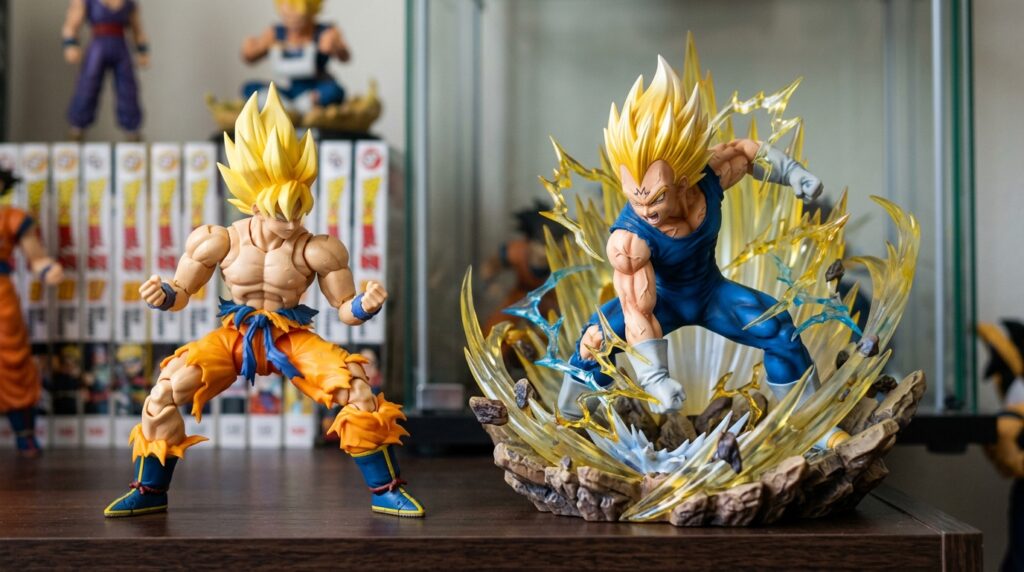
S.H.Figuarts vs. Figuarts ZERO comes down to whether a Dragon Ball figure should be poseable or designed as a finished display scene. S.H.Figuarts is the articulated action-figure line, while Figuarts ZERO figures are static. That difference matters more than the name on the box. Collectors who want to recreate a clash, adjust a stance, or swap faces and hands have more flexibility with S.H.Figuarts. Those who want a sculpted character moment with effects and a composed base may prefer ZERO. Neither line is automatically the better buy. The right value depends on whether interaction or presentation deserves the shelf space.
The distinction is especially timely with STARTune, a clear example of the display-focused approach. For comparison, S.H.Figuarts SUPER SAIYAN SON GOKU <THE GAMES BEGIN> stands about 145 mm tall and includes interchangeable hands and expressions. Its Japanese recommended retail price was ¥4,400 for the 2026 re-release. STARTune’s Namek-arrival Goku, by comparison, had a Japanese retail price of ¥8,250. The difference reflects two distinct types of display pieces, not a universal price gap between the lines. These are product-specific prices, not promises of US street prices. The key question is whether a figure should move through different poses or present its scene straight out of the box. The answer points to the line that best suits a collection, budget, and display style.
Key Takeaways
- S.H.Figuarts is the better fit for collectors who want to change poses or expressions, with included parts varying by release; the featured SUPER SAIYAN SON GOKU
is about 145 mm tall and includes interchangeable hands, expressions, and a head part. - Figuarts ZERO is designed for a fixed, finished display, so collectors who value a sculpted scene and effects over pose changes should check each figure’s composition, footprint, and included components.
- Figuarts ZERO [STARTune] SON GOKU -LET THE BATTLE BEGIN- presents Goku’s arrival on Namek with spaceship details and was listed at ¥8,250 including tax in Japan, while the 2026 re-release of S.H.Figuarts SUPER SAIYAN SON GOKU
had a Japanese recommended retail price of ¥4,400; these product-specific prices do not establish a general price gap or prices in other markets. - Before buying either line, collectors should verify the exact edition, dimensions, included parts, regional price, and preorder or release status instead of relying on the line name alone.
Which Figure Line Fits Your Collection?
Choose S.H.Figuarts for poseable action and interchangeable parts, or Figuarts ZERO for a fixed, sculpted display scene. TAMASHII NATIONS’ S.H.Figuarts is its articulated action-figure line, while Figuarts ZERO is its static display-figure line. The choice depends on whether a figure should be posed and repositioned or present a designed composition on the shelf.
A useful comparison starts with intended use. S.H.Figuarts suits collectors who want to adjust a character’s stance or change parts to create different looks. Figuarts ZERO suits collectors who prefer a finished sculpt that stays in place. Neither is the default winner. The better fit depends on how the figure will be used and the role it should play in a collection.
This guide compares intended use, articulation, accessories, size, visual presentation, and price. These factors can point in different directions. A collector may value pose options more than a dramatic sculpt, while another may prefer a composed scene to a figure that can be repositioned. Shelf space and the surrounding collection also affect whether a standalone character or a larger display arrangement makes more sense.
Price comparisons need the same care as feature comparisons. Compare specific products and editions instead of assuming every S.H.Figuarts figure costs more or less than every Figuarts ZERO release. A re-release and a new display piece can have different prices for reasons specific to each product, so the line name alone is not a reliable guide to value.
S.H.Figuarts And ZERO Compared
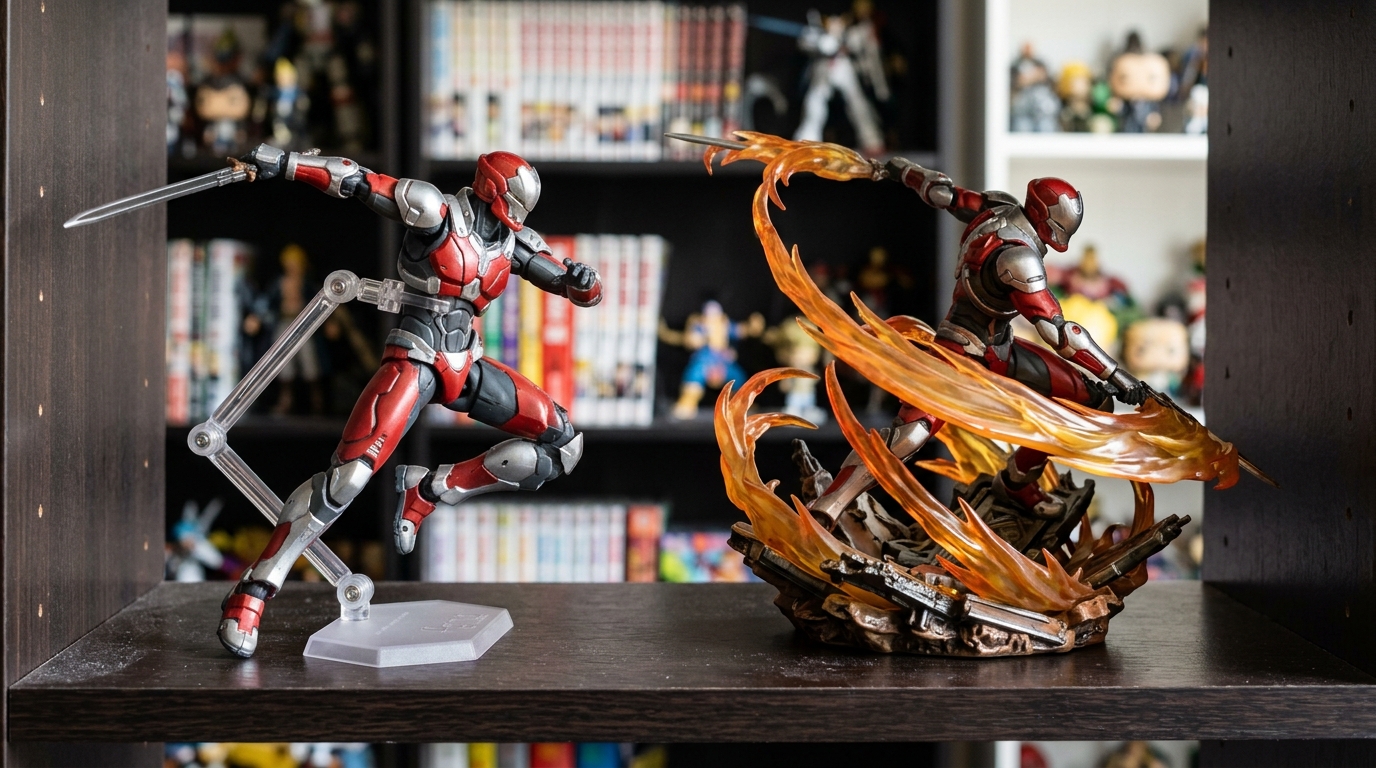
| Criterion | S.H.Figuarts: SUPER SAIYAN SON GOKU <THE GAMES BEGIN> | Figuarts ZERO: [STARTune] SON GOKU -LET THE BATTLE BEGIN- |
|---|---|---|
| Use case | Reposing Goku for action poses and changing his look | Displaying a finished scene centered on Goku’s arrival on Namek |
| Articulation | Articulated figure designed for posing | Static display figure, not designed for pose changes |
| Accessories and effects | Four pairs of interchangeable hands, three interchangeable expression parts, and an interchangeable head part | Scene-focused sculpting and effects, with a vignette-style diorama |
| Size | Approximately 145 mm tall | Check the individual product listing for dimensions |
| Display style | A character that can be repositioned on the shelf | A composed scene featuring Goku and spaceship details |
| Price | ¥4,400 including tax, Japanese recommended retail price for the 2026 re-release | ¥8,250 including tax, Japanese retail price |
Use the table to compare these two specific products, not to rank either line as a whole. The prices are product-specific Japanese retail prices, not general US prices, and other releases may differ. The figures also do not share a universal scale. Exact dimensions and included parts vary by release, so check the individual product listing before planning shelf space or comparing accessories.
The S.H.Figuarts Goku comes with several ways to adjust the character’s expression and hand poses, but its appeal depends on whether the collector wants to handle and reposition the figure. The STARTune Goku instead builds its display around the Namek-arrival scene. Its perspective-based vignette incorporates the spaceship ramp, gravity generator, and chair, making it more like a small scene than a poseable character figure. The Dragon Ball Official Site’s STARTune announcement describes the range’s detailed sculpting, paint, and effects.
For a shelf of figures that get rearranged or posed, the articulated example offers more ways to change the display. For a spot reserved for a single, composed Dragon Ball Z moment, the STARTune piece includes the scene as part of the figure. The practical trade-off is clear: interchangeable parts support variety, while a fixed diorama commits more of the display to one presentation. Neither product’s price alone establishes its value. The choice depends on whether pose changes or scene detail matters more to the collector.
S.H.Figuarts For Posing And Play
TAMASHII WEB describes S.H.Figuarts as a palm-sized action-figure series that combines modeling, movement, and coloring techniques. The brand catalog puts the line at roughly 5.5 inches tall. Collectors should check the specific figure before planning a display or comparing it with other toys.
The main draw is articulation. Movable joints let collectors shift a character from a neutral stance into a fighting pose, then adjust it again later. Torso joints can help create a forward lean or twist for a punch, while movable hips and knees support crouches, lunges, and wide stances. Range of motion and stability depend on the individual figure, so the S.H.Figuarts name alone does not guarantee a particular joint setup.
When comparing releases, collectors can look for an ab crunch, which lets the torso bend forward or backward, and butterfly joints, which can allow the arms to move farther across the chest. Double-jointed knees can support deeper bends than a single knee hinge. These are features to verify on each release, not standard equipment across the line. A figure may also have articulation limits caused by its sculpt or costume, even when it has multiple joints.
Interchangeable hands make it easier to pose a character with a fist, an open gesture, or a signature attack stance when those options are included. Face plates or other expression parts let collectors change the mood of a scene without replacing the whole figure. Some releases also include effect parts, such as energy attacks, to suggest a blast or power-up. The selection varies, so the product listing matters as much as the line name.
The flexibility makes S.H.Figuarts a strong choice for collectors who want to build their own Dragon Ball battles rather than settle on one permanent pose. Photographers can use the articulation and swappable parts to create different expressions and action shots, then change the setup for a new image. Small adjustments to hand position, head angle, and stance can make the same character look ready to block, charge, or strike.
The trade-off is that poseable figures require more setup. Collectors may need to test joint positions, balance a dynamic stance, and fit the chosen hands or expression parts before the scene looks right. Accessories may also need careful placement, and not every release includes a stand or the effect parts a particular pose might require. A fixed display figure typically arrives with its presentation already composed, while S.H.Figuarts leaves more of that work to the collector.
Pros
- Articulation supports changing stances and recreating fights.
- Interchangeable hands and expressions add variety when included.
- Some releases offer effect parts for attack displays and photography.
Cons
- Joint design and accessories vary by release.
- Dynamic poses can take time to arrange and may need extra support.
- Collectors who want an instantly composed scene may prefer a static display piece.
S.H.Figuarts is best suited to pose-focused collectors and photographers, especially those who prefer changing a character’s action or expression over keeping a finished diorama untouched.
The Games Begin Goku As A Pick
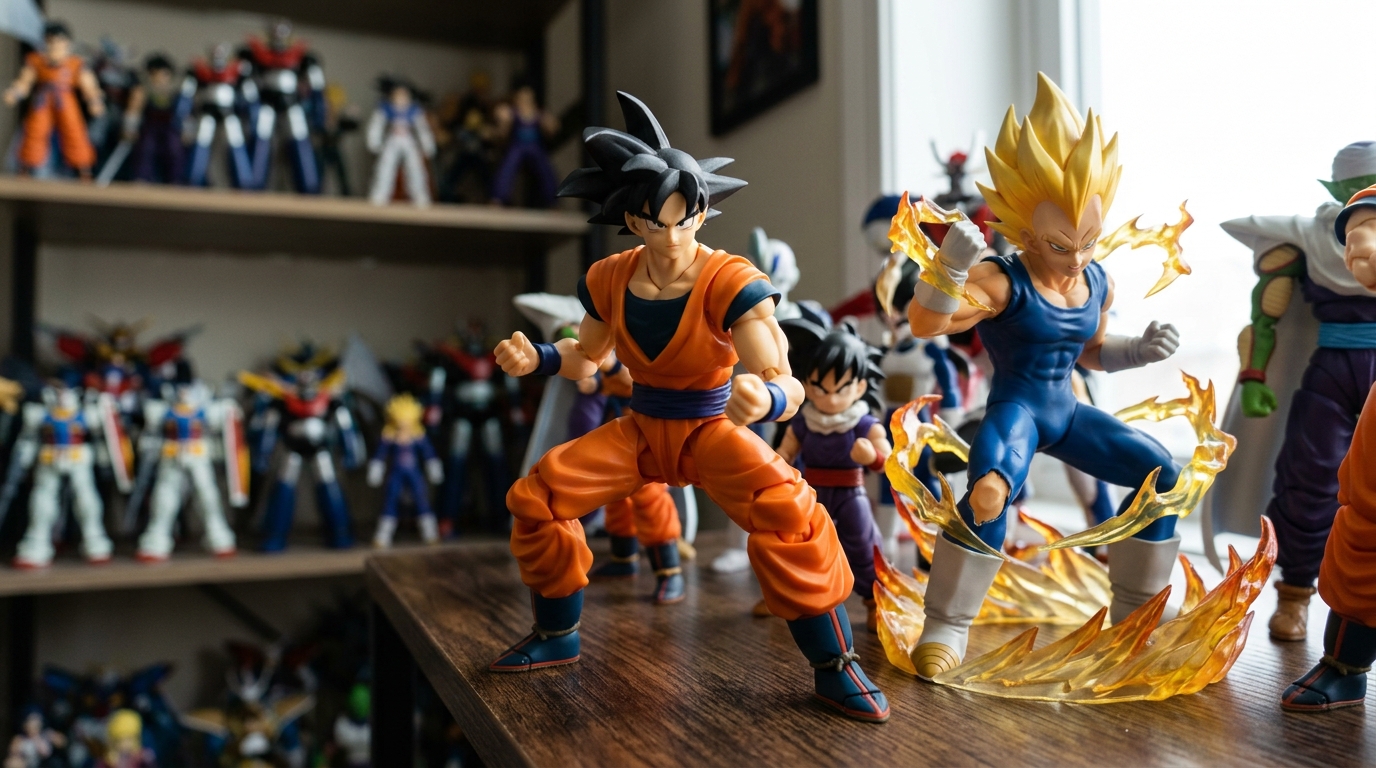
S.H.Figuarts SUPER SAIYAN SON GOKU <THE GAMES BEGIN> shows what an articulated figure offers as a single-character purchase. The figure measures approximately 145 mm tall, and its included parts let collectors change Goku’s expression and pose without replacing the whole figure. The Japanese recommended retail price for the 2026 re-release was ¥4,400 including tax.
The package includes four pairs of interchangeable hands, three interchangeable expression parts, and an interchangeable head part. Different hands can suit a clenched-fist fighting stance, an open gesture, or a pose that suggests Goku is preparing an attack. Expression swaps give the same stance a different mood, while the alternate head part offers another way to configure the character. Together, these parts support a range of display choices rather than one prescribed scene.
For play or photography, collectors can reposition Goku, change his expression, and reset his hands to suggest a new moment in a fight. A forward-leaning stance can look like a charge, while a squared stance with fists raised can suggest a face-off. These options also make the figure easier to adapt when the surrounding shelf display changes. The included parts create variety, but they do not assemble themselves into a finished scene. The collector chooses the pose and arranges the swaps.
- Pros: Pose variety lets Goku shift between action displays, and the included hand, expression, and head swaps provide options without requiring extra accessories.
- Consideration: The figure needs a chosen pose and arranged parts, so it takes more setup than a fixed scene designed to display as-is.
S.H.Figuarts SUPER SAIYAN SON GOKU <THE GAMES BEGIN> suits buyers who want one Goku figure to take different action poses rather than a fixed scene.
Figuarts ZERO For Shelf Display
Figuarts ZERO is a series of static figures that depicts characters and their worlds through sculpting, coloring, effects, and other techniques. Each release is built around a chosen presentation: the character’s stance, expression, and surrounding details work together as one display, rather than serving as starting points for the collector to reposition.
A designed pose can make a figure feel complete as soon as it is displayed. Sculpted movement in a flowing outfit, a twist through the torso, or an attack effect can suggest action without movable joints. The trade-off is that the composition is fixed. Unlike S.H.Figuarts, Figuarts ZERO is not built around articulation and interchangeable parts for changing a character’s stance or expression. The pose that looks striking on the product page may be the pose the figure keeps.
The sculpt deserves close attention because it carries much of the figure’s character. Check the face, hair, clothing folds, and how the body’s posture conveys motion or impact. Paint contributes to that effect: shading can give sculpted forms depth, while color transitions can separate a character from an effect or background element. Product photos can also show how details appear from different angles, which matters when a display case exposes more than the front.
Effects are another key comparison point. Energy blasts, debris, smoke, or other molded elements can make a figure’s action clear and connect the character to a particular moment. Their size and placement also affect the display footprint, and a dramatic effect may take up more shelf space than the character alone. Buyers should check the product listing rather than assume every Figuarts ZERO release includes the same type or amount of effects.
Bases and diorama elements can turn a character into a broader scene. A shaped base may simply support the figure, while scene details can establish a setting or add context. These components can give a display more visual weight, but they can also determine where the piece fits in a cabinet and how easily it sits beside other figures. Dimensions, base design, and included scene parts vary by product, so the line name does not predict a release’s size or contents.
When checking a product listing, look at the sculpt, paint finish, effect parts, and every base or diorama element listed as included. Product photography may show a figure in a dramatic arrangement, so distinguish included components from separate display accessories. The fixed pose also makes it worth studying the figure from the angle it will occupy on the shelf. A composition designed for a front-facing view may look different from the back or side of a display.
– Pros: Sculpting and paint can give a character a polished, expressive look; effects and scene elements can create a finished display without pose setup. – Cons: The pose offers little flexibility, and large effects or bases may take up more room than expected. Size and included components vary by release. – Verdict: Figuarts ZERO suits collectors who prioritize a composed, visually striking shelf display over changing poses, provided the specific figure’s footprint and scene details fit the available space.
STARTune Goku Shows ZERO’s Approach
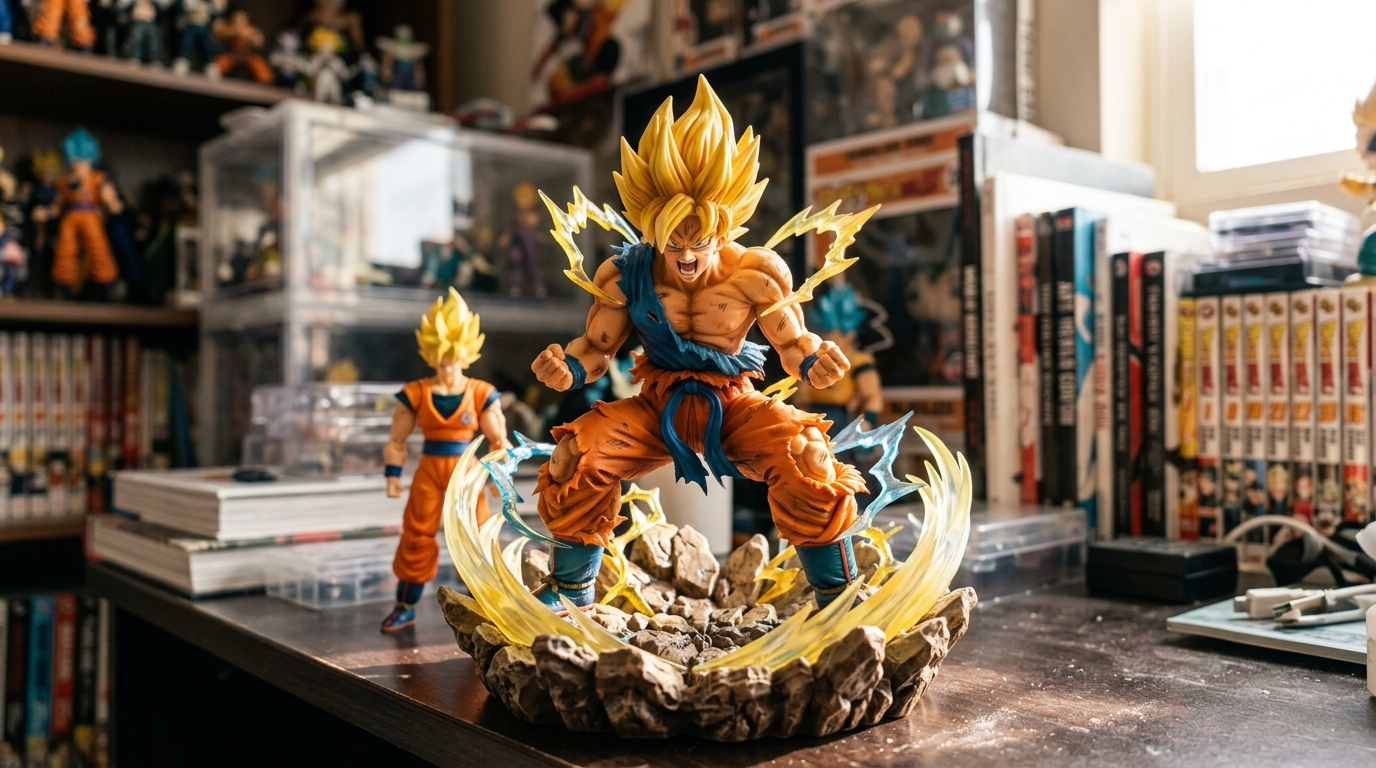
STARTune makes Figuarts ZERO’s statue-first approach easy to picture. The fixed pose keeps the display as designed instead of inviting collectors to reposition the character.
Figuarts ZERO [STARTune] SON GOKU -LET THE BATTLE BEGIN- depicts Goku arriving on Planet Namek during the Frieza arc. The perspective-based vignette incorporates the spaceship ramp, gravity generator, and chair, giving the arrival scene a sense of place instead of presenting Goku as an isolated figure. The environmental details provide context: the ramp connects him to his spacecraft, while the gravity generator and chair help evoke the setting of his journey.
That scene-setting is the main display advantage. The sculpted surroundings make the piece read as a small Dragon Ball moment, even to someone glancing across a shelf, and the perspective directs attention toward Goku. Collectors can display the scene as a complete composition without building a separate backdrop or arranging other figures around him. The trade-off is that the diorama commits shelf space to one specific setting and moment. It is not an articulated action figure, and its presentation cannot be changed by adjusting Goku into another pose.
The distinction matters when comparing STARTune with S.H.Figuarts. An articulated figure lets the collector create a new stance or action, while STARTune provides a more fully staged image from the outset. A collector who enjoys setting up battles or changing a display over time may find the fixed composition limiting. Someone who wants the arrival on Namek represented as a single, self-contained scene may value the surrounding details more than poseability.
In Japan, the figure is listed at ¥8,250 including tax. Preorders are scheduled to begin July 1, 2026, with release planned for February 2027. These details describe the Japanese retail context. The yen price is not a guaranteed price in another market. The preorder and release dates can help collectors decide whether to reserve space for a display piece built around this particular scene.
STARTune suits a shelf where a fixed vignette can be appreciated as a complete composition. Buyers who want one specific Dragon Ball moment presented with its setting may find the Namek-arrival scene more compelling than a set of interchangeable poses. Buyers who prioritize articulation should view the scenic detail as a different kind of value, not a substitute for movable joints.
Price And Where To Buy Each Line
Price is easy to misread when the line name does all the work. Japanese product listings show S.H.Figuarts Dragon Ball examples ranging from ¥4,400 to ¥9,900 including tax, while Figuarts ZERO [STARTune] SON GOKU -LET THE BATTLE BEGIN- is listed at ¥8,250 including tax. These are Japanese retail examples for specific releases, not US prices or current street prices. They show why “cheap vs. expensive” is not a reliable shortcut for judging either line.
A higher price may reflect a particular edition, the parts in the box, or the amount of the design devoted to sculpting and display. For S.H.Figuarts, compare the included hands, faces, heads, and any effect parts with the price of that specific release. More interchangeable parts can add pose options, but they matter less to someone who plans to leave a figure in one stance. A review should weigh what is included against how the buyer expects to display the figure, rather than treat articulation alone as a guarantee of value.
For Figuarts ZERO, examine the sculpt and paint alongside the effects, base, and any scene components. A detailed diorama can contribute more to a figure’s display impact than movable joints would, but its value depends on whether the buyer wants that specific scene. A large effect or setting may also affect how the piece fits on a shelf. Product photos can help assess the composition, but the written contents list is the better way to check which parts are included.
To compare where to buy, check current listings from TAMASHII NATIONS and retailers that carry Bandai Spirits figures. Before ordering, match the full product name and edition, then verify the release date, included accessories, and regional price on the listing itself. A familiar character name is not enough: re-releases and figures depicting different scenes can have different contents and prices. For a preorder, check that the listing is for the intended release and that the stated schedule fits the buyer’s plans.
Regional listings may show prices in different currencies, and Japanese recommended retail prices do not establish what a figure currently costs elsewhere. Check the retailer’s listing for the relevant region and exact release rather than comparing it directly with a Japanese yen example. The useful comparison is between the figure’s price and the parts, sculpt, effects, or scene components the buyer actually wants. A less expensive release can be a better fit when its contents meet the need; a more elaborate piece may suit a collector who values its particular presentation.
Choose The Figure That Fits Your Shelf
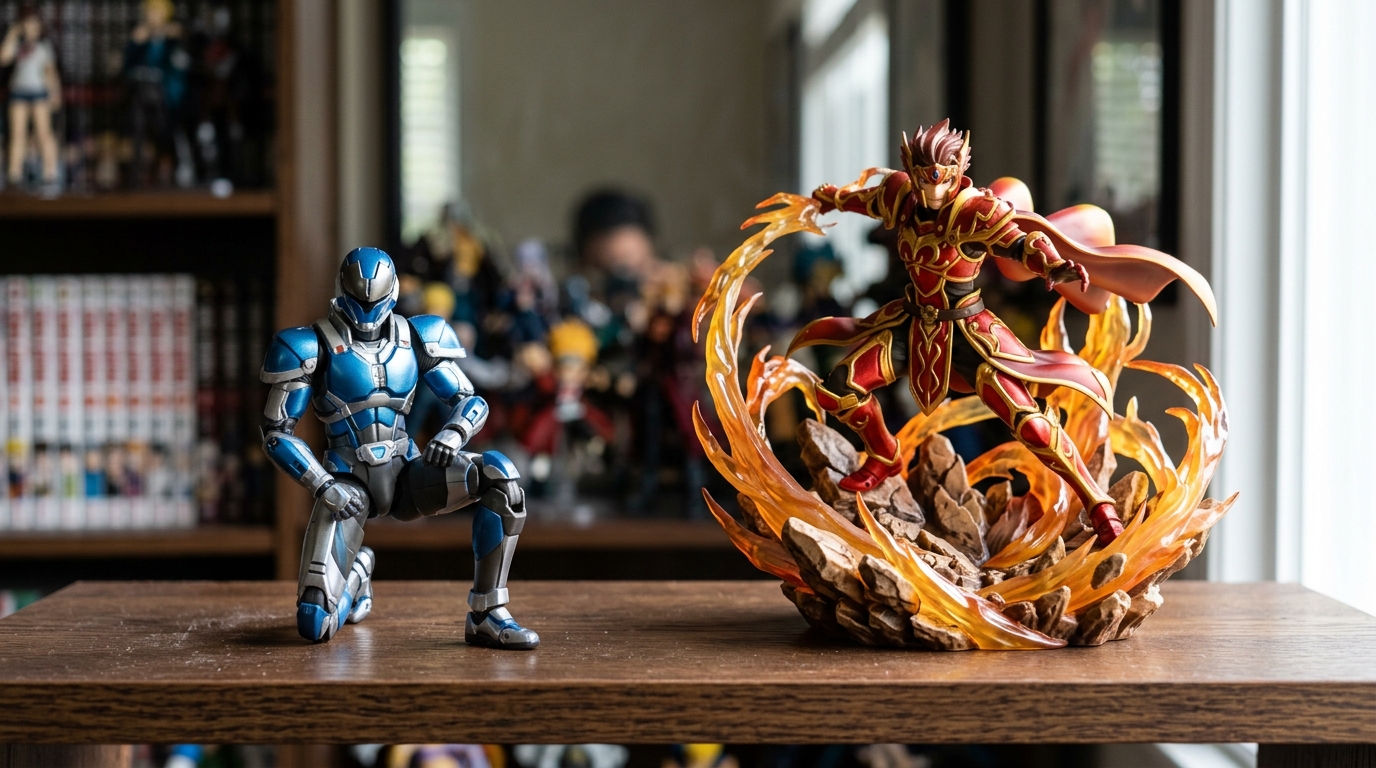
Best for most buyers who want posing options: S.H.Figuarts. The articulated line is the stronger pick for collectors who want to change a character’s stance, swap parts, or stage another Dragon Ball clash later. Its drawback is that the collector has to arrange the pose, and the specific joints and accessories vary by release.
Best for a ready-made display piece: Figuarts ZERO. Its fixed composition suits a shelf where sculpting, effects, and a finished presentation matter more than interaction. The trade-off is less flexibility: the figure stays in its designed pose.
Best for the featured scene-based release: Figuarts ZERO [STARTune] SON GOKU -LET THE BATTLE BEGIN-. Dragon Ball fans drawn to Goku’s arrival on Namek and its spaceship diorama get a focused scene rather than a figure meant to be repositioned. Collectors who want to keep changing Goku’s poses should choose the articulated S.H.Figuarts instead.
Before choosing, check the exact edition’s dimensions, included parts, regional price, and preorder or release status.
Choose The Figure That Fits Your Shelf
Before choosing a release, decide what the figure needs to do on the shelf. If the answer is “change pose for a new scene,” start with S.H.Figuarts and compare the specific release’s joint design and included parts. If the answer is “show one moment without rearranging anything,” start with Figuarts ZERO and assess whether its sculpt and effects suit the display.
For a Goku display, the choice is clear: pick S.H.Figuarts when Goku will join changing battle setups, or pick Figuarts ZERO [STARTune] SON GOKU -LET THE BATTLE BEGIN- when the Namek arrival is the scene to keep. The STARTune figure is a poor match for a shelf plan that depends on repositioning Goku.
Next, check the exact product listing before deciding. Confirm the edition, dimensions, included components, and regional price, then compare the listed footprint with the available shelf space. For a diorama, account for its base and scene elements, not just the character’s height. For an articulated figure, check that the specific release includes the hands or expressions needed for the planned poses.
If both lines still appeal, use one final test: would the figure still deserve its shelf space if its pose never changed? A yes points toward Figuarts ZERO; a no points toward S.H.Figuarts.
Frequently Asked Questions
1. What does S.H. in S.H.Figuarts stand for?
S.H.Figuarts is TAMASHII NATIONS’ articulated action-figure line, designed around poseable action and character styling.
2. Are Figuarts ZERO figures compatible with S.H.Figuarts accessories or display stands?
Figuarts ZERO figures are not guaranteed to be compatible with S.H.Figuarts accessories or stands. Compatibility depends on the specific figure and accessory, so check the product details rather than assuming parts will fit across the two lines.
3. Which is better, MAFEX or S.H.Figuarts?
Neither MAFEX nor S.H.Figuarts is universally better. The stronger choice depends on the specific figures and what the collector values. Compare each release’s articulation, sculpt, included accessories, and price before deciding.
4. Is the Figma Frieren figure better than the S.H.Figuarts Frieren?
There is no universal winner between the Figma Frieren and S.H.Figuarts Frieren figures. Compare the exact releases’ poseability, appearance, accessories, and price to decide which better suits the intended display.

