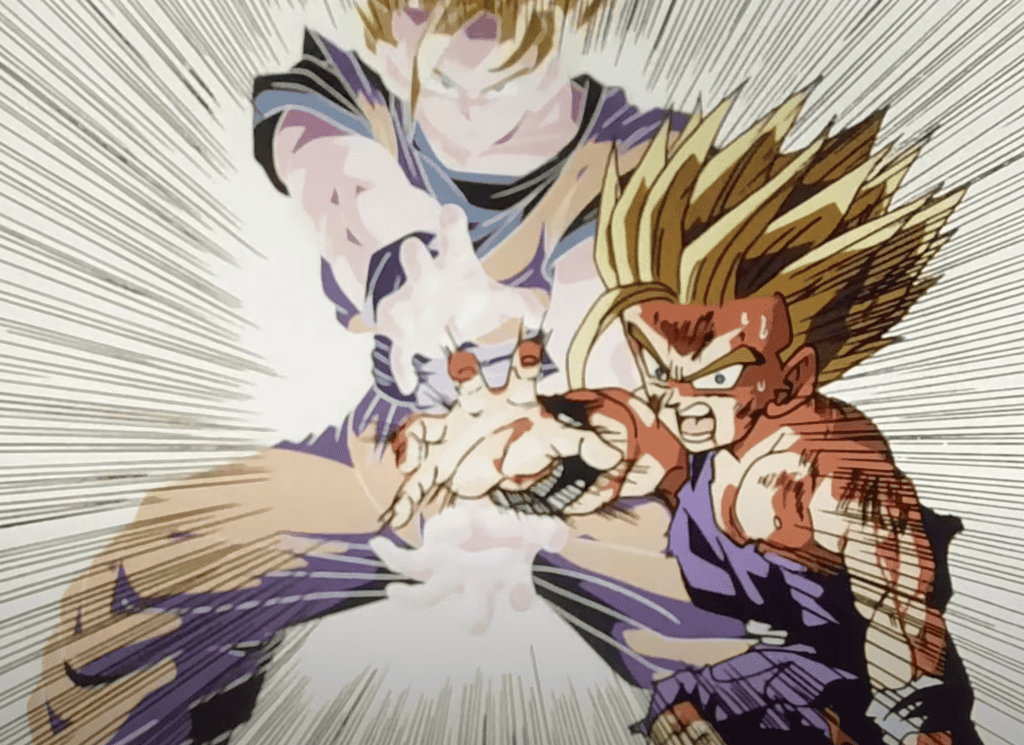
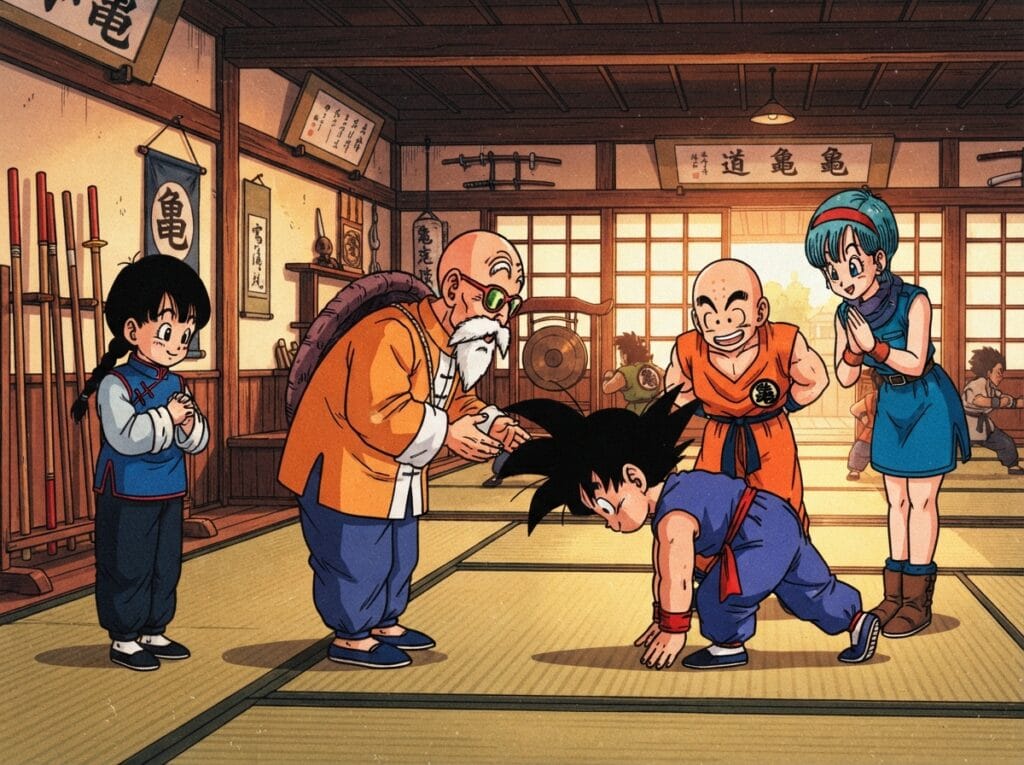
Dragon Ball Japanese honorifics are endings such as -san, -kun, and -sama that show how a speaker frames respect or familiarity. They follow a person’s name or title, but they have no exact English equivalents. Their meaning depends on who is speaking, who is being addressed, and the situation. The Dragon Ball Official Site gives clear examples: the Turtle says “Bulma-san” and “Kame-sennin-sama,” using an honorific after both a name and a title. The Dragon Ball Official Site’s manga examples show how these forms appear in the series.
We can listen for the social tone instead of treating each ending as a fixed translation. The Japan Foundation’s Marugoto notes describe -san as a common respectful form, -chan as often used for children, -kun as often used for young males, and -sama as a form used when addressing customers. The notes also connect leaving off an honorific with great closeness. These are broad patterns, not rules that explain every exchange. Age, status, setting, and personal relationships all shape how a form of address comes across. This context can help us notice when a line sounds more respectful, familiar, or formal without assuming that one suffix tells the whole story. The Japan Foundation’s honorific notes provide a helpful baseline.
Key Takeaways
- We treat Japanese honorifics as clues to respect, familiarity, or formality, not as fixed translations or proof of a character’s feelings.
- We use -san as a broadly respectful form, -kun and -chan as often less formal forms, and -sama as especially deferential, while checking the speaker, relationship, and setting.
- We can see honorifics attached to both names and titles in the official examples “Bulma-san” and “Kame-sennin-sama,” but neither form alone reveals the Turtle’s full feelings.
- We treat a dropped honorific or a different English translation as one clue, and look at the wider scene and repeated patterns before drawing conclusions about closeness, rudeness, or a change in attitude.
How Do Dragon Ball Honorifics Work?
Japanese honorifics work as social cues attached to names or titles. They signal respect, closeness, or a social relationship rather than carrying one fixed meaning. They have no exact English equivalents, so a translation may preserve the basic exchange while losing some of its social tone.
An honorific is not a guaranteed label for a character’s personality or feelings. A character using a respectful form is not automatically expressing deep admiration, just as a familiar form does not prove affection. The wording offers one clue about how the speaker frames the interaction, not a complete account of what the speaker thinks.
The same suffix can carry different shades of meaning depending on the relationship between the characters, their relative status, and the setting. A form may sound respectful in one exchange and more familiar in another. Age and gender alone do not settle its meaning. A linguistic study notes that common patterns overlap, and forms often associated with particular groups can be used more broadly in school and workplace settings. The Journal of East Asian Linguistics study also cautions that a suffix does not, by itself, guarantee intimacy.
When listening to Dragon Ball dialogue, consider who is speaking, who is being addressed, and what is happening between them. A formal meeting, a casual conversation, and a tense exchange can give the same form of address different force. A change in wording may stand out because the relationship or situation has shifted, but the scene needs to support that interpretation.
The listener’s reaction can also depend on which forms of address feel normal in their own setting. A study of Japanese junior- and high-school students found that reported emotional responses to different classroom forms varied with students’ usual experience of being addressed. This finding reminds us that social cues do not land identically for everyone, even within one language community. The University of California eScholarship study examined those responses through questionnaire scenarios.
For Dragon Ball, the safest approach is to treat an honorific as one part of a line’s tone. Consider the speaker’s role, the relationship, and the moment in the story before deciding whether the address sounds respectful, familiar, distant, or pointed. A single suffix can guide interpretation, but the surrounding scene carries the rest.
What Do -San, -Kun, -Chan, And -Sama Mean?

-San is a general respectful form, -kun and -chan are often less formal forms, and -sama is more deferential. “Matsushita-san” is an example of addressing a manager, showing how -san can mark respect in an ordinary workplace exchange. A quick English gloss such as “Mr.” or “Ms.” can help orient readers, but it cannot capture every shade of the Japanese form.
-Kun is often associated with young males, while -chan is often used for children. These patterns are useful starting points, not fixed rules about who may receive each suffix. A character’s age or gender alone cannot explain why a speaker chooses one form over another, and the same suffix may sound different across relationships and settings.
-Kun and -chan are generally less respectful than -san and can suggest intimacy or endearment. The study also cautions against treating age and gender as strict limits: -kun can be used for women in some school or company settings, and -chan can be used for adults, including adult women and, less commonly, adult men.
-Sama is more deferential than -san and can mark especially respectful address. Using -sama when addressing customers is an example. This shows a formal social use, rather than a suffix that simply means the speaker likes or admires someone. The relationship and setting still shape how the form comes across.
For a first-pass translation, readers might think of -san as respectful, -kun and -chan as less formal, and -sama as especially deferential. These short labels make dialogue easier to follow, but they cannot reproduce all the social information carried by a Japanese form of address. English usually has no single suffix that matches each one, so a translation may preserve the basic tone while leaving out distinctions tied to the speaker, the person addressed, and the situation. These glosses are a guide to the line, not a complete account of the relationship.
Which Honorifics Do Dragon Ball Characters Use?
Dragon Ball characters use honorifics after both personal names and titles. The Turtle says, “Bulma-san ga tsukureba ii n desu yo,” meaning “Bulma-san should make one.” Here, -san follows Bulma’s personal name, marking a respectful form of address.
A different example places -sama after a title rather than a personal name. In its account of chapter 119, the official site quotes the Turtle saying, “ano hito Kame-sennin-sama ni nitemasen ka”; Kame-sennin is the title, and -sama follows it. The wording shows a deferential form of address, but the suffix alone cannot tell us exactly what the Turtle feels or how the exchange should sound in English. The official chapter 119 account gives the quote. [Dragon Ball chapter 119]
The official Dragon Ball site also calls Karin “Karin-sama” and describes Yajirobe as Karin’s messenger, delivering senzu beans to Goku and the others. The name-plus-suffix form shows how Karin is addressed in that account, while Yajirobe’s role gives readers some context for their relationship. The title “messenger” does not, by itself, explain why Karin receives -sama or settle the tone of every scene between them. The official Dragon Ball site’s account of Karin and Yajirobe describes their roles.
These examples make the placement of an honorific easy to spot: Bulma-san attaches -san to a name, while Kame-sennin-sama attaches -sama to a title. Karin-sama provides another name-plus-suffix example. We can use these forms to notice how a speaker frames an address. The relationship and scene matter when we interpret whether an address sounds respectful, familiar, or especially deferential.
Should You Use -Kun Or -San?

Use -san for a broadly respectful form of address, and use -kun when a less formal choice fits the relationship and setting. Neither suffix is a fixed rule: the same form can carry different shades depending on who uses it and whom they are addressing. If you are unsure which form suits an exchange, -san is a useful respectful starting point. -Kun may sound more familiar or less formal. The speaker’s intent, the people’s relationship, and the situation all affect how the choice comes across. Gender alone is not a reliable guide. -Kun may be used for women in some school or company settings. -Chan can be used for adult women and, less commonly, adult men. These uses vary by context, so common associations should not be treated as limits. A simple rule of thumb is to notice who is speaking, whom they address, and where the conversation takes place. For example, consider whether the exchange is between colleagues, classmates, or people with a more personal relationship. That context is more useful than deciding that a form must be right or wrong based only on the addressee’s gender. In Dragon Ball, a character’s chosen form of address can add context to an interaction. The scene and the characters’ roles help readers interpret the line.
What Does Dropping An Honorific Signal?
Dropping an honorific can suggest familiarity or great closeness, but it does not automatically mean rudeness or prove a close bond. The Japan Foundation’s Marugoto teacher notes describe leaving off an honorific as usually indicating great closeness. “Usually” matters: this pattern is a useful clue, not a rule that explains every exchange.
The meaning of an omitted suffix depends on the speaker, the setting, and the relationship between the people talking. A bare name does not carry the same force in every situation, and omission alone cannot tell us whether a speaker is being warm, casual, abrupt, or disrespectful. We should avoid treating the absence of a suffix as a fixed message.
In Dragon Ball, a single line without an honorific is not enough to establish that two characters have become closer or that one character intends to slight another. A specific claim about a character’s intent needs support from the scene, not just from a general language pattern. The broad Japanese convention can guide our interpretation, but it cannot settle what a particular character means.
Instead, compare how the characters address one another across the scene. Notice whether a character uses a suffix in one exchange and leaves it off in another, then consider who is speaking and what is happening in each moment. A consistent change in address may be worth noticing, but one line by itself is a weak basis for a dramatic relationship reveal.
The same caution applies when characters do not use honorifics at all. Their usual way of speaking to each other may provide context for an omission, while a change in the situation may also affect how a line sounds. We can read the choice as one clue among others, rather than treating it as proof of a particular feeling or relationship.
How Do English Versions Handle Honorifics?

English versions handle Japanese honorifics in different ways: they may keep the suffix, replace it with an English title, or leave its social meaning unstated. English does not use the same system of endings attached to names, so translators have no single form that fits every Japanese honorific. Japanese audio preserves the spoken form, while English subtitles may keep a suffix, choose a title such as “Mr.,” or use a name without an added cue. An English dub may make another choice to suit the spoken dialogue. Manga translations can also handle forms of address differently. The choices vary by edition, so readers may get a different impression of the same exchange. A single English word for -san or -sama can miss differences in relationship and setting. “Mr.” may suggest a formal title, while -san can serve as a broader respectful form of address. “Lord” may convey deference in some contexts, but it can also suggest a rank or role that the Japanese form does not necessarily establish. Neither word captures every shade of the original. Keeping a Japanese suffix can preserve a distinction that would otherwise be hard to show in English, but it may sound unfamiliar to some readers. Replacing the suffix with an English title can make a line feel more natural while changing its tone. Leaving the cue implicit keeps the dialogue simple, yet readers may miss some of the social distance or familiarity in the Japanese wording. We recommend treating the Japanese form as added context, not as a hidden word-for-word English title. A suffix can help explain how a speaker frames an exchange. When a subtitle, dub, or manga line differs from the Japanese audio, the difference may come from the translation choice rather than a change in the scene’s basic meaning.
Can An Honorific Change A Character’s Tone?
Yes, an honorific can make a character’s address sound more respectful, familiar, or deferential, but it cannot define the character’s feelings on its own. The same speaker may choose a more respectful form in a formal or tense exchange and a more familiar form in a relaxed one. The contrast can shape the line’s tone without proving that the speaker’s personality or relationship has changed. The Turtle’s “Bulma-san” shows -san attached to a personal name, while “Kame-sennin-sama” shows -sama attached to a title. These examples illustrate how a form of address can frame the way a character speaks, but neither suffix establishes the Turtle’s full feelings toward the person addressed. The Dragon Ball Official Site’s chapter examples include both forms. [Dragon Ball chapter 93] [Dragon Ball chapter 119] A character who uses a familiar form in a casual conversation may sound more respectful when choosing -san in a formal exchange. The shift matters as part of the scene’s tone, but readers should consider the setting and relationship before interpreting it as a major change in attitude. A suffix is a social cue, not a full account of what a character thinks. Neither -chan nor -kun carries a single fixed meaning. -Chan is not automatically flirtatious: it can signal affection or familiarity, but its use alone does not prove romantic interest. The same caution applies to a more respectful or deferential form. -Sama may make an address sound especially respectful, but it does not by itself prove admiration, fear, or distance. A speaker may use it because of the person’s role or the situation, rather than because the speaker has one fixed attitude toward that person. A shift in address can help readers hear a change in tone, especially when a character moves between formal and familiar settings. But one suffix cannot prove romance, hostility, a deepening bond, or a permanent personality trait. The line’s wording offers a clue; the scene gives that clue its context.
Reading Dragon Ball’s Forms Of Address
Pick one Dragon Ball exchange that you want to understand more closely, then write down the speaker, the person addressed, and the exact form of address. Check whether the Japanese line uses a name, a title, an honorific, or no suffix. Keep that observation separate from your interpretation: “the speaker uses -san” is evidence, while “the speaker feels close to the person” is a conclusion that needs more context.
Next, compare another line between the same characters, preferably in a different situation. If the form changes, note what else changes: who is present, the characters’ roles, or the mood of the scene. A repeated pattern gives you more to work with than a single line.
If you want a reliable place to start, use the Japanese wording reproduced in the Dragon Ball Official Site’s manga notes, then compare it with the English version you are reading or watching. Record what the translation keeps or leaves unstated. This side-by-side check can show where the Japanese address adds social tone without turning one suffix into a complete explanation of the relationship.
Frequently Asked Questions
1. What does the Japanese honorific dono mean?
2. Are there rare Japanese honorifics in Dragon Ball?
The documented Dragon Ball examples here show -san and -sama, including “Bulma-san” and “Kame-sennin-sama.” Those examples do not establish which less common honorifics appear elsewhere in the franchise, so a specific claim needs support from the Japanese line in question.
3. Does Frieza’s Japanese wording make him racist?
Honorifics alone cannot establish whether Frieza’s Japanese wording is racist. That judgment depends on the specific words he uses and the scene’s context, not simply on whether he addresses someone with a respectful or familiar form.