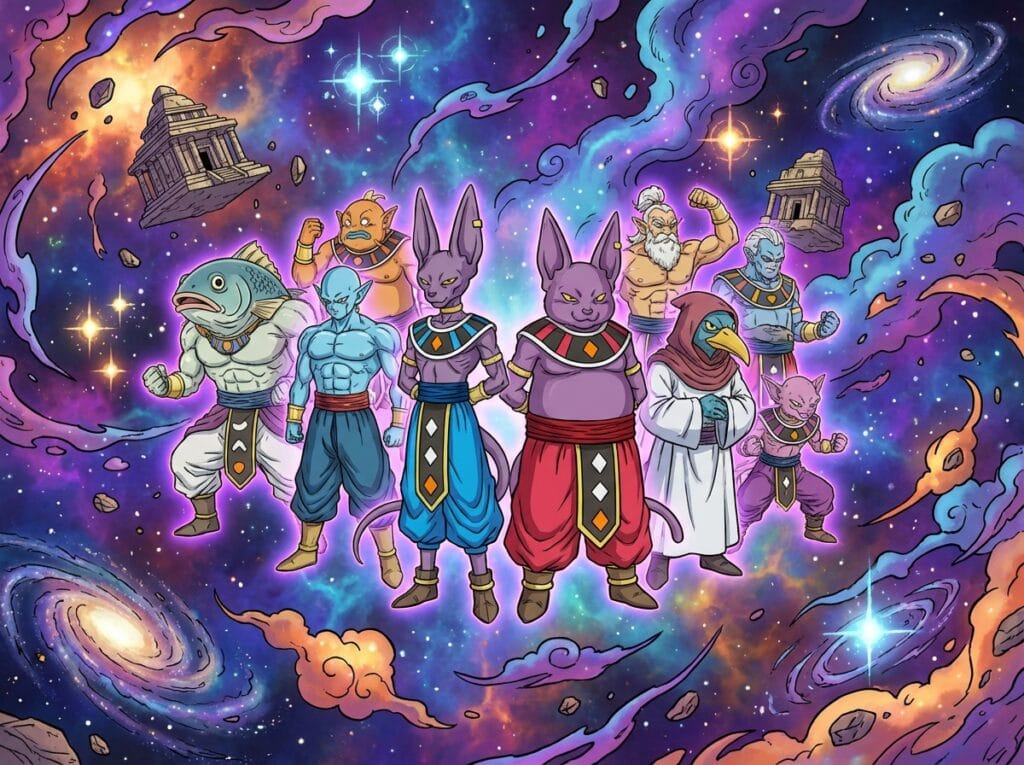
In the vast Dragon Ball multiverse, keeping the cosmic scales even requires more than just creation; it requires a terrifying amount of power. I have put together this complete god of destruction list to help you track the twelve divine beings responsible for wiping out entire planets with a single touch. These Hakaishin wield the legendary Power of Destruction, an energy so intense it can erase a soul from existence entirely.
Every universe has its own destroyer whose life is tied directly to their Supreme Kai, ensuring a perfect yet fragile balance between life and death. Whether it is the cat-like Beerus or the mechanical Mosco, each god brings a unique personality and fighting style to the series. Understanding their strengths and weaknesses is the best way to see how Goku and his friends measure up against the strongest beings in the heavens.
Key Takeaways
- The twelve Gods of Destruction maintain cosmic balance by utilizing Hakai energy to erase threats and stagnant civilizations from existence.
- A divine life-link connects each God of Destruction to their universe’s Supreme Kai, meaning the death of one results in the immediate death of the other.
- Godly ki remains undetectable to mortals, providing the Hakaishin with a level of power that far exceeds standard energy signatures.
- Universe rankings are determined by Mortal Levels, which measure how effectively a God of Destruction and Supreme Kai manage the development and stability of their reality.
The Divine Roles and Powers of Hakaishin
To truly understand the god of destruction list, you have to look at the unique balance they bring to the multiverse. While the Supreme Kais are responsible for creating life and protecting planets, the Hakaishin exist to destroy anything that threatens the cosmic order. These two roles are actually tied together by a life link, meaning if all the Supreme Kais in a universe die, the God of Destruction will also perish. This connection ensures that neither creation nor destruction becomes too powerful on its own. I first started to see the mystery of these divine roles unravel when Beerus woke up from his long slumber in search of a challenge. This haunting prophecy of a Super Saiyan God sets the stage for everything we learn about the divine hierarchy later on Dragon Ball Super episode 3, Where Does the Dream Pick Up? Haunting of the Super Saiyan God.
What makes these twelve individuals so terrifying is their access to godly ki and the Power of Destruction. Unlike the energy used by mortals, godly ki cannot be sensed by normal people and provides a level of strength that is almost impossible to overcome. The most famous tool in their arsenal is Hakai, a technique that can erase an object or a soul from existence entirely. This energy allows them to maintain balance by removing civilizations that have failed to evolve or are causing chaos. Every God of Destruction on our list possesses this frightening ability, which they use to carry out their duties over millions of years. It is this sheer power that makes even the strongest fighters like Goku and Vegeta realize how much further they have to go Dragon Ball Super episode 3, Where Does the Dream Pick Up? Haunting of the Super Saiyan God.
Every Hakaishin From Universe 1 to 6

While fans are most familiar with Beerus, the multiverse is actually home to twelve unique Hakaishin who each maintain balance through destruction. Iwan of Universe 1 kicks off our list with his distinct hairy appearance and a reputation for managing a universe with a very high mortal level. Heles follows in Universe 2, standing out as the only female deity and a warrior who values beauty and elegance above all else. Mosco of Universe 3 is a giant robotic figure who actually houses a small, pointy-eared god named Mule inside his mechanical suit. These three set the stage for the diverse designs and personalities found across the cosmos as seen in Dragon Ball Super episode 78, Even the Gods of Every Universe are Aghast?! The Losers Erased in the Tournament of Power.
Moving further down the roster, we encounter the more devious and strategic deities like Quitela and Arak. Quitela from Universe 4 is a yellow, mouse-like god who shares a famous rivalry with Beerus and relies heavily on his cunning nature. Arak of Universe 5 is a much more disciplined figure who spends his time meditating to ensure he only destroys what is absolutely necessary for his universe to thrive. Both of these gods possess the terrifying Power of Destruction and the signature purple godly ki that defines their status. Their unique approaches to their duties show that being a Hakaishin is about more than just raw strength as noted in Dragon Ball Super episode 81, Bergamo the Crusher vs. Goku! Whose Strength Reaches the Wild Blue Yonder?!
The first half of our list concludes with the loud and competitive Champa from Universe 6. He is the twin brother of Beerus, and their constant bickering over food and martial arts is a highlight of the series. Despite his lazy appearance, Champa is an incredibly powerful warrior who can erase entire planets with a single Hakai technique. He is often accompanied by his attendant Vados, who keeps him in check while he searches for the Super Dragon Balls. His introduction completely expanded the scale of the story and showed us that our universe was just one of many as seen in Dragon Ball Super episode 28, The 6th Universe’s Destroyer: His Name is Champa.
Every Hakaishin From Universe 7 to 12
To finish our list of the multiverse’s most powerful beings, we have to look at the legendary Beerus and his counterparts from the higher-numbered universes. Beerus is the cat-like Destroyer of Universe 7 who loves delicious food and long naps, but he can erase an entire planet with just a tap of his finger. Moving to Universe 8, we meet Liquiir, a three-tailed fox god who takes his job very seriously and focuses on improving his universe’s mortal level. These two show just how much variety exists in the Hakaishin designs, ranging from Egyptian mythology influences to classic folklore. I first saw all these powerful deities gather together during the Zeno Expo in Dragon Ball Super episode 78, Even the Gods are Dumbfounded! The Tournament of Power Result in Erasure.
The next group of Destroyers brings even more unique personalities and visual styles to the table. Sidra of Universe 9 is a dwarf-like god who is surprisingly indecisive and often struggles with the heavy burden of destroying worlds. In contrast, Rumsshi from Universe 10 is a pink elephant who values physical strength above all else and likes to train his body. Both of these gods face extreme pressure when the Zenos announce that the losing universes will be completely wiped from existence. This high-stakes situation reveals their true characters as they scramble to assemble the strongest fighters for their survival in Dragon Ball Super episode 78, Even the Gods are Dumbfounded! The Tournament of Power Result in Erasure.
Rounding out the final two universes are the most visually striking gods in the entire series. Belmod of Universe 11 looks exactly like a circus clown and oversees the powerful Pride Troopers, while Giin of Universe 12 is a sea creature who is incredibly efficient at his job. Belmod is especially interesting because he is closely tied to the backstory of Jiren, the strongest mortal in the tournament. These gods represent the absolute peak of power in their respective realms and hold the lives of trillions in their hands. Seeing them all in one place makes you realize just how massive the Dragon Ball multiverse really is in Dragon Ball Super episode 78, Even the Gods are Dumbfounded! The Tournament of Power Result in Erasure.
Rankings and Mortal Levels of the Universes

While fans are very familiar with Beerus and Champa, the full list of Destroyers includes powerful figures who did not even have to fight for their lives in the Tournament of Power. This exemption was granted to Universes 1, 5, 8, and 12 because they maintained a Mortal Level above seven, which is the benchmark for a well-managed reality. Gods like Iwan from Universe 1 and Giin from Universe 12 were allowed to sit on the sidelines and watch the chaos unfold from the bleachers. This high ranking proves that their work alongside their Supreme Kais was much more efficient than what we see in the lower-ranked universes. The Great Priest explained these rankings clearly to help everyone understand why some teams were safe from erasure Dragon Ball Super episode 80, Awaken Your Sleeping Battle Spirit! Son Gohans Fight!!.
Iwan, the furry and mysterious Destroyer of Universe 1, represents the top of the cosmic hierarchy since his universe has the highest Mortal Level of all. He and his fellow exempt gods like Arak and Liquiir provide a fascinating look at what happens when a Destroyer actually balances destruction with progress. Unlike Beerus, who slept for decades and let his universe’s rank slip to the bottom, these deities stayed active and kept their civilizations thriving. It is interesting to see that being a God of Destruction is not just about blowing things up but also about making smart choices to improve the quality of life. Even though we did not see them fight in the main tournament, their presence adds so much depth to the overall God of Destruction list Dragon Ball Super episode 80, Awaken Your Sleeping Battle Spirit! Son Gohans Fight!!.
Celebrating the Diverse Designs of All Twelve Destroyers
Looking back at the full roster of the twelve universes, it is clear that Akira Toriyama and Toyotarou put a lot of thought into making each deity stand out. While Beerus remains the most iconic of the group, I have always been a huge fan of the more unique character designs like Iwan and Heles. Iwan looks like a furry little soot sprite but possesses incredible power, while Heles brings a sense of elegance and beauty to the role of a destroyer. These diverse appearances make the Dragon Ball multiverse feel much larger and more mysterious than ever before. It is fascinating to see how each design reflects the specific culture or vibe of their respective universe.
Now that we have explored all the current Gods of Destruction, I want to hear your thoughts on these powerful beings. Which of these deities do you think has the coolest signature abilities or the most intimidating presence? While some rely on raw strength, others use clever techniques or their overwhelming godly ki to keep their universes in check. Maybe you prefer the robotic look of Mosco or the classic fierce nature of Champa. Drop a comment and let me know which Hakaishin you would want protecting your universe if you had the choice.
Frequently Asked Questions
1. How many Gods of Destruction are there in total?
There are exactly twelve Gods of Destruction, with one assigned to each of the twelve universes in the multiverse. Each of these Hakaishin possesses immense power and is responsible for maintaining the cosmic balance through destruction. This divine structure is first introduced when we meet Beerus and his martial arts teacher in Dragon Ball Super episode 1, Who Will the 100 Million Zeni Peace Prize Go To?
2. What happens if a Supreme Kai dies?
The life of a God of Destruction is permanently linked to the Supreme Kai of their universe. If all the Supreme Kais in a specific universe pass away, the corresponding God of Destruction will also die instantly. This fragile connection ensures that creation and destruction remain in perfect harmony throughout the heavens.
3. Can normal people sense the energy of a God of Destruction?
No, mortals cannot sense the energy of these divine beings because they use a special type of energy called godly ki. This power is far beyond the reach of standard warriors and remains invisible to anyone who has not reached a divine level of training. I saw this mystery unfold when Goku first encounters Beerus in Dragon Ball Super episode 3, Where Does the Dream Pick Up? Haunting of the Super Saiyan God.
4. What is the Power of Destruction?
The Power of Destruction, also known as Hakai, is a terrifying energy that allows a God of Destruction to erase anything from existence. Unlike a normal blast, this power completely removes a soul from the cycle of reincarnation, leaving nothing behind. Beerus demonstrates this absolute power during his early interactions with the Z-Fighters in Dragon Ball Super episode 8, Goku Steps Up! A Last Chance from Lord Beerus?
5. Why do the Gods of Destruction destroy planets?
The Hakaishin do not destroy planets out of malice, but rather to remove threats to the cosmic order and make room for new creation. Their role is to keep the universe healthy by pruning away worlds that have stopped developing or cause instability. This divine duty is a core part of the balance managed by Zen-Oh as seen in Dragon Ball Super episode 41, Come Forth, Divine Dragon, and Grant My Wish, Peas and Carrots!
6. Are all Gods of Destruction equally strong?
While every God of Destruction is incredibly powerful, they each have unique fighting styles and varying levels of strength. Some rely on raw physical power while others use mechanical suits or specialized techniques to perform their duties. Their relative power levels become a major focus during the preparations for the multiverse tournament in Dragon Ball Super episode 78, Even the Universes’ Gods are Aghast?! The Losers Erased in the Tournament of Power.

