Whether you are a lifelong anime fan or just curious about the name, the history of the Red Ribbon Army reveals a surprising tale of two very different worlds. Most of us know them as the powerhouse villains from the Dragon Ball universe, but the name also pops up in real-world health campaigns. I want to help you clear up the confusion and see how this name became such a big deal in pop culture and beyond.
I have spent a lot of time digging into Akira Toriyama’s world to understand how a tiny commander built a global military force. It is fascinating to see how a fictional group of android builders shares a name with a serious public health movement. Getting the facts straight makes watching the show or hearing about the campaign much more interesting. You deserve to know the full story behind the logo and the legend.
Key Takeaways
- The Red Ribbon Army evolved from a global paramilitary force seeking world domination into a high-tech scientific powerhouse focused on cybernetic revenge.
- The organization’s shift to a legitimate pharmaceutical front allowed them to manipulate public perception and fund the creation of advanced androids like the Gamma series.
- Despite sharing a name, the fictional Red Ribbon Army from the Dragon Ball universe is entirely unrelated to the real-world Red Ribbon health campaign for HIV/AIDS awareness.
- The persistence of the Red Ribbon legacy highlights a transition from raw military might to sophisticated psychological and technological warfare across multiple generations.
Commander Red And The Original Quest
The Red Ribbon Army first emerged as a terrifying global force with a simple yet dangerous goal of collecting all seven Dragon Balls. Led by the diminutive Commander Red, this paramilitary group used their massive wealth and advanced technology to bully anyone who stood in their way. I remember being shocked by how ruthless they were, especially since they did not care who they hurt during their search for ultimate power. Their influence felt absolute until they crossed paths with a young boy named Goku who had a pure heart and incredible strength. This early era established the group as a recurring threat that would haunt the world for decades to come Dragon Ball chapter 56, The Red Ribbon Army.
Commander Red kept his true intentions a secret from his soldiers, leading them to believe he wanted to wish for world domination. In a hilarious yet dark twist, he actually wanted to use the Dragon Balls to wish for a few extra inches of height. This selfish motivation showed just how petty the leadership was, even as they sent deadly assassins like Tao Pai Pai to do their dirty work. Goku eventually stormed their main headquarters alone, taking down an entire army with just his power pole and determination. He narrowly escaped their traps and defeated the remaining officers to end their reign of terror Dragon Ball chapter 95, A Narrow Escape.
While Goku thought he had dismantled the organization for good, the seeds of their future evolution were planted during this defeat. The brilliant Dr. Gero survived the collapse of the army and began working in the shadows to perfect his robotic creations. This transition from a massive military force to a secretive laboratory set the stage for the powerful Androids we see in later stories. It is fascinating to look back at these humble beginnings and see how a quest for height eventually led to the high tech threats featured in the newest movies. The legacy of the Red Ribbon Army is one of constant adaptation and a refusal to stay down for long Dragon Ball chapter 96, The End of the Red Ribbon Army.
Doctor Gero And The Android Legacy

After Goku dismantled the Red Ribbon Army during his childhood, the organization did not truly disappear but instead went underground. Doctor Gero, the army’s lead scientist, escaped the wreckage and dedicated his entire life to perfecting a new kind of cybernetic warfare. He moved his operations to a secret laboratory hidden in the mountains to avoid detection while he observed Goku’s growth over the years. This transition marked a shift from a global paramilitary force to a highly focused, personal vendetta fueled by advanced technology. Gero’s obsession eventually led to the creation of the unstoppable Androids 19 and 20, who finally emerged to challenge the Z Fighters in a surprise attack Dragon Ball Z episode 126, The Androids Appear.
The legacy of these mechanical menaces stretches far beyond the initial battles of the cell saga and into the modern era of Dragon Ball Super. Even after Gero was gone, his research remained a dangerous foundation for his grandson, Dr. Hedo, to eventually build upon. This connection bridges the gap between the classic Red Ribbon soldiers and the powerful Gamma androids seen in the recent movie Dragon Ball Super: Super Hero. By evolving from a simple militia into a high tech research project, the Red Ribbon Army proved that their intellectual threat was much greater than their original military strength. It is fascinating to see how a grudge from decades ago could still pose a threat to the strongest heroes in the universe today Dragon Ball Super: Super Hero.
Magenta And The Modern Superhero Revival
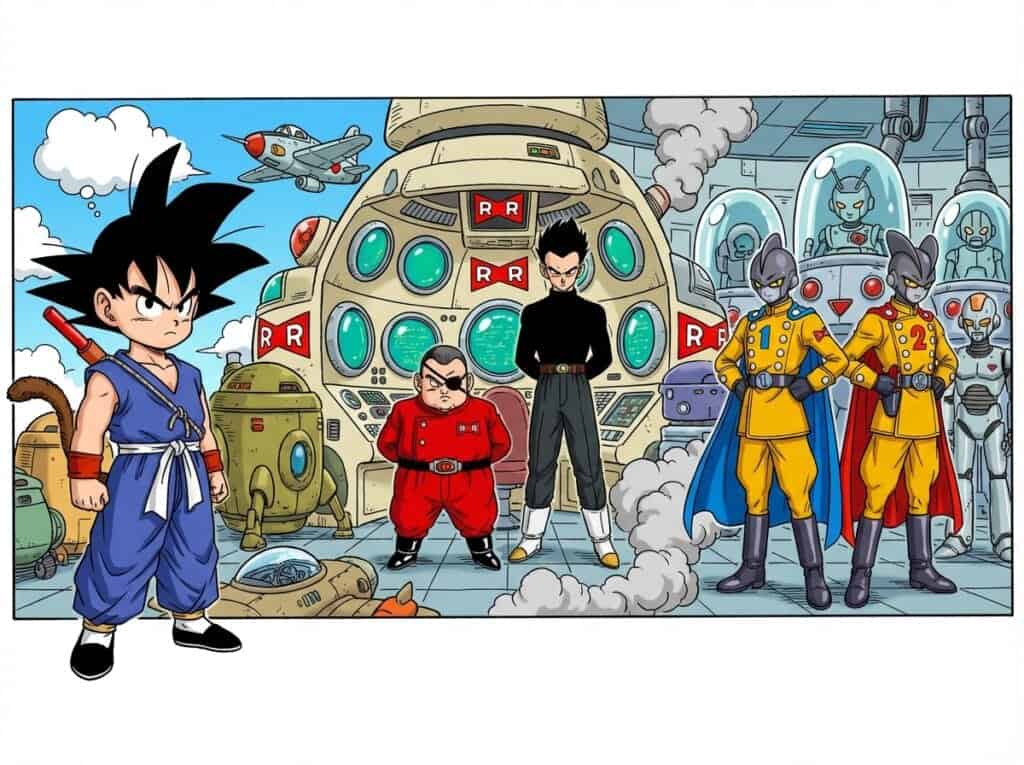
Decades after Goku dismantled their original military empire, the Red Ribbon Army resurfaced under the leadership of Magenta, the son of the late Commander Red. Magenta realized that the world had changed and a direct military assault would no longer work against powerful warriors. Instead, he decided to rebrand the organization as a pharmaceutical front to hide their true intentions from the public. This clever shift allowed them to operate in plain sight while gathering the massive resources needed for their revenge. By posing as heroes of industry, they managed to rebuild their influence without drawing immediate suspicion from the Z Fighters.
To gain the upper hand, Magenta manipulated the brilliant Dr. Hedo by convincing him that the world’s greatest defenders were actually alien invaders. Hedo used his incredible genius to create the Gamma androids, who were designed to look and act like classic superheroes. These new creations were not just powerful machines, but tools used to win over public opinion and frame Goku’s friends as the true villains. Magenta’s plan relied on this psychological warfare to ensure that the Red Ribbon Army would be seen as the planet’s ultimate protectors. This modern approach showed just how much the organization had evolved since their early days of simple conquest in Dragon Ball Super: Super Hero.
The ultimate goal of this revival was the completion of Cell Max, a terrifyingly powerful bio-android designed to be an unstoppable weapon. While the Gamma androids represented the friendly face of the new Red Ribbon Army, Cell Max was the raw, destructive face meant to crush any remaining resistance. This project pushed the boundaries of science and showed that the organization’s obsession with artificial life had never truly faded. Even though the plan eventually spiraled out of control, it proved that the Red Ribbon legacy is one of the most persistent threats in the entire series. Their ability to adapt from a militia into a modern corporate powerhouse makes them a unique bridge between old nostalgia and current stories in Dragon Ball Super: Super Hero.
The Evolution of the Red Ribbon Army
The Red Ribbon Army has come a long way from its humble beginnings as a group of soldiers searching for the Dragon Balls. What makes them so special is how they have grown from a silly group of villains into a high tech threat that spans generations. I love how the series keeps their memory alive by connecting Goku’s childhood adventures to the massive battles we see today. Their presence serves as a constant reminder that even the smallest actions from the past can have huge consequences in the future. It is this deep sense of history that keeps fans like us invested in every new chapter of the story.
The recent events in the Super Hero movie show that this organization is far from finished. By bringing back the Red Ribbon Army with new leaders and powerful androids, the creators have found a way to bridge the gap between classic nostalgia and modern action. This evolution proves that the franchise can honor its roots while still giving us fresh and exciting stakes. I think it is brilliant to see how a group once defeated by a young boy has transformed into a global scientific powerhouse. It makes me wonder what other parts of the original lore might return to surprise us next.
Looking at the future of the series, it is clear that the legacy of Dr. Gero and his creations will always be a core part of the plot. The Red Ribbon Army represents a unique type of villain that relies on human ingenuity and technology rather than just raw alien power. This keeps the world of Dragon Ball feeling grounded and connected to its martial arts origins even as the power levels reach the gods. I am excited to see how their influence continues to shape the lives of the Z Fighters in upcoming sagas. Their persistence makes them one of the most iconic and beloved parts of the entire franchise.
Frequently Asked Questions
1. Who originally founded and led the Red Ribbon Army?
Commander Red was the original leader who built this massive paramilitary force using his immense wealth and advanced technology. He was a small man with a huge ego who ruthlessly directed his soldiers to find the Dragon Balls for his own selfish reasons Dragon Ball chapter 56, The Red Ribbon Army.
2. What was Commander Red’s secret wish for the Dragon Balls?
While his soldiers believed they were fighting for world domination, Commander Red actually wanted to use the Dragon Balls to become taller. This petty secret led his second in command, Staff Officer Black, to eventually turn against him in a fit of rage Dragon Ball chapter 95, A Real Bind.
3. How did the Red Ribbon Army transition from a military group to an android creator?
After Goku defeated the main army, the brilliant Dr. Gero continued his work in secret to seek revenge. He shifted the group’s focus toward creating powerful androids and the bio-organism known as Cell to destroy Goku Dragon Ball Z episode 126, The Androids Appear.
4. What is the connection between the anime group and the real-world Red Ribbon?
There is no actual link between the fictional villains and the real-world public health campaigns. The Red Ribbon is a global symbol used to raise awareness for HIV and AIDS, which is a very positive movement compared to the cartoon army.
5. Who was the most dangerous assassin hired by the army?
The army hired the legendary mercenary Tao Pai Pai to kill Goku and retrieve the Dragon Balls. He was the first enemy to truly defeat Goku in battle, showing just how far the army would go to reach their goals Dragon Ball chapter 85, Tao Pai Pai Attacks.
6. Does the Red Ribbon Army ever return after the Cell Saga?
Yes, the organization’s legacy continues through new leadership and even more advanced technology in later stories. To better understand these mechanical threats, you can check out A Simple Guide to the Dragon Ball Androids. They remain one of the most persistent threats in the series, and understanding the rules for Dragon Ball wishes helps explain why their pursuit of the orbs was so dangerous Dragon Ball Super: Super Hero. Following the Dragon Ball timeline reveals how these villains consistently re-emerge to challenge the heroes across different eras.