I’ve spent countless hours watching Dragon Ball, and I always wondered what Piccolo and Dende were actually saying when they spoke their native tongue. For years, those strange alien chants and runic symbols just seemed like random noise created for the show. However, dedicated fans have finally made accurate Namekian language translation a reality. Linguists have broken down the spoken syllables and visual symbols, revealing a surprisingly deep language structure hidden in plain sight.
It turns out that those iconic chants rely heavily on specific sounds like “pa,” “pi,” and “pu” to form their words. The written script is just as fascinating, using unique symbols that represent entire concepts rather than just single letters. I used to think decoding these alien dialogues would be impossible, but understanding these basic rules completely changes how I experience those classic scenes. Knowing the actual meaning behind the words brings a whole new level of magic to every dragon-summoning moment.
Key Takeaways
- Spoken Namekian is a structured, translatable dialect that relies heavily on repeating “p-group” syllables like pa, pi, pu, pe, and po to create its distinct chanting rhythm.
- The written Namekian script functions through complex logograms, using sharp, geometric runes that represent entire concepts or words rather than a standard alphabet.
- Bilingual characters strategically code-switch to their native alien tongue during combat to conceal tactical plans and communicate secretly in front of enemies.
- Translating these specific linguistic details transforms seemingly random alien noises into rich world-building that deepens the lore of the Dragon Ball universe.
The Unique Sounds Of Spoken Namekian
I always found it fascinating to listen to the unique alien rhythm of the Namekian language during critical moments in the show. If you listen closely, you will notice that the spoken dialect relies heavily on repeating specific sounds to create its distinct vibe. Linguists who study the series have pointed out a high frequency of p-group syllables like pa, pi, pu, pe, and po. This constant repetition of soft consonant sounds gives the language a chanting, otherworldly quality that makes it instantly recognizable.
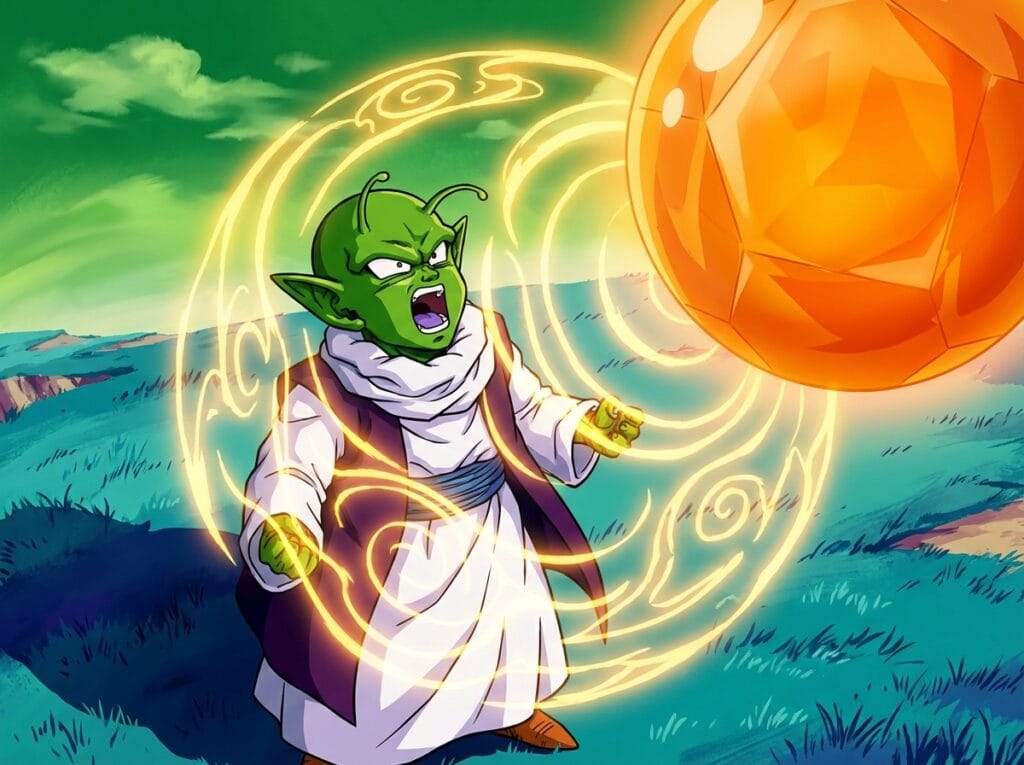
The best way to hear this phonetic pattern in action is to pay attention to the magical incantations used on Planet Namek. I love pointing out the specific scene where our heroes finally gather all seven glowing orbs and need to call forth the great dragon. You can clearly hear this distinct p-group rhythm when Dende speaks the password to summon the dragon, Dragon Ball Z episode 75, Password is Porunga. He strings those popping syllables together in a way that truly sounds like an ancient and alien dialect. Paying attention to these fun linguistic details really helps fill in some interesting lore gaps about how the Namekian people communicate.
Decoding The Written Namekian Runes

Instead of using an alphabet with individual letters like we do, the Namekian writing system relies on fascinating logograms. This means that each unique symbol represents a complete concept, idea, or entire word all on its own. I always find it amazing how these abstract runes give us a deeper look into their ancient alien culture. It completely changes how we understand the complex dialect that our favorite green heroes use to communicate across the galaxy.
We get a perfect look at these abstract symbols when Bulma and Mr. Popo travel to the edge of the world to inspect the old spaceship Kami took to Earth. The interior of the ancient vessel is completely covered in strange, blocky symbols that look almost like magical runes. Bulma realizes right away that a standard translation device will not work on this complex alien script. The characters are incredibly sharp and geometric, looking completely different compared to anything written on our planet. We can see exactly how confusing this ancient language is to human eyes, Dragon Ball Z episode 34, Krillins Offensive.
Translating these visual logograms is only half the battle when trying to fully understand the Namekian dialect. When spoken out loud, linguists have noticed that their words rely heavily on popping, rhythmic sounds like pa, pi, pu, pe, and po. I love imagining how these repetitive spoken syllables match up with the sharp, geometric runes carved into their spaceships. It shows just how much thought went into designing a language that feels truly otherworldly yet entirely functional for the characters. Figuring out these alien translations adds such a fun layer of lore to the series that goes way beyond the standard action scenes.
Famous Translations And Namekian Code-Switching
Thanks to official guidebooks and recent linguistic breakdowns, we finally have some real answers about the Namekian language. Experts have discovered that spoken Namekian relies heavily on a specific group of phonetic sounds, particularly syllables like pa, pi, pu, pe, and po. When you look at the manga, their written language appears as ancient runes or symbols that represent entire concepts rather than single letters. I love that these official translations give so much depth to those classic moments where characters summon Porunga or speak to the Grand Elder.
Another fascinating detail is how bilingual Namekians constantly switch back and forth between their native dialect and the common Earth language. They use this clever tactic to keep their strategies completely secret from enemies right in the middle of intense fights. Piccolo specifically uses his alien tongue to coordinate with Dende so the villain has absolutely no idea what they are planning. You can see a perfect example of this strategic code-switching during the battle against Frieza, Dragon Ball Z episode 76, Piccolos Return. It makes perfect sense to use a language barrier as a tactical advantage when the fate of the entire universe is on the line.
How Namekian Brings Dragon Ball to Life
Exploring the quirks of the Namekian language really shows how much thought went into making the Dragon Ball universe feel incredibly vast and alive. Learning about the heavy use of p-group sounds, like those catchy pa, pi, and pu syllables, adds a whole new layer of depth to the series. It is fascinating to see how a fictional dialect with its own unique rune symbols can fill in such a fun lore gap for us fans. Instead of just hearing random alien noises, we get to appreciate a structured language that connects us directly to the home planet of our favorite green heroes. These small linguistic details transform a simple background element into a rich piece of world-building that I absolutely love exploring.
Understanding this alien dialect entirely changes the way I experience the most intense scenes in the anime. I always used to wonder what Piccolo and Dende were actually saying to each other during those critical moments when the fate of the earth was on the line. Now, knowing the actual meaning behind their urgent chants and rapid conversations makes watching these beloved characters so much more enjoyable. It feels like we are finally in on a secret that has been hiding in plain sight for decades. The next time you sit down to rewatch your favorite saga, I hope this translation guide helps you listen to our Namekian friends with a completely fresh perspective.
Frequently Asked Questions
1. Is the Namekian language just random noise?
I used to think it was just random alien gibberish created for the show. However, dedicated fans and linguists have actually decoded its structure into a real, translatable language. It turns out Namekian has very specific rules for both speaking and writing.
2. What sounds make up spoken Namekian?
I always notice a distinct rhythm built on specific repeating syllables when watching the show. The language relies heavily on soft consonant sounds like pa, pi, pu, pe, and po. This constant repetition is what gives the spoken words that cool, otherworldly chanting vibe.
3. How does the written Namekian script work?
The written language is completely different from our English alphabet. Instead of using single letters to spell out words, Namekian uses unique runic symbols that represent entire concepts. I find it fascinating how a single visual symbol can hold so much deep meaning.
4. When do we hear the Namekian language used the most?
I absolutely love hearing the language during the magical incantations used to summon the great dragon Porunga. You can hear these specific phonetic patterns perfectly when Dende calls upon the dragon, Dragon Ball Z episode 75, Password is Porunga. It is incredibly cool to finally understand the exact words they use to make their wishes.
5. Which characters actually speak the Namekian language?
You will mostly hear characters native to Planet Namek speaking this unique dialect. I always pay close attention to Piccolo and Dende, as they are the main characters who use their native tongue throughout the series. Other Namekian elders and warriors also speak it naturally during the story.
6. Why is Namekian language translation so exciting for fans?
Knowing the actual meaning behind the alien words completely changes how I experience classic scenes. It takes away the mystery of random sounds and brings a whole new level of magic to the story. I highly recommend learning how the translation works to make your next watch-through even better.