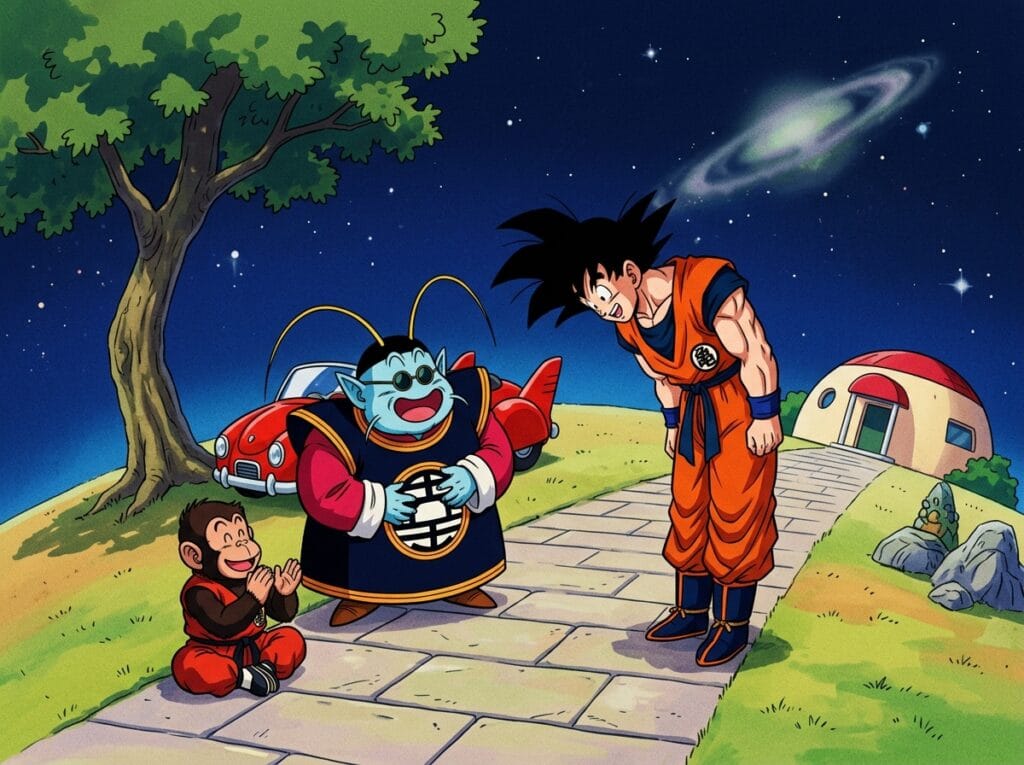
When I finally reached the end of Snake Way, I realized I didn’t have to face a terrifying monster to prove my worth. Instead, I had to master the art of the pun. King Kai is one of the most powerful mentors in the universe, but his true passion lies in the world of comedy. If you want to learn the Spirit Bomb or the Kaio-ken, you first have to survive a barrage of king kai jokes that range from clever wordplay to total groaners.
I’ve always loved how the series treats humor as a serious prerequisite for divine martial arts training. Whether it is a classic Japanese dajare about bedding or a silly pun about a monkey, these jokes are a core part of King Kai’s quirky personality. Understanding his unique brand of comedy gives us a better look at why this deity is so beloved by fans. It shows that even when the fate of the world is on the line, there is always room for a good laugh.
Key Takeaways
- Humor is a mandatory prerequisite for divine martial arts training, as King Kai requires students to master the art of the pun before teaching elite techniques like the Spirit Bomb or Kaio-ken.
- King Kai’s comedic requirements serve as a spiritual test, ensuring that protectors of the universe possess the mental flexibility and balanced soul necessary to handle immense power.
- The series utilizes ‘dajare’—Japanese wordplay based on similar sounds—to establish a unique bond between master and student that grounds high-stakes battles in lighthearted fun.
- The adaptation of King Kai’s humor from Japanese wordplay to Western ‘dad jokes’ demonstrates how universal comedy is used to humanize powerful deities and make divine lore approachable.
The Comedy Requirement For Spirit Bomb Training
When I first watched Goku reach the end of the winding Snake Way, I expected a grueling physical test from the legendary North Kai. Instead, we were treated to one of the most charmingly bizarre moments in the series when King Kai demanded a joke before he would even consider teaching his secret techniques. This quirky comedy requirement means that the Kaio-ken and the Spirit Bomb aren’t just about raw power, but also about having a sense of humor. Goku had to dig deep into his limited wit to provide a pun that would satisfy the deity’s love for wordplay. It is a nostalgic reminder that even in the face of a Saiyan invasion, the show always found room for lighthearted fun Dragon Ball Z episode 5, Gohans Metamorphosis.
This unique training ritual is actually rooted in the Japanese tradition of dajare, which are simple wordplay jokes that King Kai absolutely adores. While we often focus on power levels and transformations, King Kai uses these jokes to test a student’s spirit and mental flexibility. I love how this established a friendly, comedic bond between the master and his student that lasted throughout the entire franchise. Seeing Goku struggle to come up with a “dad joke” is just as memorable as his physical training on King Kais Planet with high-gravity. It proves that being a divine protector requires a balanced soul and a quick wit Dragon Ball Z episode 5, Gohans Metamorphosis.
From Japanese Wordplay To English Puns

When Goku finally reached the end of Snake Way, he didn’t just have to show off his strength to get training from King Kai. In the original Japanese version, the humor is built around “Japanese dajare,” which are silly wordplay jokes that rely on how certain words sound. The most famous example is the “flying futon” joke, where King Kai says “Futon ga futtonda,” a phrase that literally means the bedding flew away. It is a simple play on words that sounds hilarious to a pun-lover like King Kai, even if it feels a bit like a cheesy dad joke to everyone else. This established a fun tradition where Goku had to prove his wit before he could ever hope to master the Kaio-ken in Dragon Ball Z episode 19, The Legend of the Sais.
Translating these specific Japanese puns into English was a huge challenge for the dubbing team because the wordplay just doesn’t work the same way in our language. Instead of trying to explain why a flying futon is funny, the English dub replaced the dialogue with classic western-style puns and “knock-knock” jokes. This change helped the humor land perfectly for those of us watching at home, making King Kai feel like that one uncle who thinks he is a professional comedian. It turned the training sessions into something nostalgic and lighthearted, showing that even a deity can have a goofy side. You can see this creative shift in action when Goku struggles to find the perfect joke to crack the master’s serious exterior in Dragon Ball Z episode 19, The Legend of the Saiyans.
Even though the jokes changed across the ocean, the core of King Kai’s character remained exactly the same. Whether he is laughing at a Japanese pun about a cat or an English joke about a refrigerator, his obsession with comedy is what makes him such a memorable mentor. It is a great reminder that the world of Dragon Ball isn’t always about high-stakes battles and power levels. Sometimes, the most important part of becoming a hero is being able to appreciate a silly joke and make a friend laugh. This unique blend of divine power and goofy humor is why King Kai remains a fan favorite to this day in Dragon Ball Z episode 19, The Legend of the Saiyans.
Goku And King Kai’s Funniest Comedic Exchanges
I still remember the first time Goku met King Kai and realized that mastering the Spirit Bomb required a mastery of the dad joke. It was such a refreshing twist to see a divine deity who valued a good pun just as much as a high power level. Watching Goku struggle to come up with something funny enough to earn his training always brings back a wave of nostalgia for those early Snake Way adventures. Goku’s simple-minded nature actually worked in his favor because his jokes were so basic they caught the master of comedy off guard. Their bond really started to solidify when Goku finally cracked a joke that left the North Kai doubled over in laughter Dragon Ball Z episode 18, The End of Snake Way.
One of my absolute favorite exchanges happens when Goku is trying to push past his mental limits during his intense training sessions. In the episode Beyond the Boundaries of Mind and Matter, we see how their relationship has evolved from a strict teacher and student dynamic into a genuine friendship built on mutual silliness. Goku’s literal interpretation of the world often results in accidental comedy that King Kai finds absolutely brilliant. It is heartwarming to see how humor bridges the gap between a mortal Saiyan and a literal god of the universe. These lighthearted moments remind us that even when the fate of the world is at stake, there is always room for a bad pun Dragon Ball Z episode 54, Beyond the Boundaries of Mind and Matter.
Why King Kai’s Humor Matters Most
King Kai’s unique brand of humor is more than just a quirky personality trait, as it truly represents the heart of the series. Looking back at Goku’s long trek across Snake Way, it is clear that these jokes served as the ultimate icebreaker between a mortal and a deity. It is incredibly refreshing to see that even a powerful master of the universe values a good pun as much as a powerful punch. These lighthearted moments remind us that the world of martial arts isn’t always about serious battles and high stakes. By making laughter a requirement for his legendary training, King Kai showed us that a positive thinking process is just as important as physical strength.
Reflecting on these classic gags brings back a wave of nostalgia for the early days of the franchise. Whether he was testing Goku with a silly wordplay or demanding a high-quality joke before teaching the Kaio-ken, King Kai made the divine feel approachable and fun. This focus on comedy helped ground the lore, proving that even the most respected mentors have a playful side. I love how these interactions built a bond that lasted throughout the entire story, long after the training was over. Ultimately, the legacy of King Kai’s jokes serves as a wonderful reminder that a little bit of humor can make any journey feel much shorter.
Frequently Asked Questions
1. Why does King Kai require his students to tell a joke?
King Kai believes that a true master must have a sense of humor to handle the stresses of divine martial arts. He uses these jokes to test a student’s spirit and mental flexibility before teaching powerful moves like the Kaio-ken Dragon Ball Z episode 18, The End of Snake Way.
2. What kind of jokes does King Kai personally enjoy the most?
King Kai is a huge fan of Japanese dajare, which are simple puns that rely on clever wordplay. He loves anything that makes him laugh, even if the jokes are total groaners that make others roll their eyes Dragon Ball Z episode 19, The Legend of the Saiyans.
3. Did Goku have a hard time coming up with a joke for his training?
Yes, Goku really struggled because he is much better at fighting than he is at comedy. He eventually managed to tell a silly pun about a cat that satisfied King Kai’s strict requirements Dragon Ball Z episode 19, The Legend of the Saiyans.
4. Are the jokes different in the English version of the show?
The English dub often changes the jokes to make them easier for Western audiences to understand since Japanese wordplay doesn’t always translate directly. These English translations still capture the same goofy spirit that King Kai is famous for Dragon Ball Z episode 20, A Girl Named Lime.
5. Can anyone learn the Spirit Bomb without telling a joke?
No, King Kai is very firm about his comedy requirement for anyone seeking his mentorship. You have to make him laugh before he will even consider showing you the secrets of the Spirit Bomb or Kaio-ken Dragon Ball Z episode 19, The Legend of the Saiyans.
6. Why is humor such a big part of King Kai’s character?
Humor shows that even the most powerful deities in the universe have a lighthearted side. It reminds us that there is always room for a good laugh even when the fate of the world is at stake Dragon Ball Z episode 5, Gohans Metamorphosis.