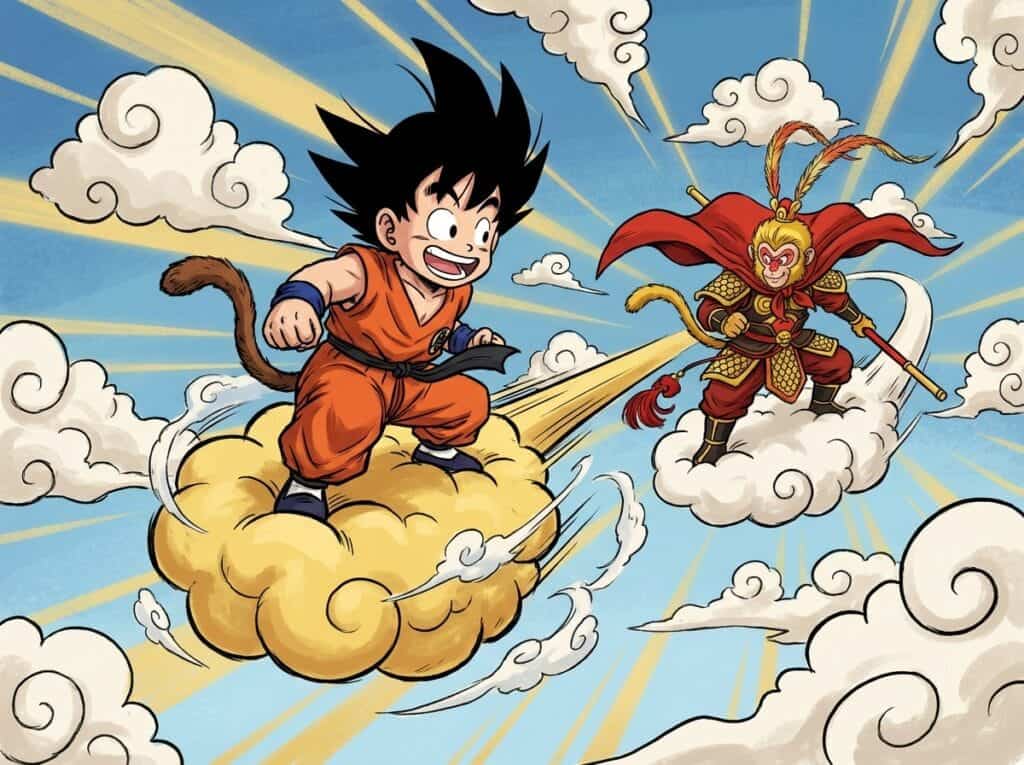
I can’t get enough of the Flying Nimbus. It’s one of my favorite parts of Dragon Ball. That fluffy golden cloud lets Goku zip across the sky at blazing speeds, turning every trip into an adventure. It only lets pure-hearted people ride it, like a magical purity test on clouds. Goku summons it with a whistle, and off they go, dodging mountains and bad guys alike. Watching it debut early in the series brings pure joy. The way it weaves through the canyons of the Dragon World makes the sense of exploration feel endless and vibrant.
The Flying Nimbus comes from the ancient Chinese novel Journey to the West. There, the Monkey King Sun Wukong rides a similar magical cloud called Kintoun to somersault through the heavens. This 16th-century story inspired many modern tales, including Dragon Ball. Akira Toriyama took that idea and made it his own, tweaking it for Goku’s world. It ties the show’s wild action to those classic legends, creating a bridge between historical literature and contemporary animation. The transition from a literary device to a visual icon is nothing short of brilliant.
In Dragon Ball, the cloud gets a shiny golden upgrade and even acts alive sometimes. Gohan rides it too once he proves his pure heart, which warms my heart every time. This purity rule adds depth, showing heart matters more than power. Fans love debating who else could ride it, keeping the lore alive. It bridges old myths to epic anime battles. Even as characters gain the ability to fly using their own energy, the Nimbus remains a beloved symbol of the series’ more innocent and adventurous beginnings.
Key Takeaways
- The Flying Nimbus originates from Kintoun, the magical cloud ridden by Sun Wukong in the 16th-century Chinese novel Journey to the West, symbolizing supernatural speed and freedom.
- Akira Toriyama adapted Kintoun into Dragon Ball’s golden Flying Nimbus, which Goku summons with a whistle and uses for high-speed travel before learning to fly.
- Only pure-hearted individuals like Goku and Gohan can ride the Nimbus, rejecting impure riders like Krillin in humorous tests that emphasize moral purity over power.
- The Nimbus bridges ancient mythology and modern anime, adding depth to Dragon Ball’s adventures with its sentient, legendary qualities.
- The cloud represents a direct link to the “Somersault Cloud” technique, which allowed the Monkey King to traverse vast distances in seconds.
Kintoun Roots in Journey to the West
Ever wonder where Goku’s trusty Flying Nimbus really comes from? It all starts with Sun Wukong, the Monkey King from the 16th-century Chinese novel Journey to the West. In the story, he gains this magical cloud called Kintoun after training with a powerful immortal. With just a somersault, Wukong flips 108,000 li, about 54,000 kilometers, in one bound. That makes it the ultimate speedy ride across the skies. This cloud symbolizes his wild freedom and supernatural prowess. In the original text, the ability is actually a secret Taoist technique known as the Cloud-Somersault, which Wukong masters to outrun even the swiftest gods.
Kintoun plays a huge role in the novel’s epic adventure, helping Wukong protect the monk Xuanzang on their quest for Buddhist scriptures. Culturally, it has inspired countless tales in East Asia, representing divine speed and mischief. Japanese adaptations call it Kintoun, keeping that whisk-away magic alive. I love how it captures the joy of effortless flight, like defying gravity on a whim. The cloud serves as a mobile platform that allows the Monkey King to survey the land for demons, acting as a scout tool long before modern technology existed.
Dragon Ball‘s version nods to this origin but adds a fun twist with the purity-of-heart rule. Akira Toriyama drew straight from Journey to the West to make Goku’s cloud feel legendary. It’s no coincidence Goku rides it just like Wukong, pure heart and all. This connection keeps the spirit of the ancient tale zooming through modern pop culture. By making the cloud a physical object rather than just a technique, Toriyama made it more tangible and relatable for a younger audience watching the early episodes.
The Cultural Impact of the Cloud-Somersault
The concept of the cloud-somersault is deeply embedded in Chinese folklore. In the original legends, the cloud isn’t just a vehicle but a sign of spiritual attainment. To “ride the clouds” meant one had transcended the mortal coil and achieved a level of enlightenment that separated them from common men. This is why the Flying Nimbus feels so special in Dragon Ball. It isn’t just a gadget or a machine; it is a manifestation of spiritual alignment. When Goku hops on, he is literally standing on a piece of the divine, which fits the mystical tone of the early search for the Dragon Balls.
Furthermore, the visual representation of the cloud has evolved. While traditional Chinese art often depicts these clouds as swirling, stylized vapors, Toriyama chose a more tactile, cotton-candy look. This change made the Nimbus feel more like a friend or a pet than a distant magical force. It’s this friendly design that helped the Nimbus become one of the most recognizable items in anime history, right alongside the Power Pole and the four-star Dragon Ball itself. Its presence in the series helped ground the high-flying fantasy in a sense of wonder and approachability.
Dragon Ball Flying Nimbus Debut

Akira Toriyama brought the Flying Nimbus into Dragon Ball by adapting it from the classic Chinese novel Journey to the West, where the Monkey King rides a magical cloud. He turned it into this golden, fluffy Kintoun that zips through the sky super fast. I love how Toriyama kept the cultural roots but made it fit perfectly into his goofy adventure world. It first shows up early in the series as Goku’s cool new ride, gifted by Master Roshi as a reward for saving Turtle. This meeting of the legendary turtle hermit and the young boy marks a turning point in the series’ scale of travel.
Goku gets his first ride on the Flying Nimbus when Grandpa Gohan summons it after Goku defeats some foes. This moment is pure fun, with Goku soaring high and loving every second. Right away, we learn about the purity requirement. Only those with a pure heart can ride it, which suits Goku’s innocent vibe. It becomes his signature way to travel before he learns to fly. Master Roshi himself can no longer ride it because his mind is filled with perverted thoughts, which serves as a hilarious contrast to Goku’s utter lack of guile.
The Nimbus debuts big in Dragon Ball episode 12, The Penalty is Pinball, during Goku’s wild pinball penalty adventure. Krillin tries to ride it but crashes because he’s not pure enough, which cracks me up every time. This sets up tons of hilarious tests and heartwarming scenes later on. It’s one of those early gems that hooks you into the series. Seeing Goku effortlessly balance on the cloud while others fall through it emphasizes just how different he is from the rest of the world. It isn’t about strength or ki; it is about the soul.
Purity Heart Test from Ancient Lore
The Flying Nimbus’s pure-of-heart rule draws straight from the ancient themes in Journey to the West, where Sun Wukong’s magical cloud demanded moral purity from its riders. In that classic tale, only the worthy could summon and control the swift Kintoun, echoing Buddhist ideas of inner cleanliness over worldly desires. Akira Toriyama brought this lore into Dragon Ball, making the golden cloud a living test of character that rejects anyone with impure thoughts. It’s a judgment from the skies, tying back to the novel’s spiritual quests. This rule serves as a constant reminder that in the early days of the series, character was the most important metric of a hero.
What makes the Nimbus so special is its sentience, like a fluffy companion that senses your soul before you even hop on. It zooms at incredible speeds, flipping and somersaulting through the air faster than any plane, perfect for Goku’s wild adventures. This awareness lets it dodge dangers instinctively, almost like it has a mind of its own from those old legends. I love how it feels alive, responding only to the purest hearts like Goku and Gohan. In the manga, the Nimbus is even shown to be part of a much larger cloud, suggesting that it is a fragment of a vast, celestial entity.
Plenty of characters have tried and failed this heart test, proving its strict ancient roots. Krillin gets comically bounced off in Dragon Ball episode 42, A Wish to the Eternal Dragon, because his mind wandered to cute girls. Yamcha and others flop too, showing even good guys aren’t always pure enough. These moments highlight the Nimbus’s unyielding purity standard, straight from Journey to the West’s moral trials. Even Bulma, despite being a protagonist, is unable to ride it, which forces her to rely on her technology while Goku relies on his spirit. This creates a great dynamic between the two leads.
The Evolution of the Nimbus in Dragon Ball Z
As the series transitioned from Dragon Ball to Dragon Ball Z, the role of the Flying Nimbus shifted. With the introduction of high-speed flight through the manipulation of ki, the Nimbus was no longer the fastest way to get around. However, it didn’t disappear. Instead, it became a symbol of the next generation. When Gohan began his journey to school or his early training, the Nimbus returned to carry him. This was a beautiful way to show that Gohan had inherited his father’s kindness and purity. It acted as a torch being passed from father to son, maintaining the legacy of the Monkey King.
Even though Goku could fly across continents in the blink of an eye during the later sagas, the Nimbus still made occasional appearances. It signifies a time of peace and a return to roots. For many fans, seeing the Nimbus on screen brings back the feeling of the original hunt for the Dragon Balls. It represents the “journey” part of the story, where the destination mattered less than the sights seen along the way. The fact that the Nimbus survived through the era of Saiyans and Androids proves how foundational it is to the identity of the franchise.
Flying Nimbus Origin FAQs

One big question I get is the difference between Kintoun and the Flying Nimbus. They’re actually the same thing, just different names. Kintoun is the original Japanese term used in Dragon Ball, while Flying Nimbus is the fun English dub name that stuck with fans worldwide. Both refer to that golden, fluffy cloud Goku summons with a whistle to zip through the skies super fast. Akira Toriyama pulled this straight from Journey to the West, where the Monkey King Sun Wukong rides a magical cloud just like it. The name “Kintoun” literally translates to “Gold Somersault Cloud,” which perfectly describes its movement.
The purity test is what makes the Flying Nimbus so special. Who can ride it? Only folks with a pure heart get a lift, like Goku and his son Gohan, but baddies like Piccolo or even Krillin get bounced right off. This rule adds heart to the story, showing Goku’s innocent spirit from the start. It’s a symbol of goodness in the Dragon Ball world. Interestingly, Chi-Chi was also able to ride it during her youth, which explains why she and Goku were such a compatible match from a spiritual perspective.
In modern takes, the Nimbus pops up in games, fan art, and even crossovers, keeping its myth alive. From ancient Chinese tales to Toriyama’s epic, its journey captivates us because it blends whimsy with deep values like purity and adventure. I still smile thinking of Goku racing on it. Pure magic that never gets old. It has even appeared in various video game adaptations as a mount, allowing players to experience the same sense of freedom that Goku felt in the early days of the manga.
Flying Nimbus’ Mythical Origins
The Flying Nimbus has its roots in the ancient Chinese tale Journey to the West, where the Monkey King Sun Wukong zooms through the skies on a magical cloud called Kintoun. Akira Toriyama brought this legend to life in Dragon Ball, turning it into a fluffy golden cloud that’s super fast and picky about who rides it. Only pure-hearted folks like Goku and Gohan can hop on, which adds a cool moral twist to the story. I love how it ties old myths to epic adventures we all grew up with. This mythological foundation gives the series a weight that many other battle shonen lack.
What makes the Nimbus stand out are its simple yet powerful rules. No bad guys allowed, and it shrinks or vanishes if you’re not worthy. It’s a test of character that Goku’s friends fail hilariously at times. From cultural icon in ancient novels to a staple in anime battles, it shows timeless appeal. Fans debate its physics, but that’s part of the fun. Some wonder if it has a top speed or if it can travel into space, though the series generally keeps it within the atmosphere. Its utility as a scout and transport was unmatched in the early chapters of the story.
The Flying Nimbus bridges worlds, from Sun Wukong’s somersaults to Goku’s world-saving dashes. Its purity theme reminds us that true power comes from the heart. Whether you’re a Dragon Ball newbie or longtime fan, this cloud’s origin story keeps pulling us back. I can’t wait to see how it evolves in future series. Its legacy is secure as one of the most iconic vehicles in the history of fiction, embodying the spirit of the adventurous hero who remains untainted by the darkness of the world.
Frequently Asked Questions
1. What is the Flying Nimbus?
The Flying Nimbus is Goku’s fluffy golden cloud in Dragon Ball that zips pure-hearted riders across the sky at blazing speeds. It turns every trip into an adventure, and Goku summons it with a whistle. I can’t get enough of watching it dodge mountains and bad guys. It is essentially a semi-sentient magical object that serves as Goku’s primary mode of transportation for much of the original series.
2. Where does the Flying Nimbus come from?
It originates from the ancient Chinese novel Journey to the West, where Sun Wukong rides a similar magical cloud called Kintoun. Akira Toriyama adapted this classic idea for Dragon Ball, tying the anime’s action to old legends. It bridges myths to epic battles. The cloud was traditionally a Taoist magic used by immortals to traverse the heavens.
3. What is Kintoun in Journey to the West?
Kintoun is the magical cloud Sun Wukong gains after training with a powerful immortal, letting him somersault 108,000 li, about 54,000 kilometers, in one bound. It symbolizes his wild freedom and supernatural prowess. Wukong uses it to protect monk Xuanzang on their quest for Buddhist scriptures. In the novel, the ability is often referred to as “Cloud-Trapeze.”
4. Who can ride the Flying Nimbus?
Only pure-hearted people like Goku and Gohan once he proves his heart. It acts like a magical purity test, rejecting anyone impure. This rule shows heart matters more than power, and fans love debating who else could ride it. Characters like Upa and Nam have also been shown to be capable of riding it due to their righteous nature.
5. How does Goku summon the Flying Nimbus?
Goku simply whistles, and the cloud comes zooming to him. It debuts early in the Dragon Ball series, making every appearance pure joy. That’s the simple magic that keeps it fun. The cloud is always nearby, waiting in the upper atmosphere until it hears the specific call of its owner.
6. Why does the Flying Nimbus have a purity rule?
The purity rule adds depth, proving that a good heart beats raw power. It warms my heart seeing Gohan ride it after proving himself. This ties into the themes from Journey to the West too, where spiritual discipline was required to master the cloud. It serves as a narrative tool to highlight the protagonist’s unique moral standing.
7. Is the Flying Nimbus based on real mythology?
Yes, it’s directly inspired by Kintoun from the 16th-century Journey to the West. Toriyama gave it a golden upgrade and lively personality for Dragon Ball. It connects ancient tales to modern anime perfectly. Many scholars view the cloud as a representation of the “lightness” of a soul that has shed its earthly burdens.
While the Nimbus is fast, fans often compare its speed to other legendary journeys, even using a Snake Way Travel Time Calculator to see how it stacks up against other long-distance treks in the series. Despite being surpassed by later power levels, the Flying Nimbus remains the gold standard for magical travel in the Dragon Ball universe.