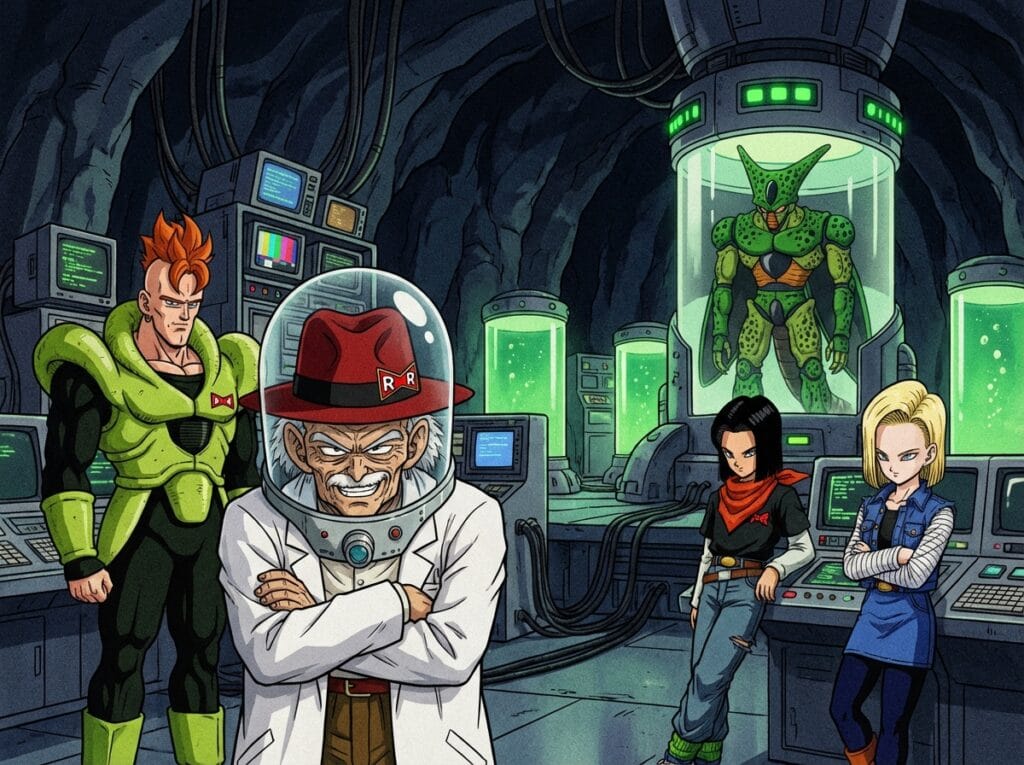
I’ve always been fascinated by the brilliant yet twisted mind of the Red Ribbon Army’s top scientist. Dr. Gero’s inventions represent some of the most dangerous threats the Z-Fighters ever faced, blending cold robotics with advanced bio-engineering. From the early mechanical models to the terrifying bio-organic lifeforms, his work changed the power balance of the entire world.
One man’s grudge against Goku led to the creation of beings that could outmatch a Super Saiyan. Whether it was the energy-absorbing models or the silent, gentle giant Android 16, every creation had a specific purpose in his quest for revenge. Exploring his lab reveals a dark legacy of genius and obsession that still haunts the series today.
Key Takeaways
- Dr. Gero’s engineering evolved from purely mechanical models like Android 19 to bio-organic cyborgs to achieve a balance of total obedience and superior power.
- The transition to human-based models 17 and 18 introduced infinite power reactors, providing relentless stamina that allows these warriors to win through attrition.
- Cell represents the pinnacle of bio-engineering by combining the genetic material of the universe’s greatest fighters into a single, evolving organism.
- Dr. Gero’s reliance on biological bases ultimately caused his downfall, as the retained human free will and Saiyan traits led his creations to rebel against his control.
From Android 8 To The Mechanical Model 19
Long before he perfected his biological projects, Dr. Gero spent years experimenting with purely mechanical designs to serve the Red Ribbon Army. One of his earliest and most famous creations was Android 8, a hulking figure who looked quite a bit like Frankenstein’s monster. While 8 possessed incredible physical strength, he was considered a failure by Gero because he developed a kind heart and a pacifist nature. This early setback taught the doctor that human emotions were often too unpredictable for a perfect weapon, leading him to rethink how he programmed his future machines Dragon Ball episode 38.
As Gero shifted his focus toward total obedience and efficiency, he eventually developed the mechanical model known as Android 19. This round, pale machine was a masterpiece of his energy-absorption era, featuring red orbs in its palms that could drain the life force directly out of an opponent. Unlike the rebellious models that came before him, 19 was completely loyal and followed every command without question or hesitation Dragon Ball Z episode 126. This specific design was so reliable that Gero even trusted 19 to perform the surgery that turned the doctor himself into a cyborg.
The technical leap from the gentle Android 8 to the cold, calculating Android 19 shows just how obsessed Gero became with control. By moving away from human-based models and focusing on dedicated robotics, he finally achieved the subservient partner he had always wanted. These mechanical inventions laid the groundwork for his goal of destroying Goku, proving that his engineering evolved and his genius was just as dangerous in robotics as it was in biology Dragon Ball Z episode 130. Even though these machines lacked the infinite energy of later models, their ability to steal power made them a terrifying threat on the battlefield.
The Infinite Power Of Cyborgs 17 And 18

After years of experimenting with purely mechanical robots and failing to control their personalities, Dr. Gero made a groundbreaking pivot in his engineering strategy. He realized that to truly surpass Goku and the Z-Fighters, he needed a more versatile foundation, leading him to kidnap the twins Lapis and Lazuli to serve as human bases. By applying bio-organic enhancements to their existing cellular structures, Gero successfully bridged the gap between man and machine. This shift allowed him to create warriors that looked and acted human but possessed terrifying modifications beneath the surface. These internal upgrades turned the siblings into Android 17 and 18, the most feared duo in the Red Ribbon Army’s history, Dragon Ball Z episode 133.
What really sets these two apart from Gero’s earlier models is the installation of the infinite power reactor. Unlike the energy-absorption models like Android 19 that have to steal power to stay fueled, 17 and 18 have a limitless supply of internal energy. This means they never get tired and their power levels never drop, no matter how long a battle lasts. This relentless stamina was on full display when Android 18 systematically wore down Vegeta during their first encounter, Dragon Ball Z episode 135. It is a technical achievement that makes them nearly impossible to defeat in a war of attrition.
I find it fascinating that Gero’s greatest success also came with his biggest risk, as these bio-organic models retained their own free will. Because they weren’t programmed from scratch like the mechanical Android 16, they kept their rebellious human spirits and eventually turned on their creator. Gero tried to suppress their independence with remote shut-off switches, but his reliance on human biology proved to be his undoing. Even though he viewed them as mere weapons, their human origin gave them the drive to seek their own paths once they were freed from their pods, Dragon Ball Z episode 134. Their story is a perfect example of how Gero’s brilliant scientific mind ultimately paved the way for his own destruction.
Cell And The Peak Of Bio-Organic Engineering
While Dr. Gero’s mechanical androids were impressive, Cell represents the absolute peak of bio-organic engineering. I find it fascinating that Gero didn’t just build this creature with his own hands, but instead programmed a hidden supercomputer to continue the work long after he was gone. This ultimate lifeform was grown in a specialized maturation pod, where it was slowly nourished by the genetic material of the universe’s greatest warriors. By combining the DNA of Goku, Vegeta, Piccolo, and even Frieza, Gero created a being that possessed the strengths of every major race in the galaxy. This biological marvel was designed to be the perfect predator, capable of using the techniques and biological advantages of all its genetic parents at once as seen in Dragon Ball Z episode 143, The Silent Warrior Revealed.
The true genius and horror of Cell lies in his ability to evolve through biological absorption. I think it is incredible how Gero engineered Cell with a long, needle-like tail designed specifically to consume other lifeforms to increase his power. His design wasn’t considered complete until he could track down and absorb Androids 17 and 18, which were the final components needed to reach his Perfect Form. This process transformed him from a cicada-like monster into a sleek, humanoid warrior with power that surpassed even a Super Saiyan. It really shows how Gero’s scientific legacy shifted from simple robotics to a terrifying mastery over life itself as seen in Dragon Ball Z episode 152, Say Goodbye, 17.
Watching Cell on screen makes it clear that he isn’t just a robot following a script, but a sentient organism with a will of its own. Because he has the cells of Saiyans, he possesses an unquenchable thirst for battle and a desire to see his opponents at their strongest. He even has Piccolo’s namekian regeneration, which makes him nearly impossible to kill unless every single cell is destroyed. I believe this makes Cell the most dangerous invention in the Red Ribbon Army’s history because he represents a perfect blend of technology and biology. Gero may have died at the hands of his own creations, but his dream of the ultimate fighter lived on through this bio-engineered masterpiece as seen in Dragon Ball Z episode 160, Cell is Complete.
The Legacy of Dr. Gero’s Androids
Dr. Gero’s scientific legacy completely reshaped the power dynamics of the world, pushing the boundaries of what was thought possible through both biology and machines. By successfully merging human spirits with mechanical enhancements, he created beings that could rival gods and change the fate of the planet forever. His work on energy absorption and infinite power reactors proved that his genius was decades ahead of any other scientist in the Red Ribbon Army. Even though his primary goal was revenge, the sheer scope of his technical achievements left a permanent mark on history.
The complexity of Gero’s projects, especially his move toward bio-engineering with the creation of Cell, shows a level of foresight that remains unmatched. He didn’t just build robots, he designed evolving life forms that could learn, adapt, and grow stronger through combat. This mix of mechanical precision and biological evolution ensures that his name will always be linked to the most dangerous advancements in the series. Looking back at his long list of numerical models, it is clear that his relentless pursuit of perfection created a legacy that outlived the man himself, much like the Android 21 origin story which further explores his dark family ties.
Frequently Asked Questions
1. Who was Dr. Gero’s first mechanical creation?
Android 8 was one of his earliest mechanical models and looked much like Frankenstein’s monster. Even though he was physically strong, Gero viewed him as a failure because he was too kind and refused to fight Dragon Ball episode 38.
2. How did Android 19 differ from the earlier models?
Android 19 was a purely mechanical model built for total loyalty and obedience to his creator. He used special red orbs in his palms to drain energy from his enemies during a fight Dragon Ball Z episode 126.
3. Why did Dr. Gero turn himself into an android?
The brilliant Dr Gero wanted to become immortal and gain enough power to finally take down Goku. He had Android 19 transfer his brain into a mechanical body so he could live forever and oversee his revenge Dragon Ball Z episode 126.
4. What makes Android 16 unique compared to 17 and 18?
Unlike the siblings who were modified humans, Android 16 was built entirely from scratch as a machine. He was very quiet and loved nature, which made Gero consider him a malfunction Dragon Ball Z episode 134.
5. What was the purpose of the energy-absorption models?
These models were designed to steal the life force and ki of the Z-Fighters to power themselves up. By taking energy directly through their hands, they could weaken their opponents while getting stronger at the same time Dragon Ball Z episode 127.
6. Why did Gero stop making purely mechanical androids?
Gero realized that mechanical models had power limits and sometimes developed unpredictable personalities like Android 8. This led him to experiment with bio-organic engineering to create more powerful and dangerous Dragon Ball Androids Dragon Ball Z episode 142. Fans who appreciate this era of the show often look for the best Dr Gero laboratory collectibles to commemorate his dark scientific achievements.