Long after the Red Ribbon Army fell, the brilliant yet twisted mind of a single scientist continued to haunt our favorite heroes from the shadows. I’ve always found it fascinating how dr gero creations shifted the entire power scale of the series, moving from simple mechanical robots to terrifying bio-organic nightmares. Whether it was the gentle nature of Android 8 or the sheer coldness of the later models, these machines were built with one goal in mind: total revenge against Goku.
Understanding these artificial humans means looking at the different ways Gero experimented with life itself. He didn’t just build tin cans; he modified living people like the twins, 17 and 18, and even modeled others after his own lost family members. It is incredible to see how his obsession with perfection eventually led to the birth of Cell, a creature designed to be the ultimate fighter. Exploring these technical marvels shows just how much one man’s grudge changed the fate of the entire world.
Key Takeaways
- Dr. Gero’s scientific evolution moved from simple mechanical robots to complex bio-organic hybrids, culminating in Cell, a creature capable of surpassing any machine through genetic adaptation.
- The shift from purely mechanical models to human-based cyborgs like Androids 17 and 18 introduced infinite energy generators, providing a level of stamina and power that redefined the series’ combat scale.
- Gero’s inability to control his creations stemmed from his failure to account for the human spirit and free will, leading to repeated betrayals by those he modeled after his own family or modified against their will.
- Driven by a lifelong obsession with revenge against Goku, Gero eventually discarded his own humanity by transferring his brain into a mechanical shell to achieve immortality and personal combat capability.
Early Mechanical Models And Failed Experiments
Dr. Gero’s journey into robotics began with a desire for absolute control, but his early models were far from the perfect soldiers he envisioned. One of the most famous examples is Android 8, also known as Eighter, who was a purely mechanical creation with a surprisingly soft heart. Despite his massive frame and incredible strength, Eighter refused to fight for the Red Ribbon Army because of his pacifist nature. This was a massive blow to Gero’s ego, as his first functional android eventually defected to become one of Goku’s closest friends Dragon Ball episode 38, Five Mirky Ninjas.
After the failure of Eighter’s personality, Gero experimented with more aggressive mechanical designs that focused on raw destruction. This led to the development of Androids 13, 14, and 15, who were programmed with a singular, cold objective to eliminate Goku. These models were much more obedient than their predecessors and showed off Gero’s ability to create modular technology. When Android 13 absorbed the components of his fallen comrades, he transformed into the terrifying Super Android 13, proving that Gero was getting closer to his goal of ultimate power Dragon Ball Z Movie 7, Super Android 13!.
Even with these advancements, Gero struggled to find the right balance between a machine’s loyalty and a warrior’s instinct. He even tried to base his designs on personal history, creating Android 16 in the likeness of his late son, Gevo. However, this model also ended up being too gentle for Gero’s liking, as 16 preferred the peace of nature over the chaos of the battlefield. These early mechanical models show that while Gero was a genius, he often failed to understand the complex spark of life that made his creations so unpredictable Dragon Ball Z episode 138, Deadly Beauty.
The Infinite Energy Of Cyborg Twins

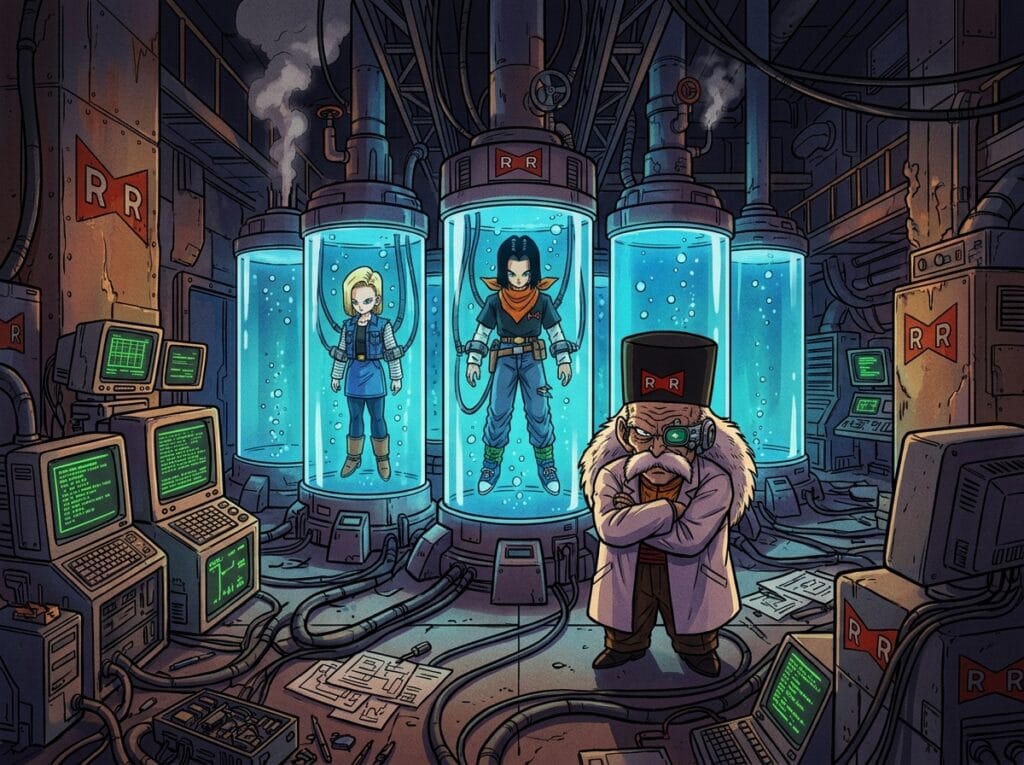
After years of building purely mechanical models like the gentle Android 8 or the energy-absorbing Android 19, Dr. Gero decided to take a much more radical approach to his engineering. He realized that to truly surpass Goku, he needed to experiment with human subjects, leading him to kidnap the twin siblings Lapis and Lazuli. By modifying their organic bodies with cybernetic enhancements, he created Androids 17 and 18, who are technically cyborgs rather than traditional robots. These two represent the pinnacle of his scientific evolution because they possess a biological foundation enhanced by high-tech machinery. This transition from cold metal to living tissue marked a terrifying new chapter in the history of the Red Ribbon Army’s quest for revenge.
What makes these twins so dangerous is the infinite energy generators implanted within their bodies. Unlike Gero’s earlier models that had to drain energy from their opponents to stay powered, 17 and 18 never get tired and their power levels never drop during a fight. This internal power source gives them a massive advantage in long battles because they can overwhelm even the strongest warriors through pure stamina. Gero thought this invention would make them the ultimate tools for his global takeover, but he underestimated the human spirit remaining inside them. Their limitless power became a curse for their creator when they refused to follow his orders Dragon Ball Z episode 133, Nightmare Comes True.
The twins’ rebellion shows the fatal flaw in Gero’s transition from machines to human-based models. Because they retained their human personalities and free will, they harbored a deep resentment for the man who turned them into monsters against their wishes. When Gero finally activated them out of desperation, his lack of control over his own creations led to his violent downfall. They didn’t care about his vendetta against Goku or the legacy of the Red Ribbon Army at all. This moment of betrayal proved that while Gero was a genius at building weapons, he couldn’t account for the unpredictability of the human soul Dragon Ball Z episode 133, Nightmare Comes True.
Bio Organic Horrors And The Perfect Being
Dr. Gero’s obsession with revenge led him far beyond simple robotics and into the disturbing world of bio-organic engineering. While his earlier mechanical models were impressive, his crowning achievement was the development of Cell, a creature grown from the DNA of the world’s greatest fighters. This ultimate fighter was designed to be the Perfect Being, possessing the tactical brilliance of Piccolo and the ruthless power of Frieza. I find it fascinating how Gero used a tiny remote tracking device to gather genetic samples over several years without anyone noticing. This long-term scientific pursuit of perfection truly highlights the dark genius behind the Red Ribbon Army’s most dangerous project, Dragon Ball Z episode 142, The Dragon Spirit.
The complexity of Gero’s work also took a deeply personal turn with the creation of Android 21, who shares a tragic connection to his past. She was designed based on the mother of his son, Gevo, blending human elements with the DNA of Majin Buu to create a powerful bio-android. This mix of family sentiment and cold science shows that Gero’s experiments weren’t just about power, but also about a twisted desire to recreate what he had lost. Seeing how her organic nature leads to an insatiable hunger reminds me of how unpredictable bio-organic weapons can be compared to standard robots. Her existence proves that even after Gero’s death, his research into genetic hybrids continued to haunt the universe, Dragon Ball Z episode 145, The Enigmatic Android.
Exploring these bio-organic horrors gives us a better look at the evolution of Gero’s technology from simple metal to living tissue. While the mechanical Android 16 was modeled after his fallen son, the shift toward DNA-based lifeforms like Cell allowed for growth and adaptation that machines simply couldn’t match. It is incredible to think that a single man’s grudge could result in a creature capable of threatening the entire solar system. Gero might have been a villain, but his ability to bridge the gap between biology and technology is what made him such a terrifying threat to Goku and his friends. These creations represent the absolute peak of the Red Ribbon Army’s scientific achievements, Dragon Ball Z episode 147, City of Revenge.
Dr Gero Final Transformation Into Android 20

Dr Gero’s obsession with revenge against Goku led him to make the ultimate commitment to his scientific work. After spending years perfecting various mechanical models and cyborgs, he realized his own aging body was a weakness that could prevent him from seeing his plans through. He decided to transfer his brain into a mechanical shell, effectively becoming Android 20 to gain immortality and the power necessary for combat. This transformation was a dark milestone in his history of experiments because it turned the creator into one of his own weapons. He even had his loyal creation, Android 19, perform the surgery to ensure he would be ready for the upcoming battle Dragon Ball Z episode 126, The Androids Appear.
The transition to a robotic body gave Gero incredible new abilities, specifically the power to drain energy from his enemies through devices in his palms. By becoming an energy-absorption model, he could technically stay powered up forever as long as there were victims to siphon from. It is fascinating to see how his fear of death and his hatred for the Saiyans pushed him to discard his humanity entirely. This move highlighted his role as the most dedicated scientist of the Red Ribbon Army, willing to sacrifice his soul for a chance at victory. Even though he was once a man of flesh and blood, he ended up as a cold machine designed for nothing but destruction Dragon Ball Z episode 126, The Androids Appear.
The Dark Legacy of Gero’s Machines
Dr. Gero may have fallen at the hands of his own experiments, but the shadow of his scientific genius still looms over our heroes today. Even after the Red Ribbon Army was dismantled, his twisted dream of perfection continued to evolve through the terrifying biological data he collected on Goku and the Z-Fighters. This dark legacy proves that Gero was more than just a vengeful scientist, as his work managed to bridge the gap between mechanical engineering and biological horror. From the gentle nature of Android 16 to the cold efficiency of the energy-absorbing models, his portfolio of creations remains the most diverse and dangerous in the series history.
The influence of Gero’s family ties and his obsession with revenge didn’t end with the destruction of Cell or the conversion of Android 17 and Android 18. We see his impact lingering in the way modern threats emerge, often tracing their roots back to the blueprints and data files he left behind in his hidden labs. It is fascinating to realize that a single man’s grudge against a young boy could result in decades of conflict and the birth of some of the strongest beings in the universe. While the doctor himself is long gone, his status as the ultimate architect of the Red Ribbon Army’s revival ensures that his name will always be synonymous with the scientific side of the struggle for survival.
Frequently Asked Questions
1. Who was the first successful android Dr. Gero created?
Android 8, also known as Eighter, was one of Gero’s first functional mechanical models. Even though he was built for war, he had a gentle soul and chose to become a peaceful friend to Goku instead of a weapon Dragon Ball episode 38, Five Mirky Ninjas.
2. Why did Dr. Gero turn 17 and 18 into androids?
Dr. Gero kidnapped the twins and modified their bodies because he wanted to create soldiers with infinite energy. Unlike his earlier mechanical robots, these bio-organic models were built using real humans to ensure they could grow stronger and never run out of power Dragon Ball Z episode 133, Nightmare Comes True.
3. What was the main purpose behind Dr. Gero’s creations?
Every single machine and bio-android Dr. Gero built was fueled by his deep grudge against Goku for destroying the Red Ribbon Army. He spent years in his hidden laboratory obsessed with crafting the perfect weapon to finally get his revenge Dragon Ball Z episode 126, The Androids Appear.
4. Which creation is considered Dr. Gero’s ultimate masterpiece?
Cell is the absolute peak of Gero’s work because he contains the DNA of the greatest fighters in the universe. This creature was designed to evolve by absorbing others, eventually reaching a perfect form that no ordinary machine could ever match Dragon Ball Z episode 143, The Silent Warrior.
5. Are all of Dr. Gero’s androids purely mechanical?
No, Gero experimented with different types of technology including purely mechanical robots, human-based cyborgs, and even bio-engineered creatures. While models like Android 19 were total machines, others like 17 and 18 were living people who were surgically enhanced Dragon Ball Z episode 132, Gero’s Revenge.
6. Did Dr. Gero ever model his androids after real people?
Yes, Gero often used his own life as inspiration, even modeling the powerful Dragon Ball Androids after his fallen son. His obsession was so great that he eventually turned himself into an android to live forever and personally oversee Goku’s defeat Dragon Ball Z episode 130, The Secret of Anti-Energy.