I’ve always found it chilling how one man’s obsession could lead to decades of biological horror. Dr. Gero was driven by a singular, dark goal: to destroy Goku using the most advanced technology imaginable. When I look back at the dr gero experiments, it’s clear that his work went far beyond simple robotics. He blurred the lines between man and machine, creating everything from gentle giants to cold-blooded killers in his hidden mountain laboratory.
The variety in his creations is truly staggering, ranging from purely mechanical robots to kidnapped humans turned into cyborgs. I find it fascinating that he even performed surgery on himself just to ensure his revenge would live on forever. Whether he was using energy-absorption tech or complex bio-organic engineering, his “Androids” changed the world of martial arts forever. Understanding these experiments helps us see just how dangerous the Red Ribbon Army’s legacy really was.
Key Takeaways
- Dr. Gero’s evolution from mechanical robotics to human-based cyborgs and bio-organic engineering was driven by a singular, obsessive quest for revenge against Goku.
- The shift from purely mechanical models to human-based cyborgs like Androids 17 and 18 introduced infinite energy sources and organic cells, making them more powerful but harder to control.
- Cell represents the pinnacle of Gero’s bio-organic research, combining the genetic material of the universe’s elite warriors to create a perfect, adaptive organism.
- Gero’s technological legacy permanently altered the martial arts landscape by introducing threats that lacked detectable Ki, forcing heroes to evolve beyond traditional combat methods.
From Robots To Artificial Humans
I’ve always found it fascinating how Dr. Gero’s obsession with the Red Ribbon Army’s downfall drove him to push the boundaries of robotics far beyond what anyone thought possible. In his early days, he focused on purely mechanical robotics like Android 19, which were built from the ground up with cold, calculated hardware. These machines relied on energy-absorption technology to drain power from their enemies during combat. Gero was so confident in this mechanical design that he even used Android 19 to transfer his own brain into a robotic body. This transition marked a major shift in his experiments as he moved away from simple robots toward more complex artificial humans Dragon Ball Z episode 126, The Androids Appear.
The most emotional example of Gero’s mechanical mastery is definitely Android 16, who holds a very special place in the lore. Gero actually modeled this massive warrior after his own fallen son, Gevo, which adds a layer of personal tragedy to his cold scientific work. Despite being physically one of the strongest creations in the lab, 16 was considered a total failure by his creator because of his gentle soul and love for nature. Gero feared that this peaceful personality would interfere with his plans for revenge against Goku. We see the true depth of this “Deadly Beauty” when the giant is finally awakened from his long slumber Dragon Ball Z episode 138, Deadly Beauty.
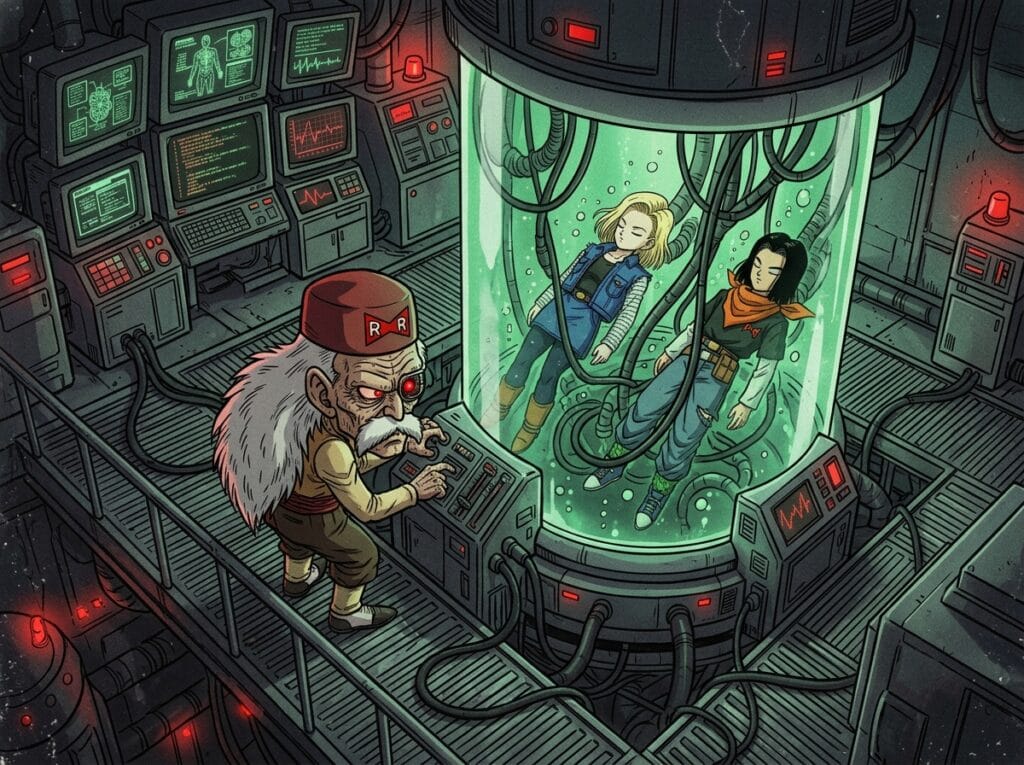
As Gero’s research evolved, he began to realize that purely mechanical parts had their limits when facing the incredible power of the Z Fighters. This realization led him to start experimenting with biological components, eventually leading to the kidnapping of the siblings Lapis and Lazuli. By combining human bases with cybernetic enhancements, he created the legendary Androids 17 and Android 18. These models were designed to have infinite energy sources, making them much more dangerous than his earlier robotic versions. This shift from metal to flesh and blood showed just how desperate Gero had become to achieve his ultimate goal Dragon Ball Z episode 133, Nightmare Comes True.
The Horror Of Human Based Cyborgs

Dr. Gero’s obsession with revenge led him down a path where he viewed human life as nothing more than raw material for his weapons. Instead of sticking to purely mechanical robots, he decided to kidnap two young siblings named Lapis and Lazuli to serve as the base for his most ambitious projects. He stripped away their humanity and identities, subjecting them to painful biological restructuring to turn them into the infinite energy models we know as Android 17 and 18. This horrific process was fueled by Gero’s long standing grudge against Goku for destroying the Red Ribbon Army years prior. The true nightmare of these experiments is revealed when we see just how much the doctor sacrificed in terms of ethics to achieve his goals in Dragon Ball Z episode 133, Nightmare Comes True.
The technological advancements Gero made during these experiments were groundbreaking but incredibly cruel. By using a human foundation, he was able to create cyborgs that possessed organic cells capable of generating endless power without ever getting tired. Unlike his earlier mechanical models, these human based creations had their own wills, which eventually led to Gero’s own downfall when his subjects turned on him. He viewed them as mere tools for his grand design, ignoring the fact that he had stolen their lives and replaced their memories with programming designed for murder. These experiments represent the absolute peak of the Red Ribbon Army’s technological terror and the cold nature of Gero’s scientific genius in Dragon Ball Z episode 134, The Awakening.
Perfecting Bio Organic Engineering In Cell
Dr. Gero’s obsession with revenge led him to create a secret underground laboratory where he could push the boundaries of biological science far beyond his earlier mechanical models. While his previous androids were impressive, his magnum opus required a much more complex approach than just metal and circuitry. He began a decades long process of harvesting genetic material from the universe’s most elite warriors, including Goku, Vegeta, and even Frieza. This ambitious project aimed to blend the best traits of various species into a single, unstoppable organism. The supercomputer continued this work long after Gero focused on his own cybernetic conversion, quietly perfecting the genetic cocktail required for a perfect being as seen in Dragon Ball Z episode 145.
The engineering behind this creature involved a sophisticated tracking device known as a remote tracking insect, which followed the Z-Fighters to collect their DNA during battles. This tiny drone was the key to gathering samples from Saiyans, Namekians, and the Frost Demon race without anyone noticing. By combining Piccolo’s regeneration with the adaptive strength of the Saiyans, Gero ensured his creation could survive almost any injury. This bio-organic engineering process was much more horrifying than his work on the mechanical models because it treated living cells as mere building blocks for a weapon. The result was a biological horror that possessed the techniques and instincts of the world’s greatest defenders as described in Dragon Ball Z episode 145.
I find it fascinating how Gero transitioned from the cold metal of the early Red Ribbon Army robots to the organic nightmare that eventually emerged from his basement. This shift in technology shows just how the evolution of Dr Gero creations and the Red Ribbon legacy was driven by a desperation to create something that could never be defeated by simple brute force. The underground lab served as a silent tomb for his ambitions, where the computer painstakingly knit together different genetic strands over several years. It is a chilling reminder of what happens when genius is fueled by pure hatred and a lack of ethics. Watching the heroes discover the incubation tank reveals the true scale of Gero’s madness and his commitment to destroying Goku at any cost in Dragon Ball Z episode 145.
The Lasting Horror of Gero’s Creations
The legacy of Dr. Gero’s experiments stretches far beyond his own life, proving that his obsession with revenge permanently altered the course of history. By shifting from simple mechanical robots to complex biological engineering, he bridged the gap between technology and life itself. This terrifying pursuit of the ultimate weapon didn’t just create powerful fighters, but it introduced a new era of scientific horror that the world was completely unprepared for. Even after his death, his supercomputer continued his work, showing just how deep his hatred for Goku truly ran.
I find it fascinating and scary how Gero’s technological advancements forced the world’s strongest heroes to reach levels of power they never thought possible. His decision to kidnap humans like Lapis and Lazuli to create cyborgs showed a complete lack of ethics in favor of raw power. This shift toward bio-organic research eventually led to the birth of Cell, a creature that combined the DNA of the universe’s greatest warriors into one perfect being. The Red Ribbon Army’s shadow stayed over the planet for years, proving that Gero’s genius was as brilliant as it was destructive.
Looking back on these experiments, it is clear that Gero changed the world by making the impossible a reality through cold, hard science. His work took the concept of a simple martial arts rivalry and turned it into a battle for the survival of the entire human race. While his goal was destruction, his creations like Android 16 and 18 eventually found their own paths, showing that even the most calculated experiments can have unpredictable outcomes. Gero’s scientific journey remains a dark reminder of what happens when brilliance is fueled entirely by spite and a thirst for vengeance.
Frequently Asked Questions
1. What was the main goal behind Dr. Gero’s experiments?
Dr. Gero was driven by a dark obsession to get revenge on Goku for destroying the Red Ribbon Army. He spent decades in his hidden laboratory creating advanced technology and biological weapons specifically designed to kill the Saiyan hero Dragon Ball Z episode 126, The Androids Appear.
2. How did Dr. Gero become an Android himself?
Gero wanted to live forever to see his revenge through, so he performed surgery on himself to transfer his brain into a mechanical body. He had his creation, Android 19, assist with the procedure to turn him into the energy-absorbing Android 20 Dragon Ball Z episode 127, I Will Defeat Them.
3. What is the difference between his mechanical robots and his cyborgs?
Some creations like Android 19 were built entirely from hardware and wires, while others like Androids 17 and 18 were kidnapped humans modified with robotics. These cyborg models were much more powerful but harder for Gero to control because they kept their human wills Dragon Ball Z episode 133, Nightmare Comes True.
4. Why did Dr. Gero create Android 16?
Android 16 was a very personal project for Gero because he modeled the robot’s appearance after his son, Gevo, who died as a soldier. Because he didn’t want to see his son die again, he made 16 gentle and programmed him with a peaceful nature Dragon Ball Z episode 134, The Awakening of 16.
5. What is energy-absorption technology?
This was a special feature Gero built into his mechanical models that allowed them to drain power directly from an opponent through palm sensors. It allowed the Androids to grow stronger during a fight while their enemies became weaker and exhausted Dragon Ball Z episode 128, Secret of the Androids.
6. How did Dr. Gero’s experiments change the world of martial arts?
His work blurred the lines between biology and machinery, introducing threats that could not be sensed through normal Ki detection. This forced the heroes to find new ways to fight since they couldn’t track the Dragon Ball Androids movements using traditional methods Dragon Ball Z episode 126, The Androids Appear. To see how Dr Gero inventions continued in other timelines, you can uncover the tragic Android 21 origin story and timeline.