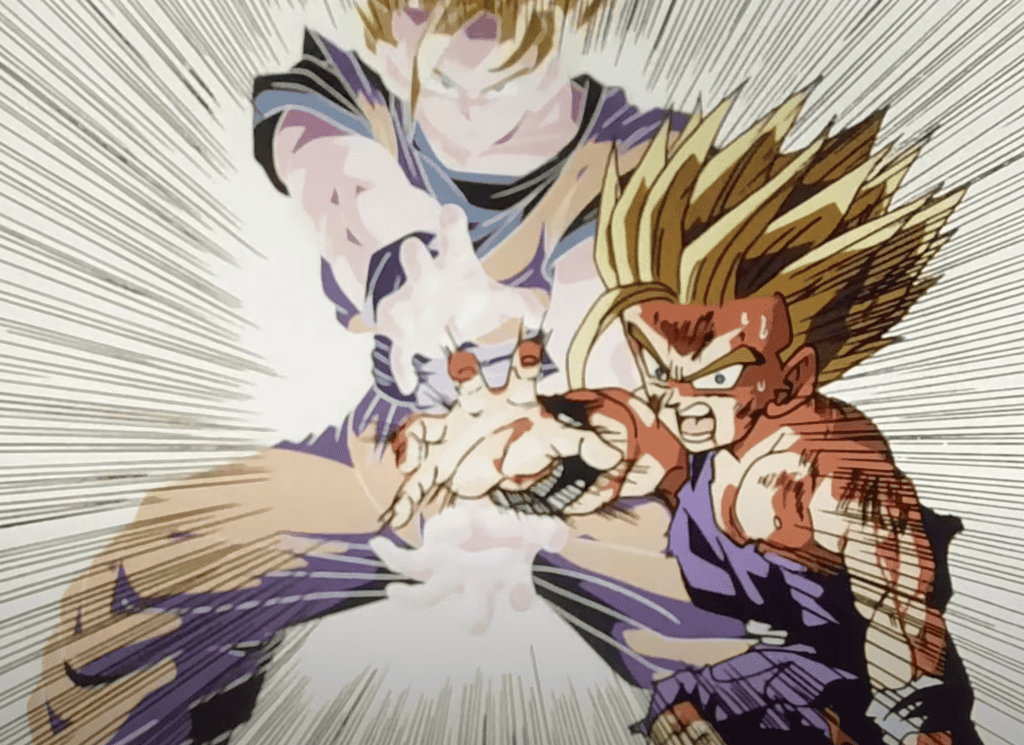
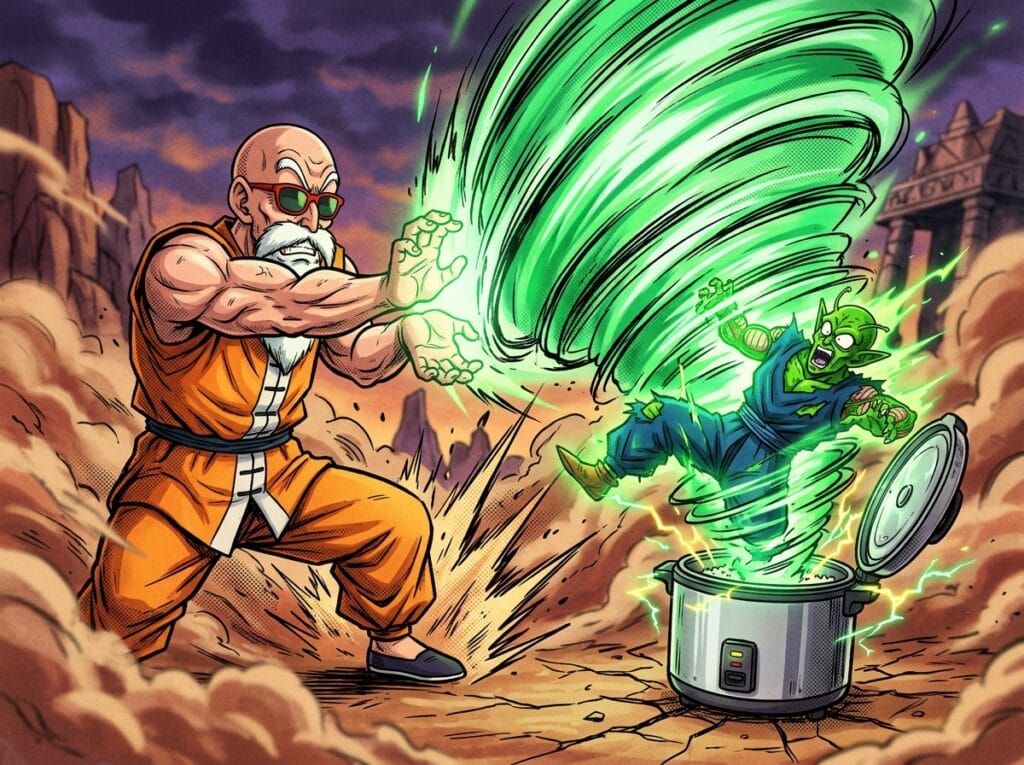
Whenever I think about the deadliest attacks in Dragon Ball, massive energy blasts usually come to mind first. But there is one legendary martial arts move that can defeat unstoppable villains without relying on raw force. When I break down the Mafuba technique, it becomes clear how a weaker warrior can trap a nearly godlike enemy inside a simple jar. Also known as the Evil Containment Wave, this desperate move completely ignores power scaling by capturing a foe within a swirling vortex of energy.
The origin of the move goes back centuries to Master Mutaito, who invented it to stop King Piccolo from destroying the world. Because the demon king was far too strong to defeat in normal combat, Mutaito used his own life energy to seal the villain inside an ordinary electric rice cooker. I find it incredible that a simple household item could save humanity when brute force failed. It remains one of the highest-risk techniques in martial arts history because pulling it off requires total control and can easily cost the user their life.
Key Takeaways
- The Mafuba, or Evil Containment Wave, completely bypasses traditional power scaling by trapping vastly stronger opponents inside simple containers using an energy vortex and a sacred talisman seal.
- Originally created by Master Mutaito to stop King Piccolo, the technique requires immense ki control and carries a high risk of fatal stamina drain for the user.
- Despite its ancient origins, the move remains a critical secret weapon in high-stakes modern battles, successfully countering godlike and immortal threats in Dragon Ball Super when raw force fails.
The Origin of Master Mutaito’s Sealing Move
When King Piccolo brought terror to the world centuries ago, standard martial arts and brute force simply were not enough to stop him. I love looking back at this era because it shows how desperate the situation really was for Earth’s defenders. Master Mutaito, the legendary teacher of Master Roshi and the Crane Hermit, realized he needed a technique that bypassed raw power entirely. Instead of trying to overpower the demon king, Mutaito spent years developing a unique wave of energy that could trap an enemy regardless of their strength. He ultimately sacrificed himself to trap King Piccolo inside a simple electric rice cooker Dragon Ball episode 102, Enter King Piccolo. This marked the birth of the Mafuba, or Evil Containment Wave, as a final resort against terrifying foes.
While the Evil Containment Wave is an amazing move, it comes with a terrifying downside that makes every user think twice before casting it. The technique demands an immense amount of inner ki, which completely drains the caster’s life force during the process. When someone uses the traditional method, the extreme physical strain almost always results in immediate death for the user. I always remind fans that Master Roshi faced this exact fate when he attempted to reseal King Piccolo years later Dragon Ball episode 112, King Piccolos Wish. It is a high-stakes move where saving the world usually costs the warrior their very life.
Even though the Mafuba started as an ancient technique born out of complete desperation, it remains one of the most reliable moves in the entire franchise. What makes it so special to me is how it bridges early martial arts lore with modern Dragon Ball battles against godlike entities. Because the move seals a target away rather than trying to destroy them, power scaling becomes completely irrelevant. Anyone from a mortal master to a modern Z-Fighter can catch a much stronger enemy off guard if their aim is true. This incredible history shows how Master Mutaito’s desperate invention created a lasting legacy that still influences the fate of the universe today.
How the Energy Vortex and Sealing Charm Work

When I look at how the Evil Containment Wave operates, the first striking visual is the massive, bright green energy swirl generated by the user. By gathering deep internal ki, a martial artist projects a violent cyclone of force that sweeps up the opponent, completely stripping away their physical control. What makes this move so amazing is that it completely ignores power scaling, meaning a weaker fighter can trap a cosmic threat inside the swirling funnel. Once the target is caught in the vortex, the user guides the wild beam straight toward an open vessel. I really enjoyed seeing Future Trunks pull off this precise vortex maneuver to trap the immortal Zamasu Dragon Ball Super episode 64, Worship Me! Praise Me! The Explosive Birth of a Merged Zamasu!.
- Gathering internal ki to unleash a swirling green energy funnel.
- Directing the vortex to drag the target inside an everyday container.
- Placing a sacred paper Ofuda talisman over the lid to complete the seal.
Trapping an enemy in the energy swirl is only half the battle because you still need a physical vessel to hold them. Master Mutaito originally used a simple electric rice cooker, proving that almost any everyday object with a lid can act as a prison. However, a physical jar or cooker alone cannot contain a powerful demon or god on its own. To make the trap permanent, the user must place a sacred paper Ofuda talisman over the lid to lock the magic shut. Without that enchanted charm attached to the vessel, the trapped target can easily break out in seconds, which caused major trouble for Goku and Trunks Dragon Ball Super episode 62, I Will Protect the World! Trunks Furious Super Power Blows Up!.
I love how this technique bridges the early days of Earth’s martial arts history with the cosmic battles of today. Long before godlike transformations existed, Master Mutaito created this dangerous move to overcome King Piccolo when raw strength was not enough. Because the technique places an immense strain on the caster’s body, executing it requires total precision and great physical sacrifice. Knowing how to properly channel the vortex while securing the talisman makes all the difference between saving the timeline and falling in battle.
Mafuba Revival in Dragon Ball Super
I love how Dragon Ball Super brought back the Mafuba, showing us that ancient martial arts still have a place alongside divine power levels. When Goku and Future Trunks faced the immortal Zamasu, sheer force was completely useless, which forced our heroes to look back at Earth’s martial arts history for a solution. Goku trained under Master Roshi to master the move, practicing on Turtle until he got the swirling energy vortex down. Later on, Future Trunks learned the technique in seconds by watching a video tutorial recorded by Piccolo on a smartphone. Trunks successfully trapped Zamasu in a jar, proving that this ancient sealing move could counter an immortal god Dragon Ball Super episode 64, Worship Me! Praise Me! The Explosive Birth of a Merged Zamasu!.
The Evil Containment Wave made an even bigger impact during the Tournament of Power, where Master Roshi showed everyone why experience matters. Roshi relied on the technique to eliminate opponents who were far stronger than him, turning the battle in favor of Team Universe 7. The action reached a peak when Frost tricked Roshi and reversed the sealing wave straight onto Vegeta. Master Roshi barely managed to shatter the container with a tiny ki blast to free Vegeta before it was too late Dragon Ball Super episode 107, Revenge F! A Cunning Trap Is Set?. This tense moment highlighted just how dangerous and unpredictable the Mafuba remains in high-stakes modern battles.
Watching these modern warriors adapt Master Mutaito’s creation brought a wonderful touch of original Dragon Ball nostalgia into the new era. I really appreciate how the writers used the move to bypass traditional strength levels instead of just giving characters another power boost. The move still carries immense risk because it drains vital stamina and can easily backfire if the user misses the container or lacks a proper talisman seal. Seeing Roshi, Goku, and Trunks pass down and execute this classic technique proved that smart tactics are just as important as powerful transformations. It cemented the Mafuba as one of the most versatile and timeless martial arts techniques in the whole franchise.
From Rice Cookers to Fighting Gods
Looking back at the entire Dragon Ball storyline, I find it amazing how a humble martial arts technique managed to stay relevant across decades of massive power spikes. What started as Master Mutaito’s desperate invention to seal away King Piccolo in an electric rice cooker eventually became a crucial secret weapon against literal gods in Dragon Ball Super. The Evil Containment Wave perfectly bridges the gap between classic Earth-bound martial arts and the modern cosmic battles we see today. It reminds us that strategy, skill, and ancient wisdom can still rival raw God ki when absolute power fails. By completely ignoring traditional power levels, this risky move gives smaller heroes a real chance to turn the tide against seemingly invincible threats.
In my opinion, the true legacy of the Mafuba lies in its emotional weight and high stakes. Every time a fighter decides to unleash this swirling green vortex, you know they are placing their very life on the line for the greater good. It brings back that classic feeling where martial arts relied on sacrifice and clever gadgets rather than just who can throw the biggest energy blast. Seeing modern powerhouses like Goku and Master Roshi dust off this vintage move keeps the series connected to its roots. Ultimately, the Evil Containment Wave remains one of my absolute favorite techniques because it proves that traditional martial arts lore will always have a sacred place in the universe.
Frequently Asked Questions
1. What is the Mafuba technique in Dragon Ball?
The Mafuba, also known as the Evil Containment Wave, is a special martial arts move designed to trap powerful enemies inside a container regardless of their strength. I love how it completely ignores power levels to seal away villains who are otherwise impossible to beat. Master Mutaito invented it long ago to save the world from total destruction.
2. Who invented the Mafuba technique?
Master Mutaito created the Mafuba hundreds of years ago as a last resort to defeat King Piccolo. He realized that brute force was not enough to win, so he developed this move to trap the demon king inside a simple rice cooker. You can see this legendary backstory revealed in Dragon Ball episode 102, Enter King Piccolo.
3. Does using the Mafuba always kill the user?
Using the Mafuba does not always kill the user, but it takes a massive toll on their stamina and life force. If a fighter drains all their energy while performing the attack, the extreme physical strain will end their life. Master Mutaito unfortunately died when he used it to seal away King Piccolo Dragon Ball episode 102, Enter King Piccolo.
4. What kind of container do you need for the Mafuba?
You can use almost any ordinary container with a lid, as long as you place a special paper talisman on it to lock the seal. I find it incredible that Master Mutaito used a simple household electric rice cooker to hold a terrifying demon king. The vessel just needs to be closed tightly so the trapped enemy cannot escape.
5. Why is the Mafuba so effective against stronger villains?
The Mafuba is so effective because it bypasses raw power entirely by swirling an opponent into a targeted beam of energy. It does not matter if a villain is vastly stronger than you because the move forces them into a container rather than fighting them head-on. This makes it one of the most useful secret weapons in martial arts history.
6. What happens if you miss while using the Mafuba?
If you miss the container or fail to seal it correctly, the move completely fails and wastes your energy. Because the technique drains so much life force, missing your target can leave you completely exhausted or even dead. That is why I always view it as one of the highest-risk moves in the entire series.
7. Can a villain break out of the Mafuba once trapped?
Once a villain is trapped and the talisman seal is attached to the container, they cannot break out using their own power. However, if the paper seal gets damaged or removed, the trapped villain can easily burst out. Someone on the outside usually has to open or destroy the vessel to set them free.