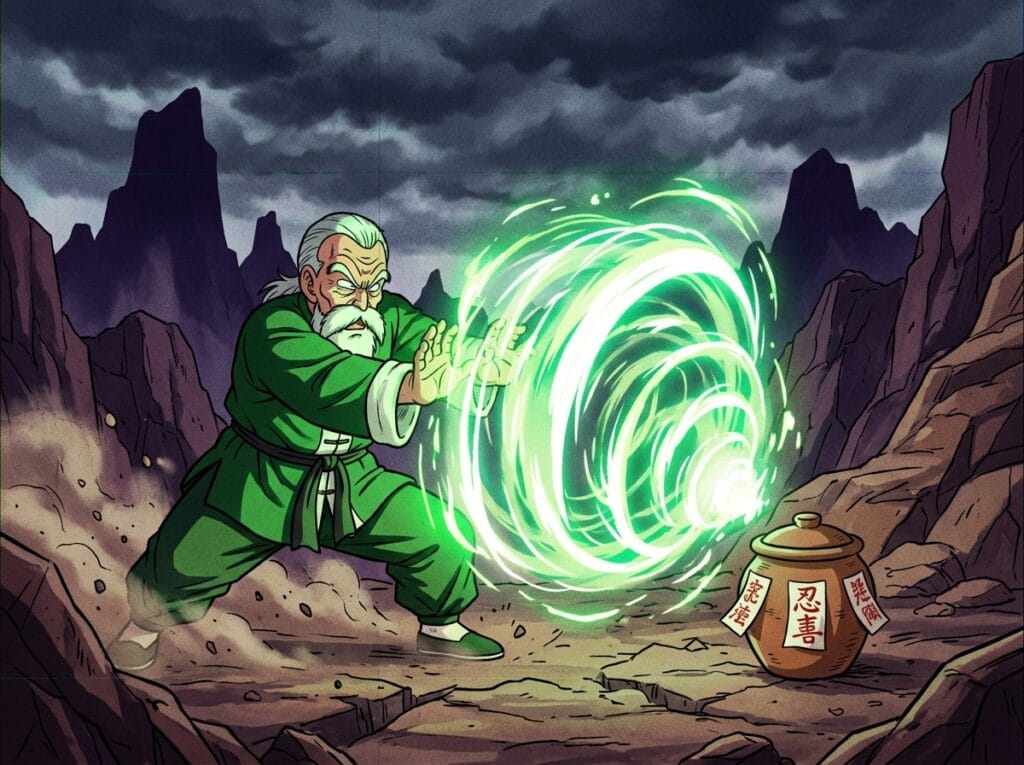
Imagine facing an enemy so powerful that even your strongest attacks can’t leave a scratch. When brute force fails against immortal villains, the legendary Evil Containment Wave becomes the ultimate solution for our favorite heroes. This ancient technique, also known as the Mafūba, allows a fighter to trap a massive threat inside a simple container using a swirling vortex of energy. It’s one of the most unique moves in the series because it relies on skill and precision rather than just raw power levels.
I’ve always been fascinated by how a humble rice cooker or a small glass jar can become a prison for the most dangerous beings in the universe. Originally created by Master Mutaito to stop a demonic threat, this move has made a massive comeback as a strategic secret weapon against modern gods. While it is incredibly taxing on the user’s life force, the high risk makes every attempt feel intense and desperate. Understanding the mechanics of the seal and the necessity of the talisman helps you appreciate just how much is at stake whenever this green energy starts to fly.
Key Takeaways
- The Evil Containment Wave (Mafūba) serves as the ultimate equalizer by bypassing raw power levels and immortality to trap enemies through precision and skill.
- Executing the technique requires a physical container and a magic paper talisman (Ofuda), the latter of which acts as a vital supernatural lock to prevent the target from escaping.
- The move carries a high risk of death for the user because it drains massive amounts of life force to compress and redirect a powerful opponent’s energy.
- Strategic mastery and ancient wisdom often prove more effective than modern transformations, allowing experienced martial artists to neutralize god-tier threats that cannot be defeated by brute force.
Origins Of The Master Mutaito Demon Seal
The history of the Mafūba begins with Master Mutaito, who realized that raw strength alone could not defeat the pure evil of King Piccolo. After seeing his students fall and his world burn, Mutaito went into isolation to develop a technique that could bypass a demon’s power level entirely. He eventually created the Evil Containment Wave, a move that uses the user’s own life force to create a swirling vortex of energy. This energy traps the target and forces them into a small container like an electric rice cooker, which is then sealed with a magic talisman. This desperate measure was the only way to save the world when traditional martial arts failed as shown in Dragon Ball episode 102, Krillins Efforts.
Using this technique is incredibly dangerous because of the massive physical and spiritual toll it takes on the body. In the early days of the series, the Mafūba was known as a suicidal move because the energy required to swirl and compress such a powerful enemy often exceeded the user’s own stamina. When Master Mutaito first used it to trap King Piccolo, the sheer strain of the technique caused his heart to stop immediately after the seal was placed. It serves as a reminder that some of the most effective moves in the series are not about who has the higher power level, but who is willing to sacrifice everything to protect others. This legacy of sacrifice is a major reason why the move carries such weight even in modern battles today.
Essential Mechanics Of Containers And Talismans

The magic behind the Evil Containment Wave relies on a unique blend of energy manipulation and physical tools to bypass an enemy’s raw strength. While the green vortex does the heavy lifting of shrinking and pulling a target into a vessel, the container itself is just a temporary cage. Without the proper preparation, even a god-tier opponent could simply burst out of a rice cooker or glass jar the moment they are inside. This is why the technique is so distinct, as it focuses on trapping the essence of a being rather than just overpowering their physical body. Master Mutaito originally developed this method specifically to handle threats that could not be killed by traditional martial arts Dragon Ball episode 102, Under Blue Skies.
The most critical component of this process is the paper talisman, or Ofuda, which acts as a supernatural lock. Once the target is vacuumed into the container, the user must quickly slap this seal onto the lid to finalize the enchantment. Without this special paper, the pressure of the enemy’s power would immediately shatter the vessel and set them free. We saw how vital this step was when Goku forgot the seal during the fight against Zamasu, leading to a disastrous escape Dragon Ball Super episode 64, Worship Me! Give Praise Unto Me! The Birth of a Merged God. It is a high-stakes game of speed and precision where the smallest oversight can render the entire life-draining effort useless.
Choosing a container is surprisingly flexible, proving that the magic lies in the ritual rather than the object’s value. From the classic electric rice cooker used against King Piccolo to the small glass jars utilized in later battles, anything that can be sealed will work. The beauty of this mechanic is that it levels the playing field against immortal enemies who laugh at physical attacks. By turning a powerful villain into a captive within a common household item, the Mafuba remains one of the most clever strategies in the series history. This technique reminds us that strategy and ancient wisdom can often overcome even the most overwhelming power levels Dragon Ball episode 111, Mother Conquers All.
Resurgence Against The Immortal Future Zamasu
When Goku and Future Trunks realized that Zamasu’s immortality made him impossible to defeat with brute force, they had to look back at the history of martial arts for a solution. In Dragon Ball Super episode 62, I Will Protect the World!, the story shifts from relying on raw power to using a clever strategy from the original series. Goku returns to the present to learn the Mafuba from Master Roshi, proving that even modern gods have a weakness. This move is perfect for this situation because it doesn’t matter how much energy Zamasu has if he is trapped inside a simple jar. It was a refreshing change of pace to see an old technique become the most dangerous weapon against a divine threat.
The execution of the move requires more than just energy, as it relies on a specific container and a special paper talisman to keep the enemy locked away. Trunks takes on the responsibility of performing the wave in the future while Goku provides the necessary distraction. Even though they are facing a literal god who can heal from any physical wound, the swirling green vortex of the Mafuba completely bypasses his invincibility. This moment highlights how important tactical skill is in the series, especially when power levels alone aren’t enough to save the world. It reminds us that the wisdom of the past is often the only way to handle the challenges of the future.
Master Roshi Tactical Mastery In The Tournament

I was absolutely blown away by how Master Roshi proved that experience and strategy can still outshine raw power in the Tournament of Power. Even though he was facing opponents with much higher energy levels, he turned to the Mafuba to level the playing field. This technique is so special because it doesn’t care about how much muscle a fighter has or if they are immortal. By using this green energy vortex, he was able to trap dangerous enemies like Caway and Dercori without having to trade punches with them. It really showed that the Turtle Hermit is still a genius on the battlefield Dragon Ball Super episode 105, Brave Fight! Muten Roshi Stakes His Life!.
Watching Roshi manage his stamina while preparing the containers was a masterclass in tactical fighting. He knew that the Evil Containment Wave takes a massive toll on his life force, so he had to be extremely precise with every move. This resurgence of the sealing technique reminds us that there are ways to win a fight that don’t involve just getting a new transformation. He successfully removed eternal threats from the ring and protected his teammates by using his brain instead of just his fists. It was a proud moment for fans to see such a classic move become one of the most effective tools in a multiversal tournament Dragon Ball Super episode 105, Brave Fight! Muten Roshi Stakes His Life!.
How Strategy Defeats Raw Power
Ultimately, the Evil Containment Wave stands out as the most unique strategy in the franchise because it completely ignores the standard rules of power levels. While most battles in the series come down to who can punch harder or fire a bigger energy blast, the Mafuba provides a tactical way to win through skill and preparation. It is one of the few techniques that can actually neutralize an immortal threat like Zamasu, proving that strategy can sometimes trump raw strength. I love that this move brings a sense of danger back to the series by showing that even the strongest gods have a weakness that can be exploited with the right tool.
Seeing this classic move return in recent arcs has been a fantastic reminder of the series’ roots and its creative potential. It bridges the gap between the grounded martial arts of the original story and the cosmic stakes of the modern era. By requiring a physical container and a paper charm, it adds a layer of tension that just doesn’t exist in a typical beam struggle. I believe the Evil Containment Wave remains the ultimate equalizer for our heroes whenever they face an enemy that simply cannot be killed. It is a perfect example of how a clever technique can be much more memorable than a new transformation, much like the evolution of Piccolo from a rival to a dedicated ally.
Frequently Asked Questions
1. What exactly is the Evil Containment Wave?
The Evil Containment Wave, also called the Mafūba, is a special martial arts technique that creates a green energy vortex to suck an enemy into a small container. It allows a fighter to defeat a much stronger opponent by trapping them instead of trying to overpower them with physical hits. This move is unique because it focuses on using your life force to control the target’s movement Dragon Ball episode 102, Krillins Efforts.
2. Who was the person that invented this technique?
Master Mutaito created this technique centuries ago after he realized he couldn’t beat the original King Piccolo with normal fighting skills. He spent years in isolation developing a way to seal away pure evil when brute force failed. His sacrifice saved the entire world from a demonic takeover Dragon Ball episode 102, Krillins Efforts.
3. Is using the Mafūba dangerous for the person performing it?
Yes, it is extremely dangerous because the move drains a massive amount of physical and spiritual energy from your body. In many cases, the strain on the user’s life force is so heavy that they can die immediately after successfully sealing their enemy. It is considered a last resort move because of the high risk involved for the fighter Dragon Ball episode 102, Krillins Efforts.
4. What kind of items can be used to trap an enemy?
You can use almost any sealable container, but the most famous example is a simple electric rice cooker. Other items like small glass jars or bottles can also work as long as they can hold the energy vortex. The container itself is just a physical shell to keep the spirit contained Dragon Ball episode 102, Krillins Efforts.
5. Why is a paper talisman necessary for the seal?
The paper talisman acts as the final lock that keeps the evil presence from breaking out of the container. Without this enchanted seal, the trapped villain can simply push the lid open and escape back into the world. It is the most critical part of the process because even a perfect energy wave fails without it Dragon Ball episode 102, Krillins Efforts.
6. Can this move work against immortal gods or villains?
The Evil Containment Wave is one of the few techniques that can actually stop an immortal being who cannot be killed by normal means. Since it bypasses power levels and physical durability, it is the perfect strategic weapon for dealing with modern gods or indestructible threats. This makes it a significant advantage when heroes face enemies they can’t scratch Dragon Ball episode 102, Krillins Efforts.