
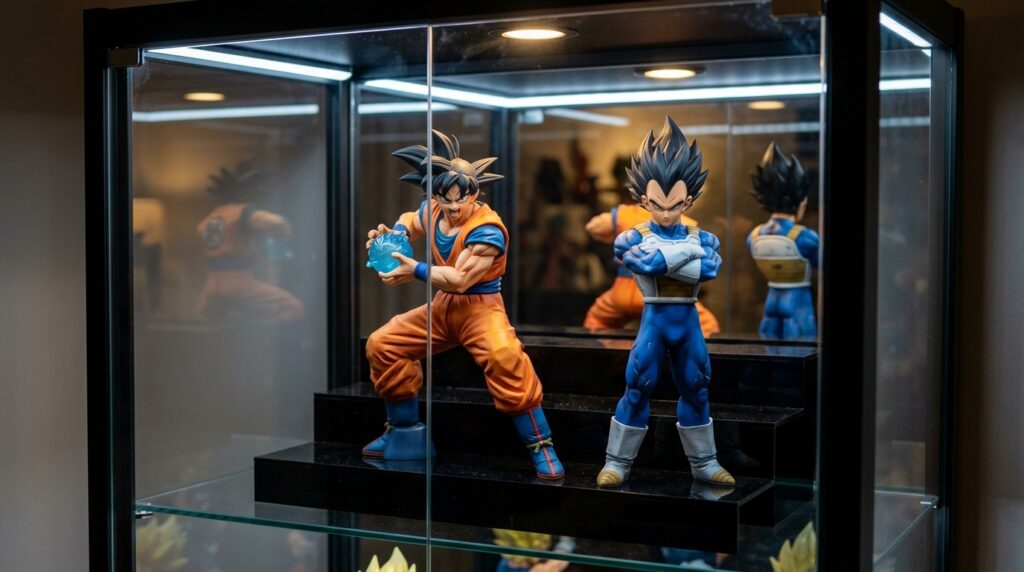
Dragon Ball display cases range from a $52.50 wall-mounted acrylic box for a single figure to a $179.99 IKEA FABRIKÖR cabinet built for a larger collection. The right choice depends on how big your figures are. Dragon Ball collectibles vary widely, from roughly 17 cm figures with effect parts to a 46 cm Goku statue, so measure case height and usable shelf depth against the figure, its base, and any accessories before you buy. A case that looks roomy on paper can still crowd a tall statue or a set of Kamehameha effect parts.
Protection matters just as much as fit. Dust and sunlight are everyday threats to painted figures, and light damage builds with both brightness and time. The Canadian Conservation Institute uses 50 lux as its historical museum benchmark, a handy yardstick when you compare a lit cabinet with a sunny window. Prices also vary. The budget IKEA BAGGEBO glass-door cabinet lists at $64.99, while the lit BLÅLIDEN setup with its spotlight costs $154.99, so it helps to know which features are worth paying for.
Key Takeaways
- Collectors should measure their tallest Dragon Ball figure on its base, add any effect parts, and leave clearance before buying, since a 46 cm Dragon Ball Z Gigantic Series Super Saiyan Son Goku calls for a generous case.
- The IKEA FABRIKÖR at $179.99 suits large collections because each of its adjustable shelves holds up to 22 lb, while each shelf of the IKEA BLÅLIDEN is limited to 7 lb.
- The IKEA BAGGEBO glass-door cabinet at $64.99 is a sensible first case for a small starter collection, though it has no built-in lighting.
- Owners should keep every display case out of direct sunlight and choose UV-filtered acrylic or glass, because light damage to painted figures builds with both brightness and time.
- Owners of lit cabinets should prefer LED lighting without ultraviolet output and switch the spotlight off when they leave the room to limit light exposure.
Matching Case Height and Depth to Your Largest Figure
The tallest piece in your collection sets the minimum height for your case. Dragon Ball collectibles run from roughly 17 cm figures with effect parts up to a 46 cm Goku statue. The Dragon Ball Official Site lists the Dragon Ball Z Gigantic Series Super Saiyan Son Goku at about 46 cm tall, so that piece alone calls for a generous case. Measure it on its base, include any stand, and leave some clearance so the lid or glass doesn’t press against the head.
Depth is where many collectors get caught out. The Figuarts ZERO Son Goku & Bulma stands about 170 mm tall, but its clear effect parts extend the footprint in front of the figure. Measure the figure, base, and accessories together, then arrange them the way you plan to display them. A piece that fits on paper can still crowd its neighbors once the effect parts go on the shelf.
Four criteria guided the picks in this guide:
– Published dimensions: Cases should list outer and usable interior measurements so you can compare them directly with your tallest figure. – Shelf load limits: One lit cabinet allows 7 lb per shelf, while a larger model allows 22 lb. Add up the weight of statues and bases before loading a shelf. – Lighting specifications: Look for wattage, lumen output, and UV filtering rather than vague descriptions like “bright.” – Price relative to size: Compare cost against usable shelf space, not just the sticker price.
Lighting needs a closer look. A spotlight rated at 115 lumens sounds impressive, but light damage depends on both intensity and how long figures are exposed each day. The traditional museum guideline of keeping ultraviolet radiation below 75 µW/lm is a useful yardstick when comparing lit cases. The U.S. National Archives prefers LED sources without ultraviolet output for exhibit cases, and it advises keeping incandescent and halogen lamps out of them entirely.
IKEA BAGGEBO Glass-Door Cabinet for Small Collections
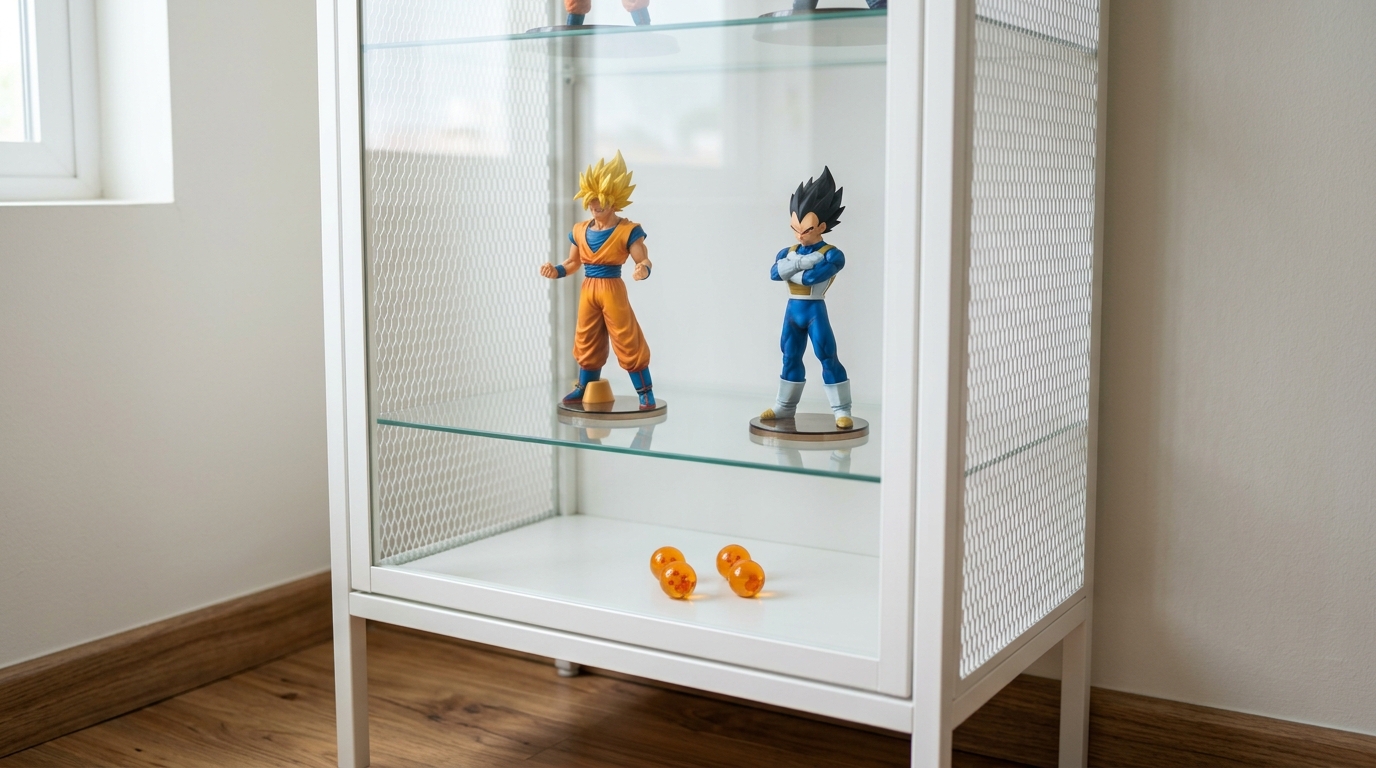
The BAGGEBO is the most affordable glass-door option in this guide, and it makes a sensible first case for many collectors. In the U.S. market it lists at $64.99 and measures 13 3/8 × 11 3/4 × 45 5/8 inches, so it fits on a spare wall shelf or in a corner without dominating the room.
The glass doors do the main job. They keep dust off painted faces and accessories while leaving every figure visible, which is often the reason collectors want a case in the first place. Because the doors are see-through, you can rotate pieces on the shelves and still show off your favorites.
The cabinet suits a few kinds of collections best:
- Starter collections of smaller figures
- Shelves or corners where footprint matters more than height
- Displays that need dust protection but no built-in lighting
The drawbacks are worth weighing before you buy. There is no built-in lighting, so figures depend entirely on the light already in the room, and a separate fixture adds cost and setup time. The narrow 11 3/4 inch depth also leaves limited room for effect parts placed in front of a figure, and a large statue will crowd the interior quickly. If your collection includes bigger pieces or a lot of accessories, the BAGGEBO will feel tight in a short time.
IKEA BLÅLIDEN and STRIMSÄV Lit Display Cabinet
The BLÅLIDEN cabinet paired with the STRIMSÄV spotlight is the lit option in this guide, and IKEA’s U.S. listing puts the set at $154.99. The cabinet measures 13 3/4 × 12 5/8 × 59 1/2 inches, about 14 inches taller than the BAGGEBO, which gives you a tall interior for a shelf of mid-sized figures.
Lighting is the main reason to choose this setup. The spotlight draws 1 W and is rated at 115 lumens, which should help show sculpted hair, facial detail, and paint work that gets lost in a dim room. Brightness is only part of the picture, though. How much light a figure receives depends on where the spotlight sits, how far the figure is from it, and which way the figure faces, so test the placement with your own pieces before you settle on a shelf.
Shelf load is the trade-off to plan around. Each shelf holds a maximum of 7 lb, which a few mid-sized figures can handle easily, but a large statue with its base may exceed that limit on its own. Weigh your pieces before loading a shelf, and keep the heaviest ones on the lowest level, where a fall does the least harm.
Light exposure also adds up over time. Illuminance is measured in lux, and total exposure is the illuminance multiplied by the hours a figure spends lit each day. A cabinet that runs for long evenings accumulates more exposure than one lit only when you want to look at it, so switching off the spotlight when you leave the room is a simple habit that helps.
The cabinet suits a particular kind of collector best:
- Shelf displays of mid-sized figures that benefit from showcase lighting
- Collectors who can keep heavier statues on a lower shelf or in another room
- Owners with space to position the spotlight away from the glass and avoid glare
IKEA FABRIKÖR for Larger Dragon Ball Collections
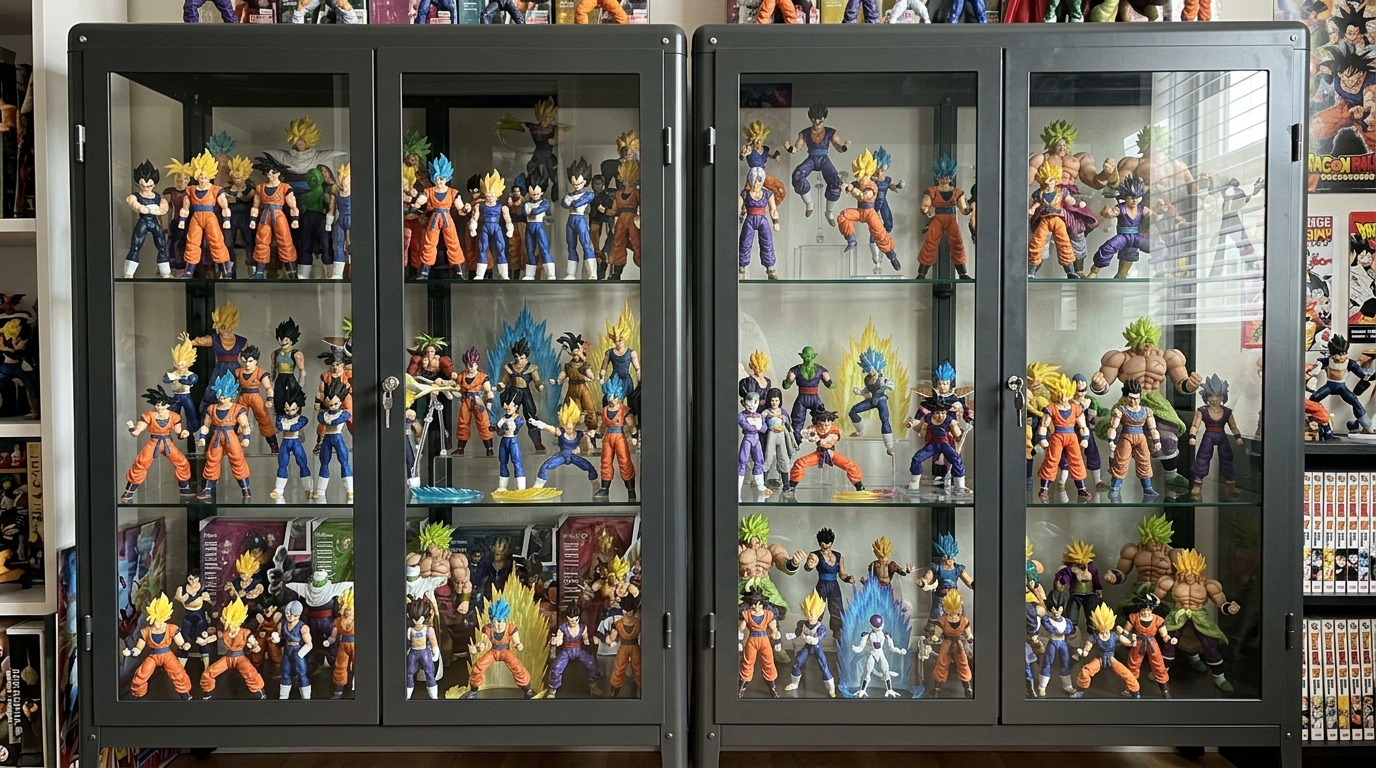
The FABRIKÖR is the widest cabinet in this guide. In the U.S. market it lists at $179.99 and measures 22 1/2 × 18 1/2 × 59 inches, giving a large collection far more room than the smaller cases above.
The adjustable shelves are the main reason to consider it. You can set each level to the height your pieces need, so a tall statue can have its own space while boxed figures and loose effect parts sit on lower shelves. Because the shelves can be moved, the layout can change as the collection grows instead of being fixed around one interior.
The load rating also stands out. Each FABRIKÖR shelf holds up to 22 lb, more than three times the 7 lb limit on the BLÅLIDEN. A heavy statue on its base can sit on a shelf without pushing it near the maximum, which makes this cabinet a better fit for big pieces.
The trade-off is size. At roughly 9 inches wider and nearly 6 inches deeper than the BLÅLIDEN, it has the largest footprint of the group, so it needs a clear section of wall or floor. Measure the spot before ordering, and anchor the cabinet to the wall because of its 59-inch height.
It suits collectors who:
- Own several statues that need tall, separate shelf spaces
- Mix boxed figures, loose figures, and effect parts on one display
- Have a wall or corner that can take a wide, tall cabinet
GameDay Display Wall-Mount Acrylic Case for Single Figures
The wall-mounted acrylic case is the smallest and simplest option here, built around one figure rather than a shelf of them. A case designed for a 12-inch or 1:6-scale action figure typically sells for around $52.50, which is less than the BAGGEBO and far below the lit BLÅLIDEN setup. Its approximate outer dimensions are 14.125 inches tall, 5.25 inches deep, and 7.125 inches wide, so it occupies a narrow strip of wall rather than a cabinet’s full footprint.
The case is made from standard UV-protecting acrylic. The clear front keeps dust off the figure while leaving every sculpted detail visible, and the UV-filtering material suits a piece that sits near a sunny window. Acrylic is also lighter than glass, which makes mounting easier, though you should confirm the hardware suits your wall type before hanging it.
The main drawback is fit. The case is sized for figures near 12 inches or 1:6 scale, so it does not suit most Dragon Ball figures, which are often smaller or larger. A 46 cm statue will not fit at all, and a smaller figure with effect parts may look lost inside a box built for a much bigger body.
It works best for:
- A single centerpiece figure near 12 inches or 1:6 scale
- A narrow wall space or shelf where a cabinet would not fit
- A favorite figure you want shielded from dust without boxing it away
Because the case holds only one figure, there is no shelf load to calculate and no lighting to manage. The trade-off is that any light comes from the room itself, so placement matters. Keep the case out of direct afternoon sun, since UV-protecting acrylic is only one part of the protection a figure needs.
Lighting and UV Protection for Display Cases
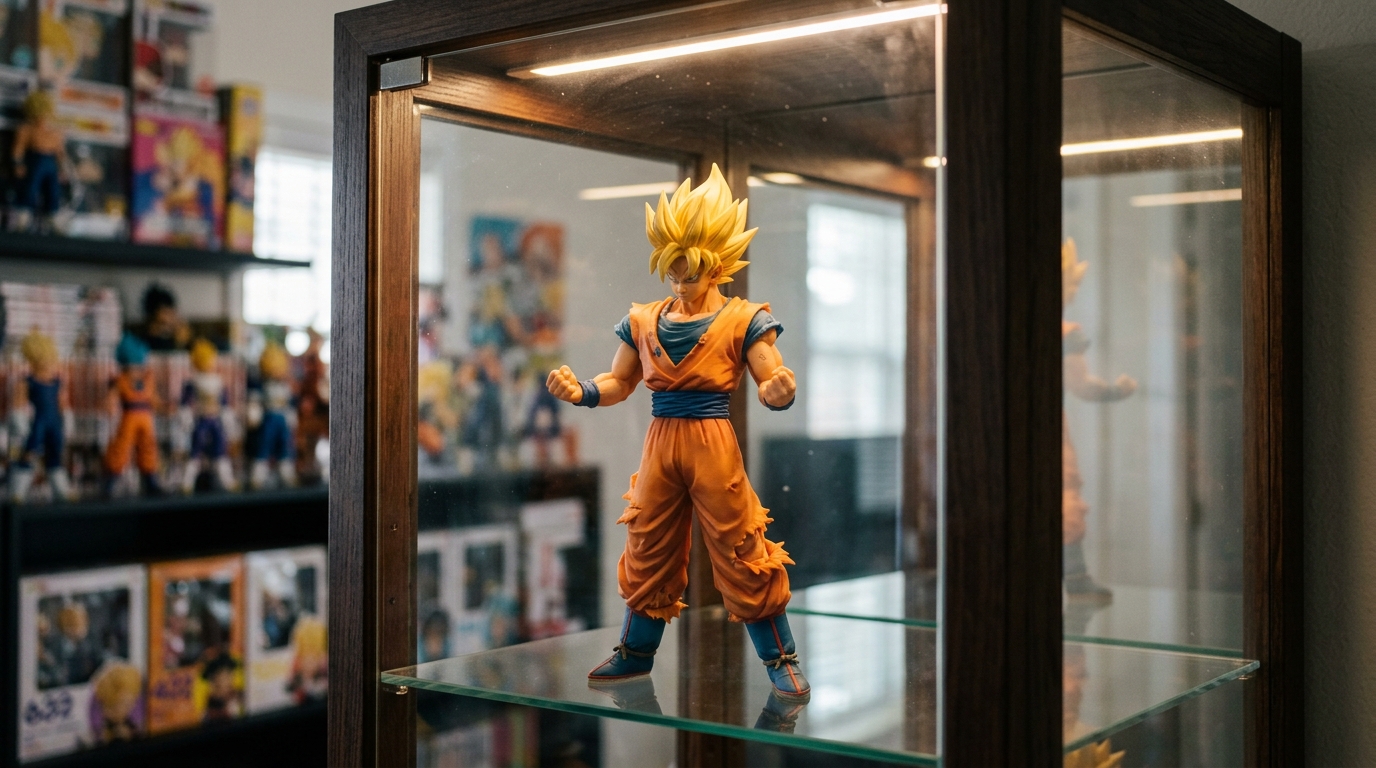
Light is one of the quieter threats to painted figures. Its effect builds with two things: how bright it is, measured in lux, and how long a figure sits in it. Multiply the illuminance by the hours of exposure and you get the total dose a figure receives. A spotlight that runs for a few hours on weekends adds up very differently from one left on every evening.
Ultraviolet light deserves separate attention. The traditional museum guideline keeps ultraviolet radiation below 75 µW/lm, so a case should limit UV through its materials rather than rely on the room around it. That is why the UV-protecting acrylic in the GameDay case matters for a figure near a window. For glass cabinets, check the product details for UV filtering instead of assuming it is there.
Lamp type matters as well. Exhibit guidance prefers LED lighting without ultraviolet output, or fiber-optic light with UV filtering, and it advises keeping incandescent and halogen lamps out of cases altogether. If a lamp must sit inside, the same guidance asks for at least 36 inches between it and the displayed items. None of the cabinets in this guide offers that much depth. The BLÅLIDEN is 12 5/8 inches deep and the FABRIKÖR is 18 1/2 inches, so an internal spotlight will sit close to the figures wherever you place it. Read the spotlight’s specifications for an LED or UV-free rating before you rely on it.
A few practical habits reduce exposure:
– Keep every case out of direct sunlight, especially where afternoon sun lands on the shelves for hours. – Choose UV-filtered acrylic or glass, and confirm the filtering in the listing. – Angle built-in lights across the figure rather than aiming them straight at the face, and switch them off when you leave the room.
Side-by-Side Comparison of the Four Display Cases
The table below compares the four picks across the details that matter most when you’re choosing a case. Cells are left blank where the listings didn’t specify a value.
| Case | Price | Dimensions | Max Shelf Load | Lighting | Best For |
|---|---|---|---|---|---|
| IKEA BAGGEBO | $64.99 | 13 3/8 × 11 3/4 × 45 5/8 inches | Small starter collections where footprint matters most | ||
| IKEA BLÅLIDEN with STRIMSÄV | $154.99 | 13 3/4 × 12 5/8 × 59 1/2 inches | 7 lb per shelf | 1 W spotlight, 115 lumens | Mid-sized figures that benefit from showcase lighting |
| IKEA FABRIKÖR | $179.99 | 22 1/2 × 18 1/2 × 59 inches | 22 lb per shelf | Large collections with tall statues and adjustable shelves | |
| GameDay Display wall-mount acrylic case | $52.50 | 14.125 inches tall × 5.25 inches deep × 7.125 inches wide | One centerpiece figure near 12 inches or 1:6 scale |
Prices are U.S. figures from the listings reviewed. Dimensions are the published measurements for each product, so check them against your tallest figure, its base, and any effect parts before ordering.
Choosing the Right Case for Your Dragon Ball Shelf
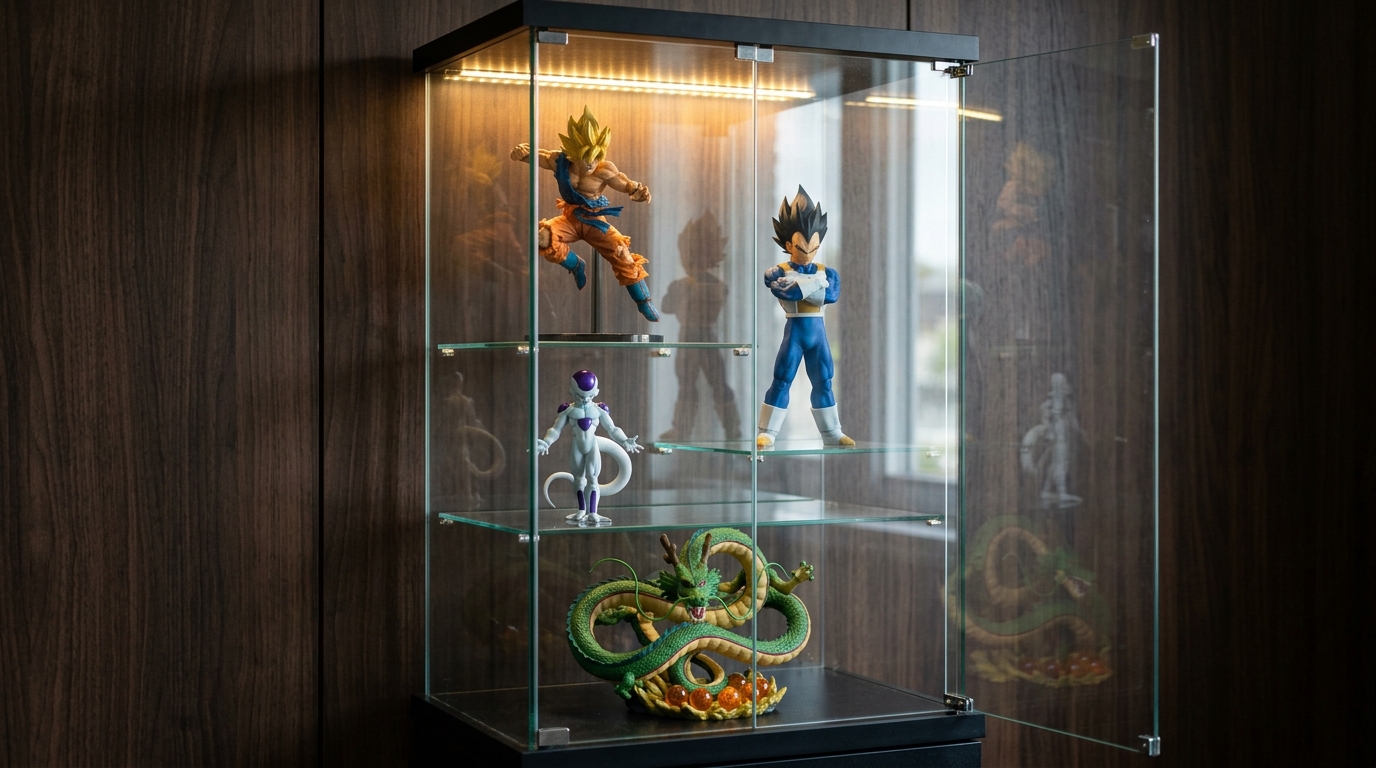
The IKEA FABRIKÖR is the best choice for most collectors whose shelves include statues. Its adjustable shelves let a tall piece have its own level, and its shelf rating handles a heavy figure on its base. If you’re starting with a small set of figures, the IKEA BAGGEBO is the more sensible first purchase, since its glass doors protect a few pieces without taking up much wall space.
Before you order, measure your tallest figure on its base and add the height of any effect parts it will display with it. Compare those numbers with the usable interior of the case, not only the outer size printed on the listing.
Next, weigh your heaviest figure on each shelf and make sure the total stays under that shelf’s rated limit. Put the heaviest pieces on the lowest level, where a fall does the least damage.
Finally, choose a spot away from direct sunlight, since afternoon sun brings both ultraviolet light and heat to painted surfaces. If your cabinet has a spotlight, choose one with LED output and angle it across the figure rather than straight at its face.
Picking Your First Dragon Ball Display Case
Start with a tape measure and the figure you value most. Stand it on its base, add any effect parts you plan to display beside it, and write down the total height and the depth the group occupies. Then measure the wall or shelf where the case will sit, leaving room to open the doors or lift the lid.
Next, match those numbers to a case. If your collection is still small, the $64.99 IKEA BAGGEBO protects a few pieces without taking over the room. If you already own a statue like the 46 cm Dragon Ball Z Gigantic Series Super Saiyan Son Goku, rule out anything shorter than its height plus base and clearance, and look at the FABRIKÖR’s 59-inch overall height first.
Then check the specifications on each listing. Confirm the usable interior dimensions, the shelf load rating, and whether any lighting is LED or UV-filtered. Add up the weight of your heaviest piece on its base and compare the total with the shelf limit before you commit.
Once the case arrives, place your figures inside for a few days before you fix the shelf heights or angle any lamp. Watch how the light falls across the faces, and check whether the effect parts crowd their neighbors. Those small adjustments will tell you more than any listing can.
Frequently Asked Questions
1. Can acrylic display cases yellow or cloud over time, and how can I prevent it?
Acrylic can yellow or take on a hazy, cloudy look after years of sun exposure, and fine scratches can make it look dull as well. Keeping the case out of direct sunlight is the most effective way to slow this down, even if the acrylic has UV protection. Clean it with a soft microfiber cloth and a cleaner made for plastics, and avoid abrasive pads and harsh solvents that leave marks.
2. Is glass or acrylic safer for a home with children or pets?
Acrylic is generally the safer choice in a home with children or pets because it is much less likely to shatter than glass. When acrylic does crack, it is less likely to throw sharp shards that could cause injury. Glass resists scratches better and keeps a crisper look over time, but a hard knock from a ball or a pet can break it. Either way, anchor the case to the wall so it cannot tip over.
3. Can I place figures on top of a cabinet, and does that change the safety of a tall statue?
Light figures can sit on top of a cabinet, but the top is not a shelf, and the shelf load limits in this guide do not apply to it. A tall statue raises the center of gravity, so a bump to the cabinet or a curious pet could knock it off. Keep heavy statues on the lower interior shelves, where they are supported and sit lower, and anchor the cabinet to the wall.
4. Should I keep figures in their original boxes inside a case or take them out?
Leaving figures in their boxes protects them from dust and handling, but it hides the sculpt and paint work that a glass case is meant to show. Many collectors display figures out of the box and store the packaging flat nearby, since boxes take up a lot of shelf depth. If you keep a box, make sure it fits within the usable interior of the case before you load the shelf.
5. How often should I dust a display case, and what cleaner is safe for figure paint?
Dust the case whenever a visible film builds up on the glass, the acrylic, or the figures themselves. A soft, dry brush or a microfiber cloth is the gentlest choice for painted surfaces. Avoid alcohol, solvents, and strong household sprays on figure paint, and test any cleaner on a hidden spot first, since glass cleaners can also leave a film on acrylic.

