
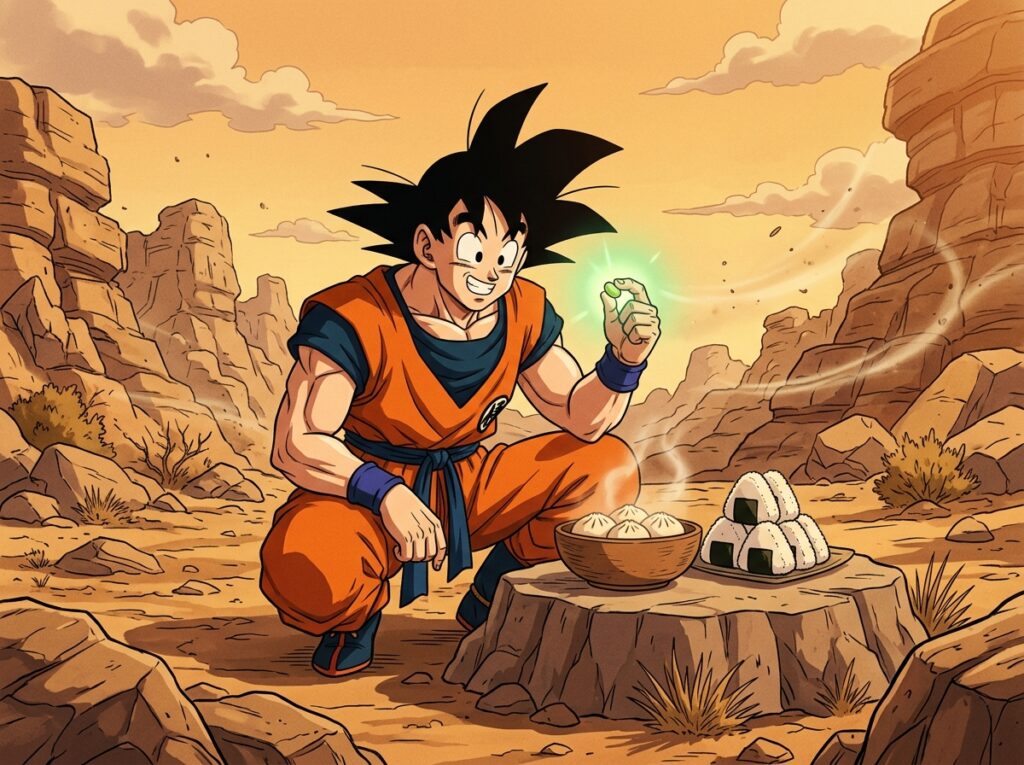
Dragon Ball food names are some of the franchise’s most fun details, and two of the best known belong to Tenshinhan and Chaoz. Tenshinhan takes his name from tenshinhan, a crab-meat omelet served over rice. Chaoz is named after jiaozi, the dumplings many people know from Chinese restaurants. Food runs through the whole series, from rice balls and noodles to steaks and large fish cooked over an open flame.
Goku’s appetite is the most talked-about food moment. After the 21st Tenkaichi Budokai, he ate roughly the portions of 50 people and ran up a restaurant bill of 470,000 Zeni, which nearly used up Master Roshi’s tournament prize money. Food also does serious work in the story. A single Senzu Bean keeps a person full for 10 days and can heal injuries, and the series’ stranger meals, from Majin Buu’s candy transformations to Cell’s energy-stealing feast, add a darker twist. Fans have even gotten real-world snacks, including 18 rubber-keychain designs that went on sale in Japan on September 29, 2025. Below, we look at the everyday staples, the hearty meals, the unusual sources of nourishment, and the licensed treats you can find today.
Key Takeaways
- Tenshinhan takes its name from tenshinhan, a crab-meat omelet served over rice, while Chaoz is named after jiaozi, the dumplings many people know from Chinese restaurants.
- Rice, bread, and noodles are the main everyday staples in Dragon Ball, according to the Dragon Ball Official Site’s food feature.
- Goku ate the portions of 50 people after the 21st Tenkaichi Budokai, and his 470,000 Zeni restaurant bill nearly used up Master Roshi’s tournament prize money.
- A single Senzu Bean keeps a person full for 10 days and can also heal injuries.
- Dragon Ball 40th Anniversary Rubber Mascot Biscuits, which include 18 rubber-keychain designs, went on sale in snack stores across Japan on September 29, 2025.
Which Foods Show Up Most in Dragon Ball?
These three staples turn up in home kitchens, restaurants, and quick bites throughout the series, and several characters are closely tied to one of them.
Bread is most often linked to Bulma from West City. The food feature notes that she often eats it, which makes sense for a character who lives in a busy city full of modern conveniences. Bread is easy to grab on the go, so it suits her fast-paced life.
Noodles tell a more regional story. Chi-Chi, Gyumao, and Yamcha come from southeastern regions, and they are often shown eating noodles. A noodle bowl on screen is a quiet clue about where a character comes from, so noodles work as a small piece of world-building.
Rice balls are the most widespread staple of all. They appear throughout the series and are eaten by many different characters, not just one group or region. Their compact shape makes them easy to carry, which is why they fit so well into the travel and training scenes that fill the story.
Meat and fish fill out the bigger meals. The food feature describes sizable steaks, bone-in legs and shanks, and large fish cooked over an open flame or served in a hot-pot soup. Mr. Satan’s steak is one of the meals Majin Buu is said to enjoy, which shows that hearty dishes are part of the series’ humor as well as its world.
Drinks are just as varied. Coffee, cream soda, alcoholic drinks, and milk all appear in the series. Milk is the most surprising of the group, since the food feature notes that in some regions it is delivered by helicopter because demand is so high. That detail is a good reminder that Dragon Ball’s food world has its own rules, even when the dishes look familiar.
Why Do Some Dragon Ball Characters Have Food Names?
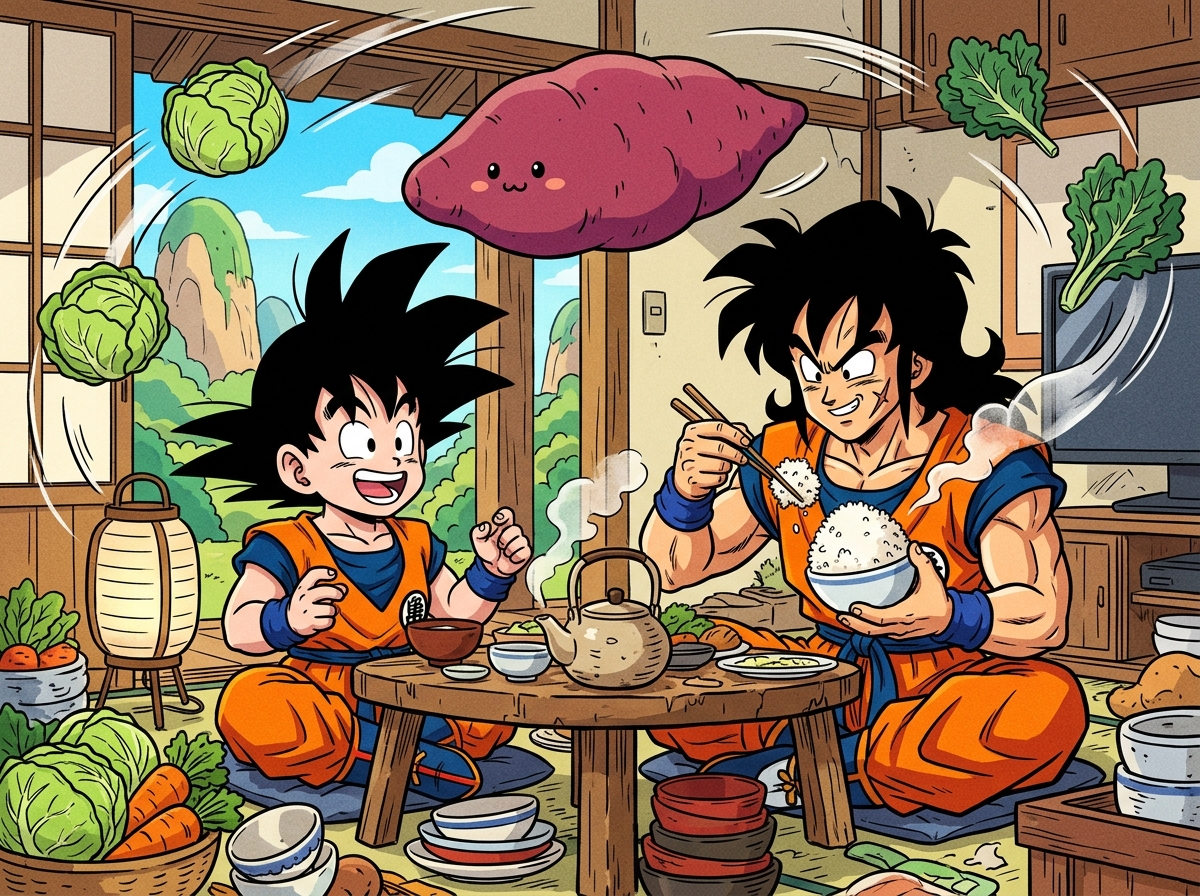
Tenshinhan and Chaoz have food names because the series borrowed them from real Chinese-style dishes. The Dragon Ball Official Site explains that Tenshinhan comes from tenshinhan, a crab-meat omelet served over rice, while Chaoz comes from jiaozi, the dumplings many people know from Chinese restaurants.
Tenshinhan‘s name points to a dish that is easy to picture. The omelet is made with egg and crab meat, cooked until soft, and set on a bowl of rice with a savory sauce poured on top. Anyone who has ordered it at a Chinese restaurant will recognize the mix of fluffy egg and warm rice, and that familiar combination is why the name feels so natural in the series.
Chaoz’s name comes from jiaozi, which are dumplings with thin wrappers around a seasoned filling. They can be boiled, steamed, or pan-fried, and they are often served in small groups at family meals and casual restaurants. Taking a simple, shared food like this for a name gives the character a friendly, everyday feel.
Neither name is random. Dragon Ball is full of food, from rice balls and noodles to steaks and fish cooked over an open flame, so tying characters to dishes fits the series’ overall style. Naming a character after a meal carries that food theme into the cast list itself, and readers who spot it get an extra layer of fun from the story.
The connection has also inspired real cooking. In a 2022 feature on the Dragon Ball Official Site, chef Banri Taguchi created “Tsurusenhan,” a fusion dish that combines jiaozi dumplings with elements of tenshinhan, including its egg, rice, and topping. It is a clear sign that the link between these names and their foods is more than a joke for fans.
Food-based names are also one of the most talked-about details among fans. Many fans enjoy checking which real dish a character’s name comes from, and the question often leads to a deeper look at the foods the series uses. For readers who like spotting small details, Tenshinhan and Chaoz are a good place to start.
What Meals and Drinks Appear Most Often in the Series?
Hearty meat and fish dishes, along with a handful of everyday drinks, are the meals and beverages that show up most often in the series. They appear in home scenes, restaurant visits, and quick breaks, usually drawn large enough to fill the frame. The Dragon Ball Official Site’s food feature describes the main meat and fish dishes in detail, so they are a good place to start.
The meat dishes stand out the most on screen. Steaks are shown as sizable portions, and bone-in legs and shanks look like the kind of meal a hungry fighter would grab and eat without slowing down. These cuts show up in scenes where characters are relaxing or refueling, which makes them feel like part of daily life rather than a special occasion.
Fish gets a similar treatment, usually in two forms:
- Fish over an open flame: A large fish cooked over a fire, often in outdoor or camping-style scenes where the setting is simple and rugged.
- Fish in hot-pot soup: A large fish served in a bubbling pot of broth, a shared style of eating that suggests a warm, communal meal.
The contrast between these two styles tells you something about the setting. A fire-cooked fish suggests the wild, while a hot-pot meal feels more like a table where people gather together.
Drinks appear less often than food, but they still fill out the everyday scenes. Coffee, cream soda, alcoholic drinks, and milk all turn up in the series, usually near a plate or during a short break in the action. Coffee and cream soda are simple refreshments, while alcoholic drinks tend to belong to adult settings where people sit and talk. These small touches make the world feel lived in, since not every character is in the middle of a fight.
Milk is the most surprising drink in the series. The official food feature notes that in some regions, milk is delivered by helicopter because demand is so high. That detail shows how the series treats ordinary food as something worth an unusual story, even when the item itself looks plain.
Taken together, these meals and drinks give Dragon Ball a grounded feel. Big steaks, bone-in cuts, and whole fish make the characters’ appetites look real, while coffee, cream soda, and milk keep the setting familiar. When you notice which dishes appear in which scenes, you start to see how the food matches the mood of each moment, whether that is a quiet meal or a busy stop along the road.
How Much Food Did Goku Eat After the Tournament?
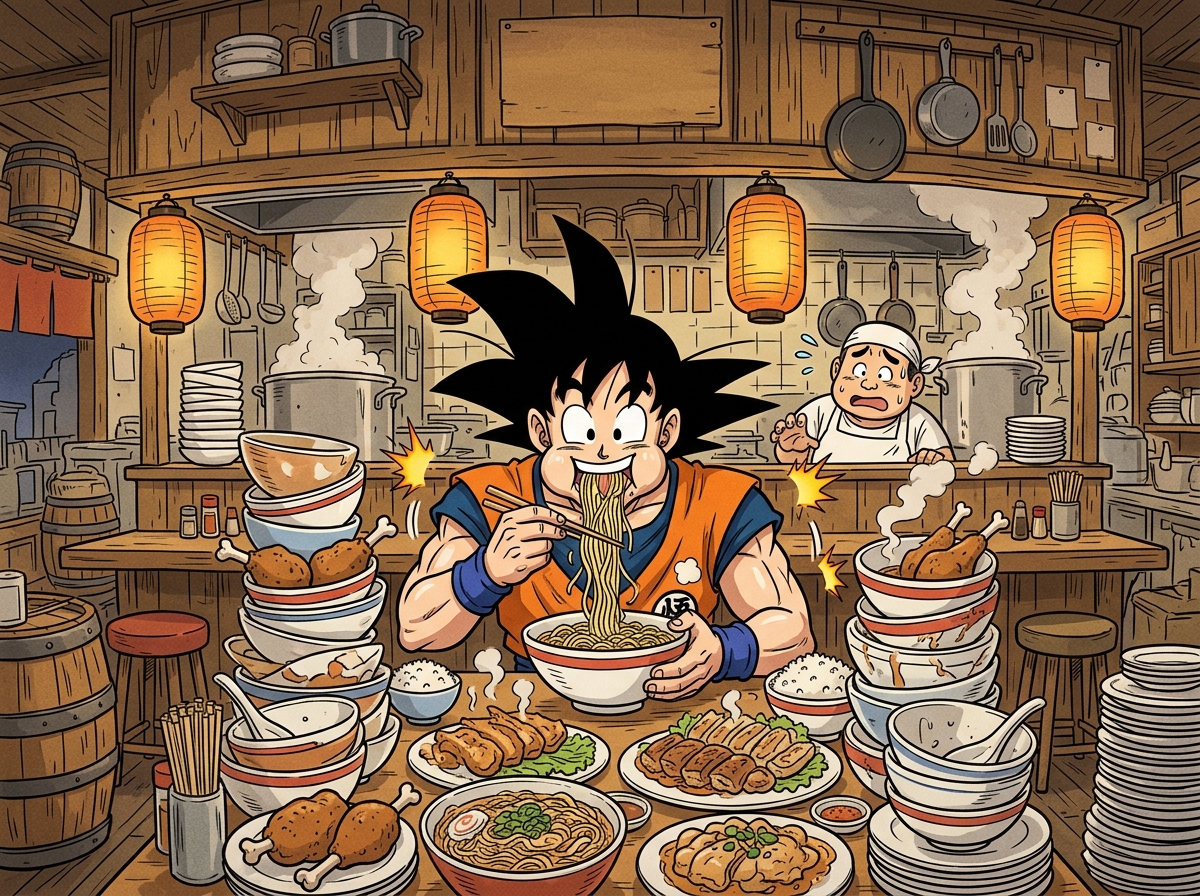
Goku ate food equal to the portions of 50 people after the 21st Tenkaichi Budokai, and the restaurant bill came to 470,000 Zeni. The moment is a classic example of the series’ playful side, where a single meal becomes the funniest part of the story.
The scene works because it takes Goku’s appetite, which fans already know well, and pushes it to an extreme. Nobody in the story is surprised that he is hungry. The joke is how far the eating goes, and the Dragon Ball Official Site’s food feature points to this kind of large, hearty meal as a regular part of the series’ style.
The bill hit Master Roshi hardest. Prize money from a major tournament is meant to be a reward, but Goku’s meal nearly used up all of it. Roshi, who is known for his love of comfort and his sometimes careless spending, ends up in the awkward position of paying for a feast he could not have expected.
Fans often remember this scene for the number as much as the food. A bill that large shows how big Goku’s appetite is without any need for dialogue. It also gives the audience a laugh at the expense of a character who is usually the one making the jokes.
What Strange Foods Do Characters Eat?
Characters in Dragon Ball eat some very unusual things, including roasted wolves, centipedes, and giant octopuses. Some of them even eat people or feed on energy instead of ordinary food. The Dragon Ball Official Site’s exotic-food feature covers these strange sources of nourishment in detail.
Hunted animals are the most down-to-earth part of this list. The feature says characters eat roasted wolves, centipedes, and giant octopuses, which is a very different menu from the rice balls and noodles that appear in everyday scenes. These meals are cooked over a fire and eaten as plain survival food, so they fit the rugged, outdoor side of the series.
Some of the stranger meals involve people. The same feature notes that Vegeta sometimes eats the inhabitants of planets he invades. It is one of the darkest food details in the franchise, and it shows how far the series will go to make a villain feel threatening.
Majin Buu takes a very different approach. He turns people into sweets such as chocolate and candy, then eats them. The feature also points out that he enjoys Mr. Satan’s steak but finds dog food unpalatable. That contrast gives Buu a playful, almost childlike side, even though his meals are often disturbing.
The most unusual meals in the series are not eaten at all. They are absorbed as energy. In the official feature, these sources include:
– Androids 19 and 20, who absorb ki for energy – Yakon, who consumes light energy and dies after eating too much of Goku’s Super Saiyan energy – Cell, who absorbed the life energy of more than 15,000 people and also absorbed Androids 17 and 18 to reach his perfect form
Cell’s feast is the most extreme example. Instead of a table full of food, he gathers power from thousands of lives, which turns eating into a method of growing stronger.
The series also includes food-like items that are more about power than hunger. The feature describes the Super Water of the Gods as a potent toxin that can draw out latent power. It also says the Room of Spirit and Time contains powder-like rations and water, which are meant to keep fighters going during their intense training.
These scenes set Dragon Ball apart from ordinary food stories. In most shows, a meal is a break from the action, a way to relax or bond with friends. Here, food can be a weapon, a threat, or a source of power. Goku’s giant restaurant bill is funny because it is still a normal meal, while Cell’s feast is frightening because the food is other people’s lives.
What Is a Senzu Bean and How Does It Work?

A Senzu Bean is a small healing bean that can fix injuries and bring a fighter back into the battle. Karin grows them in Karin Tower, the tower that bears her name, and the beans are one of the series’ most useful food items.
Eating one can heal injuries and restore physical stamina and energy. That means a fighter who is battered and worn out can recover in the middle of a fight, which keeps the story moving and lets characters return to the action when it looks like they are finished.
The beans also work as a meal. One Senzu Bean keeps a person full for 10 days, so a single bean can replace several meals. That makes it handy for a long trip or a training stretch where stopping for food would waste time.
It is a neat bit of story design. Because the beans heal so quickly, they raise the stakes when they run short. A character who is out of beans has to rely on their own strength and endurance, which makes every battle feel more risky.
Not every power-boosting item in the series is so friendly. The Super Water of the Gods is described as a potent toxin that can draw out latent power, meaning strength that is hidden inside a person until something brings it out. It is a dangerous drink rather than a snack, and it sits at the opposite end of the food scale from the Senzu Bean.
Training gets its own kind of food. The Room of Spirit and Time contains powder-like rations and water, simple supplies that keep fighters going during long, intense sessions. Compared with the steaks and noodle bowls seen elsewhere, these rations are plain and practical, built for endurance rather than enjoyment.
Can You Eat Real Dragon Ball Food Today?
Yes, a few Dragon Ball foods exist in the real world. In 2022, a chef created a fusion dish inspired by the series’ food names, and in 2025, a snack line with Dragon Ball branding went on sale in Japan.
The fusion dish is called Tsurusenhan. Chef Banri Taguchi created it for a 2022 feature on the Dragon Ball Official Site, and it combines jiaozi dumplings with elements of tenshinhan. Those two dishes are the same ones that gave Chaoz and Tenshinhan their names, so the dish brings the character names back to the kitchen.
Tsurusenhan borrows the parts of tenshinhan that make it recognizable. The egg, the rice, and the topping all come from the crab-meat omelet served over rice, while the jiaozi side adds the dumpling element. Seeing both dishes combined on one plate shows how easily a food name from the series can turn into a real recipe.
The snack side is more straightforward. Dragon Ball 40th Anniversary Rubber Mascot Biscuits went on sale in snack stores across Japan on September 29, 2025. The set includes 18 rubber-keychain designs, so the release is as much about collecting as it is about snacking.
The biscuits are decorated with lettering from the original comics. That detail ties the treat back to the printed pages where the story began, and it gives fans a small, familiar link to the early manga. The 40th anniversary in the product name marks how long the franchise has been running.
Availability is the main limit. The biscuits were sold in snack stores across Japan, so fans elsewhere may need to look through local shops that carry Japanese snacks, and stock may vary.
Most other foods from the series exist only on screen. You can cook rice balls, noodles, steak, or fish over a flame at home, since those are everyday foods in the real world. The Senzu Bean, Super Water of the Gods, and Cell’s energy-stealing feast have no real-world versions, so they remain part of the story alone.
Spotting Food Details on Your Next Rewatch
Start with a simple checklist. Pick one character, such as Bulma, and note every time you see bread in her scenes. Then do the same for Chi-Chi, Gyumao, and Yamcha, watching for the noodle bowls that hint at their southeastern roots.
Keep a second column for rice balls. Because many different characters eat them, and they show up during travel and training, they are an easy staple to count across episodes.
When a steak or a large fish appears, pause and check how it is served. A fish cooked over an open flame suggests a rugged, outdoor setting, while a fish in hot-pot soup points to a warm, shared meal. Noticing that difference tells you what mood the scene is going for.
Watch for Majin Buu’s sweets, too. Each time he turns someone into candy or chocolate, note the tone of the scene. Then compare it with his enjoyment of Mr. Satan’s steak, which shows the contrast between his playful side and his disturbing habits.
Finally, watch the battle scenes for injuries and exhaustion. If a fighter is badly hurt, look for a Senzu Bean nearby. Once you start tracking these details, every meal scene becomes a small puzzle to solve.
Frequently Asked Questions
1. Are Saiyan names based on vegetables?
Yes, many Saiyan names come from vegetables, which is a running joke in the series. Vegeta is the most famous example, and Kale, Cabba, and Nappa follow the same pattern. Raditz is one of the main Saiyans whose name does not come from a vegetable.
2. Are the Dragon Balls a Chinese food?
No, the Dragon Balls are not food at all. They are magical orbs that grant a wish when all seven are gathered. The Chinese-style food names in the series belong to characters like Tenshinhan and Chaoz, who are named after tenshinhan and jiaozi.
3. Can fans buy Dragon Ball snacks outside Japan?
The Dragon Ball 40th Anniversary Rubber Mascot Biscuits went on sale in snack stores across Japan on September 29, 2025. Fans in other countries may need to check shops that carry Japanese snacks, and stock can vary from one store to another.

