
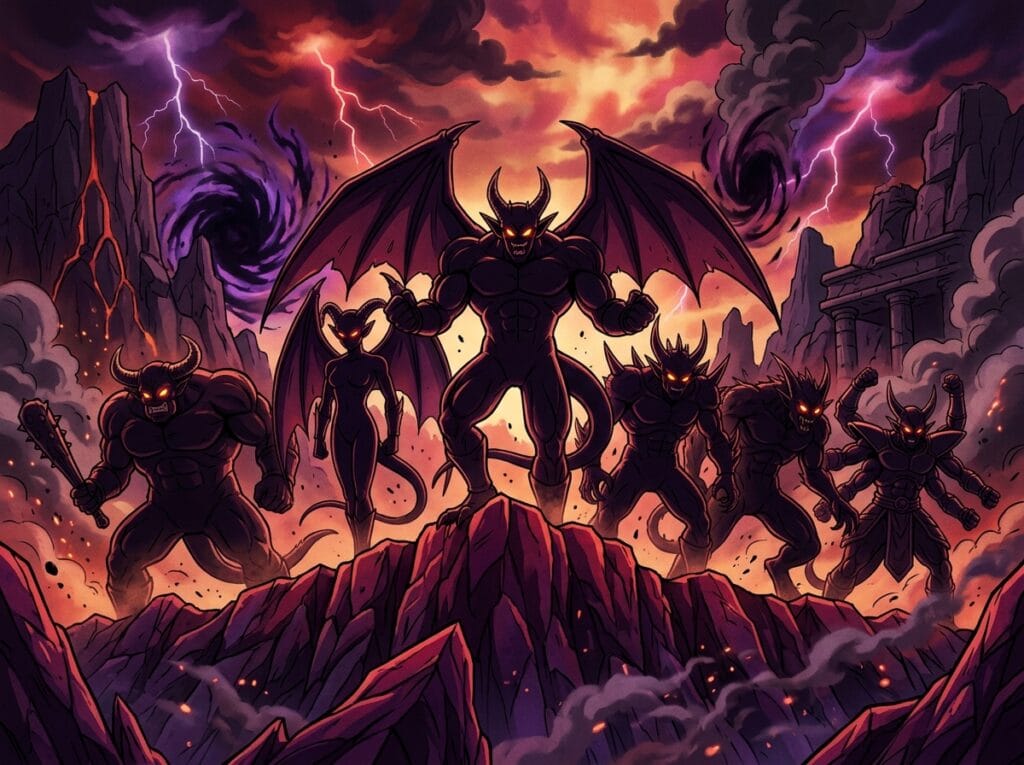
The Dragon Ball Daima demons bring a new side of the series into focus through strange powers, ancient rivalries, and secrets rooted in the Demon Realm. I find them especially interesting because they are more than simple villains. They include rulers, guardians, Majins, and entire races with their own histories. Understanding who they are makes the 20-episode story and its biggest twists easier to follow.
The Demon Realm is divided into three Demon Worlds. Each one is protected by a Tamagami and contains one of the three Demon Realm Dragon Balls. From Gomah’s rise as Demon King to the arrival of Majin Kuu and Majin Duu, these characters reshape the balance of power. This overview explores their origins, abilities, roles, and the major revelations involving demons, Glinds, and Namekians.
Key Takeaways
- Dragon Ball DAIMA portrays demons as a diverse society of races and roles—including Glinds, Namekians, Majins, rulers, guardians, and ordinary citizens—rather than a single evil species.
- The Great Demon Realm consists of three Demon Worlds, each containing a Dragon Ball protected by a Tamagami created by Neva. Recovering the three Dragon Balls becomes central to challenging Gomah’s rule and reversing the heroes’ transformation.
- Gomah’s rise as Demon King reshapes the realm through fear, secrecy, and political control, while Glorio, Majin Kuu, and Majin Duu represent competing loyalties and new forces in the struggle for power.
- DAIMA expands Dragon Ball lore by linking the Demon Realm to the origins of Glinds and Namekians, deepening the series’ mythology surrounding magic, creation, and ancient races.
What Demons Mean In Dragon Ball Daima
In Dragon Ball DAIMA, I see demons as the varied residents of the Great Demon Realm, not as one evil species. The realm contains different races, including Glinds, Namekians, and Majins, each with their own abilities, traditions, and ways of life. Some demons hold political power, while others serve as guardians, researchers, soldiers, or ordinary citizens. This broader view makes the Demon Realm feel like a society with its own history instead of a simple source of villains, as shown in Dragon Ball DAIMA episode 1.
The Great Demon Realm is divided into three Demon Worlds, each with its own environment, communities, and political tensions. A Demon Realm Dragon Ball is protected in each world by a Tamagami, a powerful guardian created by Neva. These three worlds are central to the search for the complete set of wish-granting Dragon Balls. Traveling between them also shows how different demon cultures and powers can be, while revealing the rivalries that shape the realm’s leadership, as shown in Dragon Ball DAIMA episodes 3–12. I find that this structure gives the setting a clear social and political order instead of treating it as one uniform location.
By the end of the 20-episode series, demons represent many kinds of ambition, loyalty, and identity. Gomah’s rule shows how the Demon Realm can be controlled through fear, while Majin Kuu and Majin Duu show that even newly created Majins can develop distinct personalities and goals. The story also connects the Demon Realm to the origins and history of familiar races, especially through its treatment of Namekians and Glinds. As a result, DAIMA changes the audience’s understanding of demons from isolated enemies into people shaped by culture, power, and their place within the three Demon Worlds, as shown in Dragon Ball DAIMA episodes 13–20.
Gomah Glorio And The New Majins

Gomah becomes the new Demon King after Dabura’s death, but he rules through fear, secrecy, and political control rather than overwhelming strength. He uses the Demon Realm Dragon Balls to turn Goku and his allies into children, believing their smaller bodies will make them easier to defeat. Unlike Dabura, who was a direct and confident warrior, Gomah is cautious, selfish, and willing to use others to protect his position. His power changes dramatically after he gains the Third Eye, turning him from a schemer into the main physical threat of the final battle, as shown in Dragon Ball DAIMA episodes 1, 2, and 19–20.
Glorio connects the heroes to the Demon Realm’s larger political struggle. He first approaches Goku as an ally while hiding his ties to Dr. Arinsu. He comes from the Third Demon World and helps guide the group through the three Demon Worlds, giving him knowledge that the outsiders lack. As the story develops, I see that Glorio is not simply serving Gomah or opposing him for personal glory. His real goal is tied to Arinsu’s plan to change the Demon Realm’s leadership. His serious nature and sense of duty also set him apart from Majin Buu, whose actions are often driven by instinct, hunger, or childish emotion, as shown in Dragon Ball DAIMA episodes 3–8 and 18–20.
Majin Kuu and Majin Duu are new creations made from Majin Buu’s remains, but they develop personalities and abilities that separate them from their famous predecessor. Kuu is clever, nervous, and analytical, while Duu is more childlike, energetic, and physically powerful, making them an unusual but effective pair. Rather than seeking destruction for its own sake like early Buu, they become connected to Arinsu’s experiments and the struggle for control of the Demon Realm. Their roles also differ from Dabura’s because they are artificial Majins shaped by someone else’s ambitions instead of established rulers or elite fighters, as shown in Dragon Ball DAIMA episodes 12–20.
Tamagami And Demon Realm Dragon Balls
Neva created the three Tamagami to protect one Demon Realm Dragon Ball in each of the three Demon Worlds. These guardians are powerful warriors created by a Namekian, and each one tests challengers through combat, strategy, or a contest of skill instead of simply handing over its Dragon Ball. I find their role important because the Tamagami show that the Demon Realm’s greatest treasures are controlled by strict trials, not ordinary strength alone. Goku, Vegeta, Piccolo, and their allies must travel through dangerous worlds and adapt to unfamiliar rules while facing these unusual guardians, as shown in Dragon Ball DAIMA episodes 3–18.
The battles become a race against Gomah, whose control of the Demon Realm threatens the heroes and their allies. Goku’s encounters with the Tamagami push him to use patience, teamwork, and new forms of power, while the group’s progress brings them closer to collecting all three Dragon Balls. Once gathered, the set becomes central to undoing the damage caused by the heroes’ transformation and gives them a chance to confront the Demon King. The Dragon Balls therefore do more than grant a wish. They shift power away from Gomah and toward the people resisting his rule, as shown in Dragon Ball DAIMA episodes 9–18.
Namekians Glinds And Demon Realm Lore

The finale reveals that Namekians are connected to the Demon Realm, adding new depth to a race long associated with Dragon Balls, healing, and powerful magic. I find this important because it expands Namekian history beyond Planet Namek and connects it to the wider structure of the Dragon Ball universe. DAIMA also identifies Glinds, the race that includes Supreme Kai and Kibito, as people who originated in the Demon Realm and were born from special trees rather than through ordinary family lines. Their long lives and natural magic now have a clearer place in the series’ lore, even though the story does not explain every detail of how Namekians and Glinds are related, as shown in Dragon Ball DAIMA episode 19.
The Demon Realm itself is divided into three Demon Worlds, with each world protecting one of the three Demon Realm Dragon Balls. Neva created the three Tamagami to guard them, showing that Namekian abilities and Dragon Ball magic have influenced the realm’s history for generations. The final battle with Gomah, along with the roles of Majin Kuu and Majin Duu, also shows that demons are not one simple race. They are a broad group with different powers, origins, and loyalties. For me, these revelations make DAIMA feel like a bridge between familiar characters and a much larger mythology surrounding magic, creation, and the universe’s oldest peoples, as shown in Dragon Ball DAIMA episode 20.
Dragon Ball DAIMA Shows Demon Diversity
Dragon Ball DAIMA presents demons as a broad group of people, cultures, and creatures rather than a single kind of villain. I see that most clearly through the three Demon Worlds, each with its own communities, dangers, and connection to the Demon Realm Dragon Balls. The Tamagami, created by Neva to guard those Dragon Balls, show that powerful demons can serve as protectors instead of enemies. At the same time, characters such as Gomah and Glorio reveal very different sides of Demon Realm society, from ruthless rule to reluctant cooperation.
The series also expands its mythology through the new Majins, Majin Kuu and Majin Duu, while offering important clues about the origins of the Glinds and Namekians. Gomah’s rise after Dabura adds a new chapter to demon leadership, but DAIMA makes clear that the Demon Realm is larger than any one king. For me, that wider view is the show’s lasting contribution to the series’ lore because it turns “demons” into a living collection of races, histories, and cultures. From the three Demon Worlds and the Tamagami to Gomah, Glorio, the new Majins, and the origins of important races, Dragon Ball DAIMA gives the franchise a much richer mythology.
Frequently Asked Questions
1. What are the demons in Dragon Ball Daima?
I see the demons in Dragon Ball Daima as the varied residents of the Great Demon Realm, not as one evil species. They include Glinds, Namekians, Majins, rulers, guardians, soldiers, researchers, and ordinary citizens. This makes the Demon Realm feel like a living society with its own history and traditions, as shown in Dragon Ball DAIMA episode 1.
2. Where is the Demon Realm located in Dragon Ball Daima?
The Demon Realm is a separate region with its own communities, political conflicts, and natural environments. It is divided into three Demon Worlds, and each world protects one Demon Realm Dragon Ball. Traveling through these worlds reveals how different demon cultures and power structures can be, as shown in Dragon Ball DAIMA episodes 3–12.
3. What are the three Demon Worlds?
The three Demon Worlds are the main divisions of the Great Demon Realm. Each has its own environment, communities, political tensions, and a Demon Realm Dragon Ball protected by a Tamagami. Together, they form the setting for the search for the Dragon Balls and the struggle for control of the realm, as shown in Dragon Ball DAIMA episodes 3–12.
4. What are the Tamagami in Dragon Ball Daima?
The Tamagami are powerful guardians created by Neva to protect the three Demon Realm Dragon Balls. Each Tamagami watches over one Dragon Ball in one of the Demon Worlds, making them important obstacles for anyone seeking the complete set. Their role also shows that the Demon Realm has its own ancient defenses and systems of power, as shown in Dragon Ball DAIMA episodes 3–12.
5. Who is Gomah, and why is he important?
Gomah is a powerful figure who rises as the Demon King and changes the balance of power in the Great Demon Realm. His leadership brings the realm’s political struggles to the center of the story and affects both demons and outsiders. His rise is established early in the series, beginning with Dragon Ball DAIMA episode 1.
6. Are Majins demons in Dragon Ball Daima?
Yes, Majins are one of the major groups connected to the Demon Realm, but they are not the only type of demon. Majin Kuu and Majin Duu show that Majins have an important place in the realm’s power struggles and larger mysteries. Their arrival adds new challengers to the conflict surrounding Gomah and the Demon Realm.
7. What do Glinds and Namekians have to do with the demons in Dragon Ball Daima?
Glinds and Namekians are among the races connected to the Great Demon Realm, showing that the realm is home to more than one kind of demon. Their histories and abilities help explain the deeper links between the Demon Realm, its rulers, and its ancient secrets. This wider view makes the setting more complex than a simple battle between heroes and villains.

