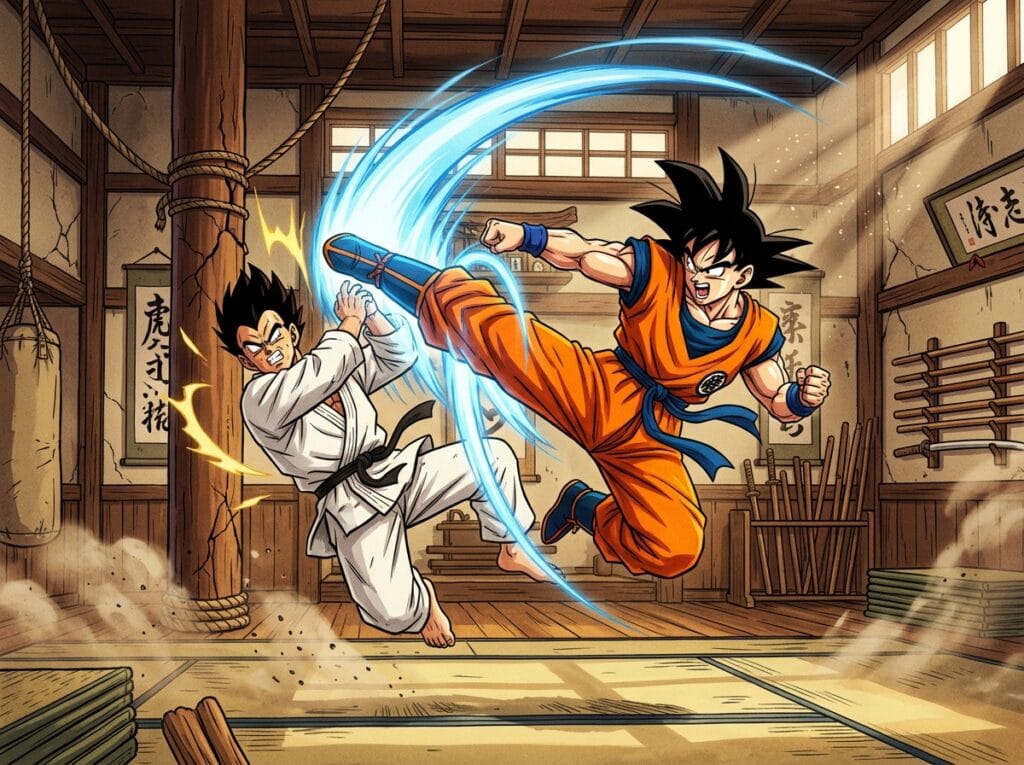
Dragon Ball martial arts is more than flashy punches and energy blasts. I see it as a blend of real fighting principles, Chinese martial arts cinema, Japanese tournament traditions, acrobatics, and imaginative techniques that push combat beyond human limits. At its core, the series values timing, movement, discipline, adaptation, and learning from defeat.
Understanding these influences makes each battle more meaningful, from Goku’s early training under Master Roshi to the advanced lessons he receives from later teachers. It also explains why Dragon Ball does not follow one identifiable real-world martial arts style. Instead, it gives each fighter a distinct method shaped by personality, training, and experience.
Key Takeaways
- Dragon Ball martial arts is a fictional blend of hand-to-hand combat, Chinese martial arts cinema, Japanese tournament traditions, acrobatics, and imaginative techniques rather than one identifiable real-world style.
- Its core principles are timing, movement, discipline, adaptability, mental focus, and learning from defeat; raw strength alone is never enough for lasting growth.
- Goku’s development under Master Roshi, Kami, King Kai, and Whis shows that progress comes through repetition, humility, recovery, judgment, and continuous refinement.
- Ki expands traditional combat with fictional abilities such as energy blasts, flight, and teleportation while preserving the importance of control, positioning, awareness, and strategy.
Introduction To Dragon Ball Martial Arts
Martial arts gives Dragon Ball its story structure, not just its action scenes. I see this most clearly in Goku’s early battles, where punches, kicks, throws, blocks, feints, and counters matter as much as raw strength. His training with Master Roshi teaches him that discipline, patience, and clever movement can help him overcome a stronger opponent. The World Martial Arts Tournament also turns combat into a test of skill, judgment, and personal growth rather than a simple contest of power.
As the story develops, Dragon Ball expands traditional hand-to-hand combat with fictional ideas such as ki, the life energy that characters learn to control and project. Techniques such as the Kamehameha build on focused movement and breathing, then add powers that do not exist in real-world martial arts. Later teachers, including Kami, King Kai, and Whis, introduce new forms of training that improve Goku’s speed, awareness, balance, and control. I find that these lessons keep the fights connected to martial arts principles even when the battles reach supernatural levels.
Dragon Ball does not follow one identifiable martial arts style because it blends several influences into its own fictional system. Its combat reflects Chinese martial arts films, Japanese tournament storytelling, acrobatic movement, and character-specific techniques, while also using exaggerated speed and energy attacks. Each fighter develops a different approach, from direct power and aggressive pressure to deception, timing, and defensive counterattacks. This mix lets the franchise explore real training ideas while giving its battles the freedom to move beyond the limits of ordinary human combat.
Goku’s Martial Arts Training Path

Goku’s martial arts path begins with Master Roshi, who teaches him that natural talent is not enough. Through basic exercises, repetitive practice, and demanding chores, Goku builds strength, balance, speed, and discipline while learning to respect the training process. Roshi also shows him that fighting involves more than trading punches and kicks. Timing, evasion, feints, counters, and careful observation can all change the course of a match. These lessons reflect the franchise’s blend of Chinese martial arts ideas, tournament traditions, and exaggerated action.
Training with Kami expands Goku’s understanding of movement and control by forcing him to refine his senses, footwork, and reactions. King Kai then adds study and mental discipline, teaching techniques such as the Spirit Bomb while reminding Goku that powerful abilities require judgment and responsibility. I see these stages as an important part of Dragon Ball martial arts because they connect physical development with humility, recovery, and knowledge. Goku improves not only by becoming stronger, but also by accepting correction and examining why a technique succeeds or fails.
Whis takes this approach further by teaching Goku to remain calm, efficient, and aware instead of relying only on force or anger. Across each stage, defeat becomes useful because Goku treats it as information rather than a permanent setback. He then returns to training with a better plan. His growth also depends on recovery, since rest allows his body to adapt and prevents hard work from becoming reckless overtraining. By the time he reaches the highest levels of combat, Goku’s progress shows that martial arts in the series combines discipline, adaptability, humility, and continuous learning.
Dragon Ball Fighting Styles And Techniques
Dragon Ball martial arts begins with familiar combat basics, including punches, kicks, throws, blocks, counters, and evasive footwork. I see the early fights as contests of timing and awareness rather than simple tests of strength. Fighters use feints to make an opponent react, then change direction or attack an opening. Acrobatics add another layer, with flips, aerial recovery, and sudden changes in distance making battles feel fast and unpredictable. Energy techniques such as the Kamehameha expand this foundation into fantasy, but they still depend on control, positioning, and the right moment to strike.
Each major fighter brings a different approach to the same basic ideas. Goku relies on adaptability, observing an opponent closely and adjusting his rhythm when a plan stops working. Vegeta usually fights with direct aggression, pressing forward with powerful combinations and using pride to maintain pressure. Piccolo uses his reach, calm judgment, and precise attacks to control space, often making distance part of his strategy. These differences help Dragon Ball martial arts feel like a collection of personal methods rather than one fixed system.
The series also draws from Chinese martial arts cinema, Japanese tournament storytelling, and the discipline of traditional training stories without representing one identifiable real-world style. I find its most useful training ideas in repetition, humility, recovery, and learning from defeat. Teachers such as Master Roshi, Kami, King Kai, and Whis each show that improvement requires more than physical power. Focus, patience, and self-control matter too. As the story becomes more fantastical, those lessons remain connected to practical movements such as reading an opponent, conserving energy, and creating openings. That balance between recognizable technique and imaginative combat gives the franchise its lasting appeal.
Ki And The Expansion Of Martial Arts

Ki expands Dragon Ball martial arts beyond punches, kicks, and close-range exchanges into a complete combat system. I see it as a fictional energy that fighters learn to control through discipline, breathing, focus, and intense training. With ki, a martial artist can strengthen a strike, protect the body, sense another fighter’s power, or release an energy blast such as the Kamehameha. This changes combat distance because a battle can shift from hand-to-hand exchanges to ranged attacks in an instant. Even so, timing, movement, and reading an opponent remain important parts of Dragon Ball martial arts.
As the series develops, ki also allows fighters to fly, teleport, and transform, giving skilled combatants new ways to attack or escape. Techniques such as Instant Transmission show how sensing energy can support movement, while transformations often increase a fighter’s speed, strength, and control. Divine training later introduces abilities that require calm reactions and precise energy management rather than strength alone. These additions make the system broader, but they still build on the early lessons of practice, adaptation, and learning from defeat. I find that connection important because the most powerful techniques are usually presented as results of training, not simple gifts.
The ki system draws inspiration from ideas about internal energy found in martial arts stories, but it should not be treated as a real-world power supported by scientific evidence. Real martial arts can develop balance, breathing, body awareness, concentration, and efficient movement, yet they do not enable flight, teleportation, or energy blasts. Dragon Ball uses those familiar training ideas as a foundation for imaginative abilities that suit its fantasy setting. This distinction helps me appreciate the series without confusing fictional ki with claims about actual human powers. In this way, the franchise respects the discipline of martial arts while expanding it into a world of superhuman combat.
Real World Influences And Tournament Culture
Dragon Ball martial arts draws heavily from Chinese martial arts cinema, especially its focus on disciplined training, colorful teachers, unusual techniques, and sudden changes in momentum. I also see the influence of Japanese martial arts storytelling, where a fighter’s growth depends on practice, humility, respect, and learning from defeat. Goku’s training under Master Roshi shows this clearly because physical conditioning is paired with patience, routine, and lessons about everyday work. The series then adds exaggerated jumps, acrobatics, comic timing, and fictional energy control to create a style inspired by real traditions without representing one identifiable martial art.
The Tenkaichi Budokai gives these ideas a clear competitive structure. Fighters must follow rules, study their opponents, manage their stamina, and find ways to win when raw strength is not enough. Ring-outs, feints, counters, disguises, and changes in distance make several matches feel like tactical contests rather than simple power comparisons. I especially like how tournament opponents can reveal a fighter’s weaknesses, forcing characters to adapt instead of relying on the same attack every time.
Tournament culture also gives Dragon Ball martial arts a strong sense of sportsmanship and community. Competitors may be rivals, but they often respect one another’s skills and treat each match as an opportunity to improve. Classic training narratives reinforce that idea by presenting defeat as useful feedback rather than a final judgment. Through its mix of real-world influence and imaginative combat, Dragon Ball presents martial arts as a balance of technique, discipline, strategy, and personal growth.
Conclusion On Dragon Ball Martial Arts

Dragon Ball martial arts works because it begins with movements that look familiar, including punches, kicks, throws, blocks, footwork, feints, and counters. I see influences from Chinese martial arts cinema, Japanese tournament traditions, and the dramatic acrobatics of action storytelling, but the franchise does not represent one identifiable real-world style. Each fighter also brings a distinct approach, from Goku’s adaptability and improvisation to Piccolo’s reach, control, and careful timing. Training remains just as important as technique, with teachers such as Master Roshi, Kami, King Kai, and Whis emphasizing discipline, repetition, recovery, and learning from defeat. These ideas give the battles a practical foundation before the story expands into flight, energy control, and other imaginative abilities.
The lasting appeal of Dragon Ball martial arts comes from its balance between discipline and creativity. Ki, or life energy used for attacks, defense, movement, and heightened awareness, makes the combat system more fantastical without replacing strategy or personal effort. I can still recognize the importance of timing, distance, adaptability, and mental focus even when a fight includes energy blasts or impossible speeds. The characters’ progress also shows that growth is not limited to gaining strength. Humility, persistence, better judgment, and respect for others matter just as much. By combining real-world martial arts influences with character-based styles, demanding training ideas, and spectacular fantasy, Dragon Ball makes its fights feel both inspiring and uniquely imaginative.
What Defines Dragon Ball Martial Arts
Dragon Ball martial arts is best understood as a fictional combat system shaped by many influences rather than one identifiable real-world style. I see its foundation in basic techniques such as punches, kicks, throws, blocks, footwork, feints, and counters, especially in the early adventures and tournaments. Training under teachers such as Master Roshi, Kami, King Kai, and Whis also highlights discipline, humility, recovery, and the importance of learning from defeat. As the story develops, these practical ideas combine with acrobatics, speed, supernatural strength, and energy control to create a distinct style for each fighter.
The lasting appeal of Dragon Ball martial arts comes from its focus on growth and adaptation, not simply on having the greatest power level. Goku, Vegeta, Piccolo, and other characters approach combat differently, showing how timing, technique, strategy, and personal experience can shape a fighter. The franchise also reflects the influence of Chinese martial arts cinema, Japanese tournament storytelling, and dramatic action choreography while adding its own fictional rules. When I look at the series as a whole, its martial arts are most valuable as a lesson in practice, resilience, and creative problem-solving.
Frequently Asked Questions
1. What is Dragon Ball martial arts?
Dragon Ball martial arts is a fictional combat system that combines real fighting principles with fantasy abilities. It includes timing, movement, blocks, feints, counters, throws, acrobatics, and ki techniques. I see it as a flexible approach where skill, discipline, and adaptation matter as much as physical power.
2. What real martial arts influenced Dragon Ball?
Dragon Ball draws from Chinese martial arts cinema, Japanese tournament traditions, traditional hand-to-hand combat, and acrobatic movement. It does not copy one real-world style exactly. Instead, it blends different influences to create a unique fighting system for each character.
3. Does Goku use a real martial arts style?
Goku does not follow one identifiable real-world style. His fighting combines striking, grappling, evasive movement, unusual angles, and techniques learned from several teachers. His style keeps changing because he studies his opponents and adapts after every battle.
4. How does Master Roshi influence Dragon Ball martial arts?
Master Roshi teaches Goku that training requires discipline, patience, and steady effort, not just natural strength. He also shows that clever movement and good judgment can help a fighter defeat a stronger opponent. These lessons shape Goku’s approach throughout the series, beginning with his early training and tournament battles.
5. What role does ki play in Dragon Ball martial arts?
Ki is the life energy that fighters learn to sense, control, and project. It expands normal martial arts with fictional abilities such as energy blasts, flight, and power increases. Even with these supernatural techniques, effective ki use still depends on focus, breathing, timing, and control.
6. Why are the World Martial Arts Tournaments important?
The World Martial Arts Tournaments make combat a test of skill, judgment, and personal growth rather than a simple contest of strength. Fighters must manage rules, pressure, distance, and unfamiliar opponents. These events also show how characters learn from defeat and improve through experience.
7. How do Kami, King Kai, and Whis change Goku’s fighting?
Each teacher adds a different layer to Goku’s development. Kami improves his awareness and control, King Kai teaches him to manage greater power, and Whis focuses on balance, speed, and instinctive movement. Their training helps Goku fight with more precision instead of relying only on stronger attacks.
8. Can real martial artists learn from Dragon Ball martial arts?
Real martial artists can learn useful ideas from Dragon Ball, including the value of consistent training, timing, footwork, adaptability, and learning from mistakes. Techniques such as energy blasts and superhuman speed are fictional, so they cannot be copied safely or literally. The most practical lesson is to build skill through discipline while staying calm and responsive under pressure.

