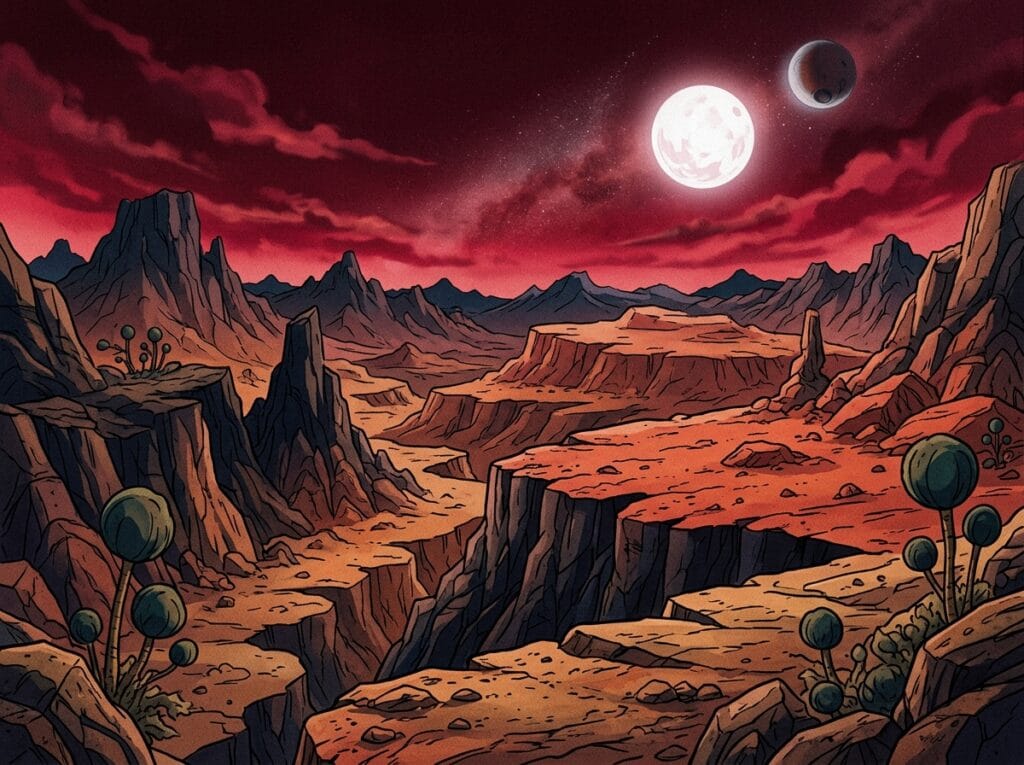
If you’ve ever wondered how the Saiyans became the most feared warriors in the universe, the secret lies within the harsh planet Vegeta geography. This alien world was a place of extremes, featuring a blood-red sky and gravity ten times stronger than what we experience on Earth. Every step a Saiyan took required immense effort, turning their daily lives into a constant, high-intensity workout from the moment they were born.
Living under two suns and two moons, the inhabitants of this rugged terrain had to adapt to a truly unique environment. While the planet was home to both the high-tech Tuffles and the brutal Saiyans, the rocky terrain and thin atmosphere favored those with raw power. It wasn’t just a home; it was a natural training ground that forged the legendary strength of characters like Goku and Vegeta before the planet met its tragic end.
Key Takeaways
- Planet Vegeta’s gravity is ten times stronger than Earth’s, serving as a natural high-intensity training ground that forged the Saiyans’ legendary strength, speed, and durability from birth.
- The planet’s harsh geography, characterized by arid deserts, jagged rock formations, and a lack of natural water, forced the Saiyan race to evolve extreme resilience and keen survival instincts.
- A unique celestial setup featuring dual suns and two moons created a rare lunar cycle where a full moon occurred only once every few decades, triggering the devastating Great Ape transformation.
- The historical conflict on the planet highlighted a stark geographical and cultural divide between the technologically advanced Tuffles in urban centers and the primitive, power-focused Saiyan settlements.
Ten Times Gravity And Atmospheric Conditions
Planet Vegeta is a harsh and unforgiving world that played a massive role in making the Saiyans the strongest warriors in the universe. The most famous feature of the planet is its crushing gravity, which is ten times stronger than what we experience on Earth. Living under this constant pressure meant that every simple movement was a form of intense weight training for the inhabitants. This extreme environment forced the Saiyan race to evolve incredible natural strength, speed, and durability just to survive daily life. I see the results of this biological conditioning when Raditz first arrives on our planet and displays power far beyond any human Dragon Ball Z episode 1, The New Threat.
Beyond the heavy gravity, the atmospheric conditions of Planet Vegeta created a landscape that looked nothing like our own. The sky was often filled with a distinct red or yellow tint, suggesting a chemical makeup that was much different from Earth’s nitrogen and oxygen mix. This thick atmosphere likely contributed to the planet’s rugged climate and the desert-like appearance of its rocky terrain. With two suns beating down on the surface, the heat and radiation levels were likely much higher than what most species could handle. These brutal conditions ensured that only the most resilient life forms could thrive in such a desolate environment Dragon Ball Z episode 1, The New Threat.
The unique geography of the planet also included a very specific lunar cycle that dictated the Saiyans’ military culture. While the planet had two moons, the orbits were so specific that a full moon only occurred once every few decades. This rare celestial event triggered the Great Ape transformation, a massive surge in power that allowed the Saiyans to conquer worlds with ease. Even though the population was relatively small at less than one hundred thousand, their ability to survive such a high-gravity world made them a feared force throughout the galaxy. Understanding these environmental factors helps me see why the Saiyans became the ultimate warrior race before their home was lost Dragon Ball Z episode 1, The New Threat.
Arid Deserts And Jagged Rock Formations

The landscape of Planet Vegeta is incredibly harsh, characterized by endless stretches of arid deserts and massive, jagged rock formations. You won’t find many lush forests or rolling green hills here because the environment is built for survival rather than comfort. Huge, sharp mountain ranges dominate the horizon, creating a skyline that looks as dangerous as the warriors who live there. These rocky structures are often stained in deep reds and oranges, reflecting the planet’s unique atmospheric glow. The lack of vegetation makes the terrain feel open and exposed, which likely helped the Saiyans develop their keen senses for tracking enemies across long distances Dragon Ball Z episode 20, Gokus Ancestry.
One of the most striking things about this world is the complete lack of natural water sources like rivers or oceans. Instead of blue water, the surface is covered in dry, cracked earth and dusty plains that seem to go on forever. This scarcity of water creates a brutal climate where only the strongest creatures can manage to thrive. Since there aren’t many places to find a refreshing drink, the Saiyans had to evolve extreme resilience and become exceptionally hardy just to endure their daily lives. Living in such a parched environment meant that every resource was precious and had to be fought for constantly Dragon Ball Z episode 20, Gokus Ancestry.
The combination of intense heat and the absence of moisture turned the planet into a giant natural training ground. Navigating through the cliffs and canyons required immense physical strength, especially when you consider the planet’s crushing gravity. Without large bodies of water to cool the air, the temperature stayed consistently high across the desert wastes. This unforgiving geography played a massive role in shaping the Saiyan culture into one that values power and resilience above all else. Every jagged peak and dusty valley served as a reminder that their home was a place that only the elite could truly master Dragon Ball Z episode 20, Gokus Ancestry.
Dual Suns And The Rare Full Moon
The sky over Planet Vegeta is a striking shade of red or yellow, which creates a harsh and alien atmosphere compared to the blue skies of Earth. This unique coloration is largely due to the planet orbiting a star with two suns, bathing the rocky landscape in intense heat and light. These dual suns contribute to the planet’s rugged environment, forcing the Saiyan race to evolve under extreme conditions. Living under a binary star system means the geography is often arid and unforgiving, which perfectly matches the warrior nature of its inhabitants. I can see the distinct look of this celestial setup during the flashbacks in Dragon Ball Z episode 17, City in Peril.
Even though the planet is famous for the Great Ape transformation, seeing a full moon is actually a very rare event for a Saiyan at home. Planet Vegeta has two moons that orbit the world, but their paths are so specific that they almost never align perfectly to reflect enough Blutz Waves for a transformation. Depending on which records you look at, a full moon might only occur once every eight to one hundred years. This scarcity meant that most Saiyans had to rely on artificial means or off-world missions to access their hidden power. The rare celestial alignment of these two moons is a key piece of world-building that explains why the Saiyans were so eager to conquer other planets with more frequent lunar cycles Dragon Ball Z episode 17, City of No Tomorrow.
Tuffle Cities Versus Primitive Saiyan Settlements

The contrast between the two civilizations on Planet Tuffle was visible from high in the atmosphere, highlighting a massive technological and cultural gap. I find it fascinating how the Tuffles utilized the planet’s geography to build massive, gleaming metropolises that looked like something out of a sci-fi dream. These high-tech urban centers were packed with advanced laboratories and towering skyscrapers, all protected by sophisticated defense systems. While the Tuffles mastered the environment with their machines, they eventually lost everything to the raw power of their neighbors. I can see the sleek design of these lost cities during the flashbacks in Dragon Ball Z episode 20, Gokus Ancestry.
In stark contrast to those polished cities, the Saiyans preferred to live in rugged, primitive settlements scattered across the planet’s harsh wastelands. These outposts were often built into the sides of rocky cliffs or made from simple, durable materials that could withstand the intense 10x gravity. I’ve always noticed how these areas lacked any of the comfort or greenery found in Tuffle territory, reflecting the Saiyans’ focus on combat over luxury. Life in these rocky deserts was brutal, but it served as the perfect training ground for the galaxy’s fiercest warriors. The barren landscape surrounding these Saiyan camps is vividly shown in Dragon Ball Z episode 20, Gokus Ancestry.
The geographical divide between these two groups really shows how much the environment shaped their history. While the Tuffles flourished in fertile areas where they could develop their science, the Saiyans thrived in the most unforgiving corners of the world. This separation meant that two completely different worlds existed on a single planet, right up until the Saiyans decided to take everything for themselves. Seeing the ruins of the Tuffle race origin next to the rough Saiyan structures tells the whole story of the planet’s violent past. This tragic history shift in the planet’s landscape is a major focus during the history lessons in Dragon Ball Z episode 20, Gokus Ancestry.
How Planet Vegeta Forged Elite Warriors
Ultimately, Planet Vegeta was far more than just a backdrop for the Saiyan race, as its brutal environment was the very thing that forged them into the most feared warriors in the universe. The combination of crushing ten times gravity and a harsh, alien atmosphere meant that every single day was a struggle for survival from the moment a Saiyan was born. This constant physical strain naturally boosted their power levels and durability, ensuring that only the strongest individuals could thrive in such a demanding world. It is fascinating to see how the simple physical layout of a planet can dictate the entire culture and destiny of its people.
The red skies and rare lunar cycles of this iconic world created a unique biological ticking time bomb for anyone standing on its surface. While the geography was undeniably hostile, it provided the perfect training ground for a race that would eventually challenge the gods themselves. Even though the planet is now nothing more than stardust, its legacy lives on through the incredible strength of characters like Goku and Vegeta. Understanding these environmental factors helps me appreciate the true grit of the Saiyan survivors who carried the weight of their world’s gravity into every battle they fought across the stars.
Frequently Asked Questions
1. How strong is the gravity on Planet Vegeta?
The gravity on Planet Vegeta is ten times stronger than what we experience on Earth. This crushing pressure means every movement is a form of intense weight training that forces Saiyans to develop incredible natural strength. I see how this conditioning makes them superior warriors when Raditz first arrives on Earth in Dragon Ball Z episode 1, The New Threat.
2. What does the sky look like on the Saiyan homeworld?
The sky on Planet Vegeta has a distinct blood-red or yellow tint rather than the blue we see on Earth. This unique color comes from a thick atmosphere with a different chemical makeup than our own. These harsh atmospheric conditions contribute to the rugged and unforgiving climate of the planet in Dragon Ball Z episode 20, Gohan’s Ancestry.
3. How many suns and moons does Planet Vegeta have?
Planet Vegeta orbits two suns and is circled by two different moons. This unique celestial setup creates a complex environment that the inhabitants had to adapt to for survival. The presence of multiple moons is especially significant for the Saiyan transformation process in Dragon Ball Z episode 17, City of No Tomorrow.
4. What kind of terrain covers the planet?
The geography of Planet Vegeta is primarily made up of a rocky and rugged landscape. This harsh terrain offered very little comfort and favored inhabitants with raw physical power and high durability. The jagged environment served as a natural training ground for the Saiyan race in Dragon Ball Z episode 20, Gohan’s Ancestry.
5. Why were Saiyans so much stronger than humans?
Saiyans evolved to be incredibly strong because they had to survive the planet’s extreme ten times gravity from the moment they were born. Their bodies naturally adapted to the heavy pressure and thin atmosphere, giving them a massive biological advantage over races from planets with lighter gravity. This evolution is why even a low-class Saiyan warrior can easily overpower human martial artists in Dragon Ball Z episode 2, Reunions.
6. Who else lived on Planet Vegeta besides the Saiyans?
Before the Saiyans took full control, the planet was shared with a highly advanced race known as the Tuffles. While the Tuffles relied on sophisticated technology, the Saiyans relied on their raw physical power to thrive in the planet’s difficult geography. This conflict between technology and strength eventually led to the Saiyan Tuffle War and the Saiyans becoming the sole rulers of the world in Dragon Ball Z episode 20, Gohan’s Ancestry.