Martial arts tournament history shows how combat evolved from ancient wrestling contests and traditional challenges into organized events with rules, weight classes, and trained officials. I find it fascinating because each discipline, including wrestling, judo, karate, taekwondo, and mixed martial arts, developed its own path to competition. Understanding that history makes modern tournaments easier to appreciate.
As I trace these changes, I connect ancient athletic traditions with the rise of international championships and Olympic combat sports. I also explain how safety rules, scoring systems, gender inclusion, and technology reshaped competition over time. Together, these developments show how martial arts preserved their fighting roots while becoming more structured and accessible.
Key Takeaways
- Martial arts tournaments evolved from informal contests and traditional challenges into structured competitions with standardized rules, weight classes, trained officials, safety measures, and modern scoring technology. International championships and Olympic recognition helped expand disciplines such as judo, karate, taekwondo, wrestling, and mixed martial arts worldwide.
- The World Martial Arts Tournament in Dragon Ball uses ring-outs, surrender, or incapacitation to determine winners, emphasizing technique, strategy, endurance, and character growth rather than raw strength alone.
- The 21st, 22nd, and 23rd Tenkaichi Budokai progressively transform the tournament from a local championship into a stage for rivalries, personal development, major conflicts, and alliances involving characters such as Goku, Tien, and Piccolo.
- Dragon Ball Z and Dragon Ball Super expand competition from a public arena to generation-spanning and universe-level events, but the Universe 6 Tournament and Tournament of Power serve different purposes from the recurring World Martial Arts Tournament.
World Martial Arts Tournament Origins
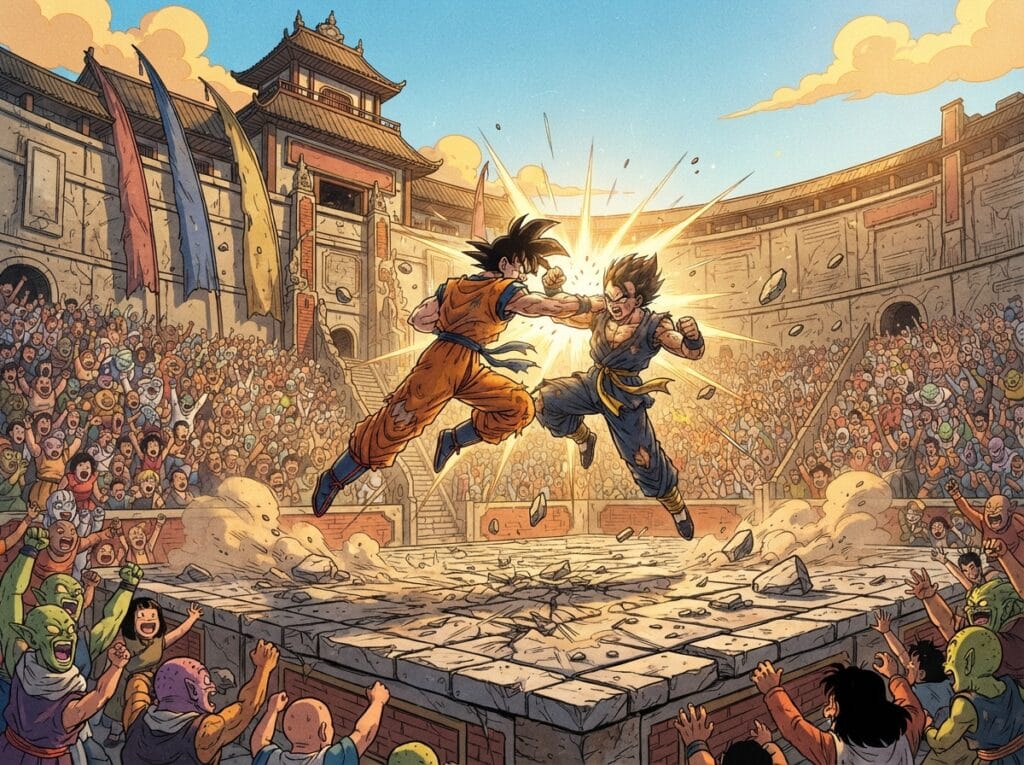
The World Martial Arts Tournament begins as a formal contest where skilled fighters test themselves before a large audience. The 21st Tenkaichi Budokai uses a simple ring-out format. A competitor loses after being forced outside the marked arena, becoming unable to continue, or surrendering. Weapons are not allowed, so each match focuses on movement, technique, endurance, and judgment. These rules make the tournament easy to follow while allowing fighters such as Goku, Krillin, Yamcha, and Jackie Chun to display different styles. Dragon Ball episodes 14–28, “The World Martial Arts Tournament.”
The prize structure gives the competition a practical purpose beyond personal pride. The champion receives 500,000 zeni, making victory valuable even for fighters who are not seeking fame. However, the event soon becomes more important as a meeting place for martial artists with different goals and training backgrounds. I see this most clearly when familiar rivals face one another and unexpected opponents test whether raw strength is enough to win. The ring-out rule keeps matches tense because a fighter can lose without being knocked unconscious.
Later, the 22nd Tenkaichi Budokai builds on this foundation by bringing together an even stronger group of rivals and showing the influence of competing martial arts schools. The tournament remains a public showcase, but its matches also reveal personal grudges, new techniques, and changes in each fighter’s skill. The event connects smaller martial arts rivalries to the larger conflicts that follow without becoming a separate survival competition. I view the 21st and 22nd tournaments as important milestones because they establish the Tenkaichi Budokai as both a serious sporting contest and a recurring gathering for Dragon Ball’s strongest martial artists.
Dragon Ball Tournament Rivalries

When I trace martial arts tournament history through Dragon Ball, I see the World Martial Arts Tournament evolve from a playful test of skill into a place where fighters confront serious personal goals. Jackie Chun’s battle with Goku first shows that winning is not the only measure of progress. Roshi uses the disguise to teach Goku humility and the value of continued training. Their close final also establishes the tournament as a contest where experience, strategy, and character matter as much as raw strength. Dragon Ball episodes 28–30, “The 21st World Martial Arts Tournament.”
By the 22nd World Martial Arts Tournament, Goku’s rivalry with Tien gives the event a more serious emotional foundation. Tien begins as a proud student of the Crane School, but his match with Goku challenges his belief that victory justifies cruelty and forces him to question his teacher’s lessons. Their final is decided by timing and circumstance rather than a simple display of power, making the result important to both fighters’ growth. I see this tournament as a turning point because Tien leaves it as a potential ally instead of remaining a traditional villain. Dragon Ball episodes 84–101, “The 22nd World Martial Arts Tournament.”
The 23rd World Martial Arts Tournament pushes the competition further by connecting it to revenge, identity, and Goku’s next stage of development. Piccolo enters under the name Ma Junior, carrying King Piccolo’s legacy and anger while hiding his true identity from the other competitors. Goku’s decision to face him in the final shows that the tournament is no longer just about proving who is strongest. The match also protects the world and settles an unfinished conflict. By the end, Goku has matured enough to think beyond immediate victory, while Piccolo’s survival creates a rivalry that develops into an unexpected partnership. Dragon Ball episodes 133–153, “The 23rd World Martial Arts Tournament.”
Z And Super Tournament Changes
The World Martial Arts Tournament returns in Dragon Ball Z with a junior division that lets younger fighters compete before the adult matches begin. This format introduces Trunks and Goten, whose abilities show how much the next generation has advanced, while Videl also becomes an important part of the tournament story. The adult division brings back familiar faces, but the competition soon becomes less important than the threat surrounding the arena. I see this era as a turning point because the tournament still uses a traditional ring and knockout rules, yet the fighters now face dangers far beyond an ordinary sporting event. Dragon Ball Z episodes 200–219, “The World Martial Arts Tournament.”
The tournament is disrupted when Babidi’s fighters target the energy of powerful competitors, drawing Goku, Vegeta, Gohan, and their allies into the conflict with Majin Buu. As a result, the adult matches are abandoned or pushed aside, showing that the event can no longer remain separate from the larger battles shaping Earth’s future. This disruption also changes the tournament’s role in the story. It becomes a meeting point for heroes, rivals, and new fighters rather than a central contest. For me, that contrast explains why the World Martial Arts Tournament remains memorable even when the competition does not reach a normal conclusion. Dragon Ball Z episodes 200–219, “The World Martial Arts Tournament.”
Dragon Ball Super later expands martial arts competition beyond one arena and one planet. The Universe 6 Tournament places teams from different universes against one another in a structured series of matches while keeping the personal rivalries and ring-based action of the earlier tournaments. The Tournament of Power goes further by turning the contest into a large survival competition involving many universes, so it should not be confused with the recurring World Martial Arts Tournament. I view this progression as a shift from local martial arts history to interuniversal competition, with each format raising the scale and stakes. Dragon Ball Super episodes 28–41, “The Tournament of Destroyers.”
Tournament Legacy Across Eras

The original Dragon Ball series presents the World Martial Arts Tournament as a public contest with clear rules, prize money, and a ring-out victory condition. Fighters cannot rely on weapons or outside help, so the early matches highlight training, technique, creativity, and personal rivalries. The 21st, 22nd, and 23rd Tenkaichi Budokai gradually raise the skill level, moving from exciting human competition to battles involving superhuman fighters. I see these tournaments as both sporting events and storytelling stages because each match introduces new techniques, reveals character growth, and builds toward major conflicts.
Dragon Ball Z changes the stakes while keeping the tournament structure familiar. The 25th World Martial Arts Tournament offers a return to organized competition, but secret identities, unusual fighters, and the threat of Majin Buu quickly make the event part of a larger crisis. The later 28th tournament shifts attention back toward discovery and future potential, especially through Goku’s interest in Uub. Across these eras, the fighters become stronger, the rules matter less than the danger surrounding the matches, and the tournament connects one generation of heroes to the next.
By Dragon Ball Super, contests between powerful fighters can involve entire universes, but the World Martial Arts Tournament still provides the series with an important foundation. The Universe 6 versus Universe 7 competition expands the idea into a cosmic showcase, while the Tournament of Power serves a separate survival-based purpose rather than replacing the traditional World Martial Arts Tournament. I think the original ring remains important because it represents limits, fairness, spectators, and personal ambition in a story that eventually reaches gods and galaxies. Its legacy shows how martial arts tournament history can grow from local rivalries into universe-level storytelling without losing the appeal of one fighter facing another under agreed rules.
How Tournaments Shaped Dragon Ball
The World Martial Arts Tournament, or Tenkaichi Budokai, began as a local championship but quickly became one of Dragon Ball’s most important storytelling tools. In the early series, each tournament gave me a clear way to measure Goku’s progress while introducing memorable rivals such as Tien and Piccolo Jr. The contests also showed that victory was not always the same as becoming the strongest because strategy, discipline, and personal values often mattered just as much as power. By the 23rd tournament, the event had grown from a simple martial arts contest into a stage for resolving major conflicts and protecting the wider world.
In later eras, the tournament changed along with the series, shifting between serious battles, comedic moments, and glimpses of life beyond the main heroes. The 25th tournament introduced a new generation through Goten and Trunks while showing how fame, money, and public expectations had changed the competition. Even when the event moved into the background, it continued to connect characters, reveal new fighters, and provide a familiar measure of growth. Looking back, I see its history as a progression from a local championship to a defining part of Dragon Ball, with every era using the tournament to introduce rivals, test development, and expand the series’ world.
Frequently Asked Questions
1. What is martial arts tournament history?
Martial arts tournament history is the story of how combat contests developed from ancient wrestling and traditional challenges into organized events. I look at how rules, weight classes, scoring, officials, and safety standards shaped modern competitions. It also shows how different arts, including wrestling, judo, karate, taekwondo, and mixed martial arts, followed their own paths.
2. What is the World Martial Arts Tournament in Dragon Ball?
The World Martial Arts Tournament, or Tenkaichi Budokai, is a fictional competition where skilled fighters face one another in a public arena. In the 21st tournament, a fighter loses after being forced out of the ring, becoming unable to continue, or surrendering. Weapons are not allowed, so each match focuses on movement, technique, endurance, and judgment, as shown in Dragon Ball episodes 14–28, “The World Martial Arts Tournament.”
3. How does the World Martial Arts Tournament compare with real martial arts competitions?
The World Martial Arts Tournament uses a simple ring-out format, while real competitions usually rely on points, penalties, time limits, submissions, or knockouts. Modern events also use trained officials, weight classes, medical checks, and detailed safety measures. Both types of tournaments test skill and preparation, but real competitions follow standards designed to protect athletes and create fair matches.
4. Why were rules important in the development of martial arts tournaments?
Rules made it possible to compare fighters fairly and give spectators a clear way to understand each match. They defined legal techniques, prohibited dangerous actions, and created consistent ways to decide a winner. I see this change as a major step from informal challenges toward organized championships.
5. How did martial arts tournaments become international events?
Martial arts tournaments expanded internationally as organizations created shared rules, formal championships, and systems for training judges and referees. Judo, karate, taekwondo, wrestling, and other disciplines gained wider recognition through national and international events. The Olympic Games also helped bring several combat sports to audiences around the world.
6. How did safety and technology change martial arts tournaments?
Safety rules introduced measures such as protective equipment, weight divisions, medical checks, and limits on dangerous techniques. Technology later improved judging through video review, electronic scoring, digital timers, and clearer broadcasts. These changes made tournaments safer, more accurate, and easier for fans to follow.
7. When did women become more included in martial arts tournaments?
Women’s participation grew as governing bodies created more divisions, championships, and equal opportunities for athletes. Judo, taekwondo, wrestling, karate, and mixed martial arts now include major women’s competitions at national and international levels. This progress helped tournaments represent a wider range of athletes and made martial arts more accessible.
8. What makes martial arts tournaments important today?
Modern tournaments preserve the central goals of martial arts, including discipline, technique, courage, and controlled competition. They also give athletes a structured way to test their training against different styles and opponents. I see them as a bridge between traditional fighting practices and the organized sports enjoyed by audiences today.