If you have ever wondered what it takes to reach the top of the world in the Dragon Ball universe, you are likely thinking about Korin Tower. Standing over 8,000 meters tall, this massive white spire stretches from the earth all the way into the stratosphere. It is a legendary test of endurance that pushes even the strongest martial artists to their absolute physical limits. I have always been fascinated by how this simple, slender structure serves as the ultimate gateway between the mortal world and the heavens above.
The legend of the Sacred Water at the summit is what drives most people to attempt the grueling multi-day ascent. While many believe a single sip of this water grants magical power, the real secret is far more interesting than any potion. The true strength comes from the sheer struggle of the journey and the mental toughness required to keep moving upward when the air gets thin. Watching characters like Goku tackle this vertical marathon shows us that real growth happens during the climb itself.
Key Takeaways
- Korin Tower serves as a grueling test of endurance, standing over 8,000 meters tall as a perfectly vertical pillar that forces climbers to push past their absolute physical and mental limits.
- The legendary Sacred Water at the summit is actually ordinary tap water, revealing that true strength is gained through the struggle of the journey rather than a magical shortcut.
- The climb acts as a vital training tool that forges warriors through intense cardiovascular effort and thin-air conditioning, bridging the gap between grounded martial arts and superhuman power.
- Success on the tower is defined by the time and effort invested in the ascent, as those who bypass the physical struggle fail to achieve the spiritual and physical growth earned by those who climb manually.
Physical Scale Of The Korin Tower Climbing Feat
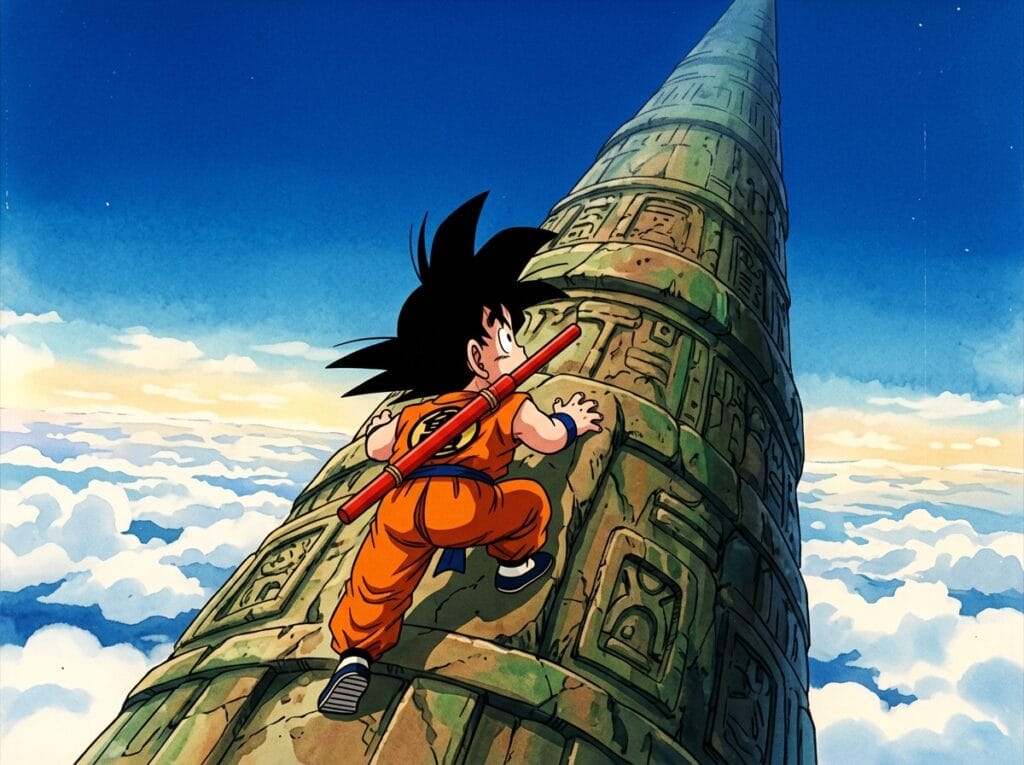
To understand the scale of the Korin Tower climb, you have to imagine looking up at a structure that pierces the heavens. Official guidebooks list this massive white pillar at over 8,000 meters tall, placing it in the same league as the highest peaks on Earth. While Mount Everest stands at 8,848 meters, Korin Tower is a perfectly vertical, smooth surface with no ridges or base camps to rest on. This means a climber is essentially performing a non-stop pull up for miles on end while the air gets thinner with every single inch. Goku first faces this overwhelming physical challenge during his desperate quest to defeat Mercenary Tao in Dragon Ball episode 58, The Land of Korin.
The sheer height of the tower means that the journey takes a massive toll on the body and the mind. Unlike a mountain trek with zig-zagging paths, this is a grueling vertical sprint that forces characters to push past their absolute physical limits. Because the summit sits above the clouds and reaches toward the stratosphere, the oxygen levels drop significantly as the climber nears the top. This air gets thin, making every movement feel like lead, turning a test of strength into a legendary battle of willpower. Goku eventually masters this ascent, but it takes him three full days of climbing to reach the summit for the first time in Dragon Ball episode 61, Korin Tower.
What makes this 8,000 meter feat so special is that the tower itself acts as the ultimate training tool. While legends say the Sacred Water at the top grants power, the real strength comes from the massive cardiovascular effort and muscular effort required to reach the peak. By the time a warrior reaches the home of Master Korin, their body has been forged by the most intense gravity-defying workout imaginable. It is a beautiful bridge between the grounded martial arts of early Dragon Ball and the superhuman feats that define the rest of the series. Yajirobe even manages to scale the tower while carrying a wounded Goku on his back in Dragon Ball episode 114, Conquest and Rebellion.
Legendary Records Of The First Tower Climbers

Master Roshi was the first person in the modern era to reach the summit, and his journey remains a testament to the dedication required by early martial artists. It took him three full years to finally catch Korin and earn the right to drink the water, which shows just how much grit he had before he ever met Goku. This lengthy timeframe highlights that while Roshi was incredibly strong for a human, he still had to push his physical limits to their absolute breaking point. His ascent set the standard for what it meant to be a legend in the world of martial arts, Dragon Ball episode 61, Korin Tower.
When Goku arrived at the base of the tower, he managed to shatter Roshi’s record by completing the climb in just one day. This incredible speed immediately signaled that Goku possessed a level of natural potential and raw power that far surpassed his master. Even after the exhausting climb, he spent three days trying to take the water from Korin before he finally succeeded. This specific training arc transformed him from a talented boy into a warrior capable of taking on the world’s deadliest threats, Dragon Ball episode 62, Sacred Water.
Mercenary Tao provided a chilling contrast when he used his own unique method to reach the top in a matter of seconds. By throwing a stone pillar and riding it through the air, he bypassed the physical struggle that defines the tower’s true purpose. While his arrival was fast, his lack of actual climbing meant he never gained the spiritual or physical growth that Goku and Roshi earned through hard work. This difference in their journeys proves that the time spent on the climb is just as important as reaching the peak itself, Dragon Ball episode 64, The Last of Mercenary Tao.
The Secret Truth Behind The Sacred Water
When I first watched Goku struggle to reach the top of the massive tower, I was just as convinced as he was that the Sacred Water held magical properties. After all, climbing over 8,000 meters into the clouds is a feat that should lead to a legendary reward at the summit. You spend the whole journey anticipating a massive power boost from a single sip of that mystical liquid. It is a classic trope that makes us focus on the destination rather than the grueling path taken to get there. This legendary ascent serves as a bridge between simple martial arts and the supernatural growth seen later in the series, Dragon Ball episode 61, Korin Tower.
The big twist is that the Sacred Water is actually just ordinary tap water, which feels like a total shock after seeing Goku spend three days trying to snatch it from Korin. I realized that the true power did not come from the bottle, but from the relentless effort of climbing and the agility required to catch the master cat. Understanding the secrets of Master Korin and his methods reveals that every muscle Goku built and every breath he took in the thin air of the stratosphere was what actually increased his strength. Korin’s game was a clever ruse designed to force a warrior to surpass their own physical limits through pure repetition and determination. The struggle itself was the real miracle, proving that there are no shortcuts to becoming a legend, Dragon Ball episode 64, The Last of the Sacred Water.
The True Reward of the Ascent
Looking back at the legendary ascent of Korin Tower, it is clear that this climb is much more than just a physical challenge. It stands as a timeless symbol of perseverance, teaching us that there are no shortcuts to true strength. While the promise of the Sacred Water draws many to the base, the real transformation happens within the clouds during that grueling trek. I love how this journey reminds us that the struggle itself is often the greatest reward we can find. By the time a climber reaches the summit, they have earned a level of mental toughness and discipline that no magical potion could ever provide.
The tower serves as a vital bridge between the mortal world and the mystical realm of Kami’s Lookout. Reaching the top is a spiritual milestone that proves a warrior is finally ready to look toward even higher levels of divinity. It connects the early days of youthful adventure with the grand, cosmic scale of the later series. Every time I think about that slender spire piercing the stratosphere, I am reminded of the Korin Tower history and lore that define the heart of the story. This climb remains one of the most iconic moments of growth for the heroes we have followed for years.
Frequently Asked Questions
1. How tall is Korin Tower exactly?
Korin Tower stands at a massive height of over 8,000 meters tall. This makes it nearly as high as Mount Everest, but it is much harder to climb because it is a perfectly vertical pillar Dragon Ball episode 58, The Land of Korin.
2. How long does it take to reach the top?
A normal climber would take weeks to reach the summit, but a skilled martial artist like Goku managed to do it in three days his first time. The journey requires non-stop movement without any places to stop and rest Dragon Ball episode 59, The Red Ribbon Force.
3. Does the Sacred Water really give you magical powers?
The Sacred Water itself is just regular water and does not actually have magical properties. The real power comes from the intense physical training and mental toughness you gain during the long climb and the struggle to catch Korin Dragon Ball episode 61, Korin Tower.
4. Can anyone climb the tower?
While anyone can try, the tower is designed to test the absolute limits of human endurance. Most people give up because the air becomes very thin and the physical strain of pulling yourself up for miles is overwhelming Dragon Ball episode 58, The Land of Korin.
5. Where is Korin Tower located?
The tower is located in a remote area known as the Land of Korin. It is guarded by Upa and his father Bora, who protect the sacred ground at the base of the spire Dragon Ball episode 58, The Land of Korin.
6. What happens when a climber reaches the summit?
Once you reach the top, you meet Master Korin, a wise martial arts master who lives in a small shrine. You must then pass his test of speed and agility to earn the right to drink the Sacred Water, or even the more potent Ultra Divine Water, Dragon Ball episode 60, Korin of Korin Tower.