Dragon Ball anime production is a detailed process that turns manga panels into action, sound, music, and motion. I trace how the original story moves through publishers, rights holders, writers, artists, voice performers, and animation teams before reaching the screen. With two new Dragon Ball Super television projects entering the spotlight, understanding this process makes the franchise’s next era easier to follow.
From story planning and character design to episode scheduling and final editing, each stage shapes how Dragon Ball feels and looks. I explain who makes the key decisions, how television production has changed over time, and why some arcs take longer to adapt than others. The result is a clear look at the creative and practical work behind one of anime’s most enduring series.
Key Takeaways
- Dragon Ball anime production is a collaborative process involving manga creators, publishers, rights holders, writers, directors, animators, voice performers, broadcasters, and promotional partners—not a single studio working alone.
- Adapting manga into weekly television episodes requires story planning, scripts, storyboards, character designs, animation, compositing, voice recording, music, editing, and quality checks. Tight schedules often lead to extended scenes, filler, repeated shots, or uneven artwork to prevent the anime from catching up with the manga.
- Dragon Ball’s visual style and pacing have evolved across Dragon Ball, Dragon Ball Z, GT, Kai, and Super as different teams adopted new creative priorities and digital production tools while preserving the importance of strong poses, timing, and expressive action.
- Two separate Dragon Ball Super television projects represent different production directions: Dragon Ball Super: Beerus revisits earlier material and is scheduled for Japan in fall 2026, while the Galactic Patrol Prisoner arc will adapt new manga material without an announced premiere date.
Dragon Ball And Its Origins
The original manga provided the foundation for the Dragon Ball television series. Publishers managed the manga and related rights, while the animation studio adapted the story for television. A Japanese broadcaster then provided the platform that brought the anime into viewers’ homes. I find it helpful to view these roles as part of one production chain, with the manga providing the source material, the animation team managing production, and the broadcaster connecting finished episodes with viewers.
The original Dragon Ball anime premiered in Japan in 1986, followed by Dragon Ball Z in 1989 as the story moved into more dramatic battles and expanded mythology. The animation team adapted manga chapters into television scripts, storyboards, character layouts, animation, voice recording, music, and completed episodes. Because the show was produced while the manga was still being serialized, the staff sometimes extended scenes or created original material to maintain distance from the source. That challenge helped Dragon Ball become a long-running television series, but it also explains why the anime can move at a different pace from the manga.
I see Dragon Ball’s success as the result of close coordination between creative and production partners rather than the work of one studio alone. Toriyama’s designs and storytelling established the foundation, publishers managed the manga’s release and related rights, and the animation team shaped those pages into performances with motion, sound, and timing. Broadcast scheduling and promotion also helped the series reach a broad audience over many years. Together, these roles created a repeatable process that carried Dragon Ball from printed chapters to a television franchise with lasting global influence.
From Manga Panels To Animated Episodes

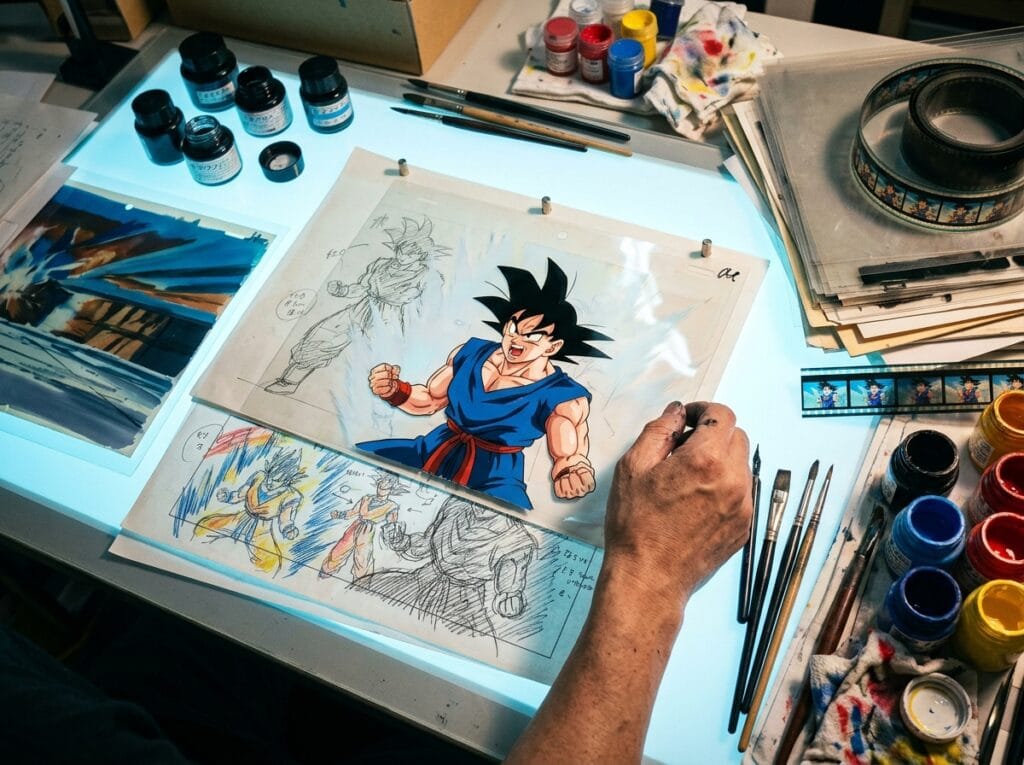
I see Dragon Ball anime production as a chain of connected decisions that begins before any drawing is animated. Story planners adapt the manga into episode outlines, writers shape those outlines into scripts, and storyboard artists plan the camera angles, timing, action, and dialogue. Character designers then prepare model sheets so artists can keep faces, clothing, and forms consistent. Key animators draw the most important poses, while other artists add the movement between them. This stage turns still manga panels into a visual plan for a complete episode.
After the main drawings are approved, production moves through coloring and compositing, which combines characters, backgrounds, effects, and camera movements into finished shots. Music and sound effects add energy to battles and emotion to quieter scenes, while voice actors record dialogue to match the animation. A weekly television schedule leaves little room for major delays, so limited time can lead to simpler motion, repeated shots, or uneven artwork between episodes. The production team must also balance the manga’s pace with the need to deliver a new broadcast episode regularly. When the anime catches up with the source material, original filler stories or extended scenes can create more distance and keep the adaptation moving.
The final episode passes through editing, quality checks, audio mixing, and broadcast preparation before it reaches television audiences. I find this last step important because it shows that animation is not finished when the drawings are complete. Every scene must work as part of a timed program. Manga pacing strongly affects the result, since a short printed scene may need extra dialogue, reaction shots, or action to fill an episode. At the same time, a demanding schedule can limit revisions and make production problems visible on screen. The finished Dragon Ball episode is therefore both an adaptation of the manga and a record of the choices made under weekly television pressure.
Dragon Ball Animation Styles And Production Changes
Dragon Ball anime production changed noticeably between the original series, Dragon Ball Z, and Dragon Ball GT. I can see this in the character designs, which grew sharper and more muscular as the stories became more focused on powerful battles. Dragon Ball often used softer expressions and brighter colors, while Dragon Ball Z added stronger shadows, dramatic speed lines, and larger action scenes. Dragon Ball GT kept much of the Z look but used a different creative approach, with more emphasis on travel, science fiction, and new settings. The opening sequences also reflected these shifts, moving from playful adventure themes to bold songs and fast images built around transformation and conflict.
Dragon Ball Kai shows how older animation can be reshaped without creating an entirely new series. The production team remastered the original footage, meaning they cleaned and adjusted it for modern television, while also trimming much of the material that had expanded beyond the manga. Dragon Ball Super then combined traditional hand-drawn character work with digital coloring and compositing, the process of layering drawings, effects, and backgrounds into one image. Its fight scenes often use wider camera angles, rapid movement, and effects that make energy attacks feel larger than in earlier shows. Across the series, the openings became more polished and cinematic, using editing, music, and visual effects to establish each story arc quickly.
I find the biggest difference is not just the technology, but how each production team interpreted the source material. Some teams highlighted comedy and expressive faces, while others focused on scale, tension, or carefully staged martial arts movement. The shift to digital tools made it easier to adjust colors, add glow effects, and create complex backgrounds, but strong timing and clear poses remained central to the action. New Dragon Ball Super projects also show how the franchise continues to revisit earlier material while expanding its animated world with fresh production goals. Looking at these changes together makes Dragon Ball anime production easier to understand as an evolving process rather than one fixed visual style.
Dragon Ball Super Production And Future Projects

Dragon Ball Super was built through a partnership between an animation studio, a Japanese broadcaster, and a promotional partner. The animation studio handled the series’ production, the broadcaster provided its television platform, and the promotional partner supported the business and marketing work. I find this structure useful because it shows that a major anime is not created by one studio working alone. Writers, directors, animators, broadcasters, and rights partners must coordinate to turn the original Dragon Ball material into a television series.
Creating new material after the original television run presented a different challenge. The production team had to expand the story while respecting the characters, world, and tone that longtime fans already knew. It also had to balance television scheduling with the time needed to plan episodes, animate action scenes, and maintain a consistent visual style. In my view, this helps explain why Dragon Ball Super became both a continuation of the earlier anime and a new production with its own pacing and creative decisions.
Two separate Dragon Ball Super television projects have now been announced, marking an unusually active period for the franchise. Dragon Ball Super: Beerus is an enhanced reworking of the early Super material and is scheduled to arrive in Japan in fall 2026. Separately, the Galactic Patrol adaptation, based on the manga’s Galactic Patrol Prisoner arc, has entered production but does not yet have an announced premiere date. I see these projects as different production efforts rather than one continuous release, with Beerus revisiting existing material while Galactic Patrol moves the story into a new animated arc.
How Dragon Ball Anime Comes Together
Dragon Ball anime production brings together manga adaptation, studio coordination, animation craftsmanship, and the practical demands of television broadcasting. I see the process as a careful balance between preserving the source material and expanding it into movement, sound, music, and performances that work on screen. Episode schedules can shape pacing, while production teams must manage storyboards, key animation, voice recording, editing, and delivery deadlines. Long-running series also need planning that keeps characters, designs, and story arcs consistent across television specials, films, and new projects.
Each production era gives Dragon Ball its own visual and storytelling identity because creative priorities, broadcast conditions, and available animation methods continue to change. Earlier episodes often show the energy of hand-drawn experimentation, while later productions may use updated digital tools, sharper compositing, and more elaborate action staging. I also find that franchise planning influences how stories are expanded, revisited, or adapted for new audiences, including the announced Dragon Ball Super: Beerus project and the Galactic Patrol Prisoner arc adaptation. Looking at these choices makes the anime more than a simple manga translation, because every era reflects the people, tools, schedules, and creative decisions behind its journey to television.
Frequently Asked Questions
1. What is Dragon Ball anime production?
Dragon Ball anime production is the process of turning manga chapters into television episodes with story scripts, storyboards, character designs, animation, voices, music, and editing. I see it as a team effort that connects Akira Toriyama’s original work with the finished series viewers watch.
2. Which organizations and creators helped bring Dragon Ball to television?
Publishers released the manga in a popular Japanese manga magazine, while Toriyama supported the creative work and identity of the Dragon Ball world. An animation studio managed production, and a Japanese broadcaster provided the television platform.
3. When did the Dragon Ball anime first begin?
The original Dragon Ball anime premiered in Japan in 1986. Dragon Ball Z followed in 1989, continuing the story with larger battles, new characters, and a wider mythology.
4. How does the manga become a Dragon Ball anime episode?
The production team first plans the story, then prepares a script, storyboard, character layouts, animation, voice recording, music, and final edits. I view each stage as important because changes in timing, movement, sound, and camera work shape how the manga feels on screen.
5. Why does the Dragon Ball anime include scenes that are not in the manga?
The anime was produced while the manga was still being serialized, so the television team sometimes needed to slow the adaptation and maintain distance from the source. To do that, staff extended battles, added scenes, or created original material instead of moving through manga chapters too quickly.
6. Who makes the main creative decisions during Dragon Ball production?
Toriyama’s manga provides the original story and character foundation, while the animation studio and its production staff decide how to adapt that material for television. Directors, scriptwriters, artists, animators, voice performers, composers, editors, publishers, rights holders, and broadcasters each influence a different part of the final result.
7. Why do some Dragon Ball story arcs take longer to adapt than others?
Arc length depends on the number of manga chapters, the amount of action, the need for added anime material, and the television production schedule. Major battles often require more animation planning and editing, while slower scenes may be expanded to keep the anime from catching up with the manga.

