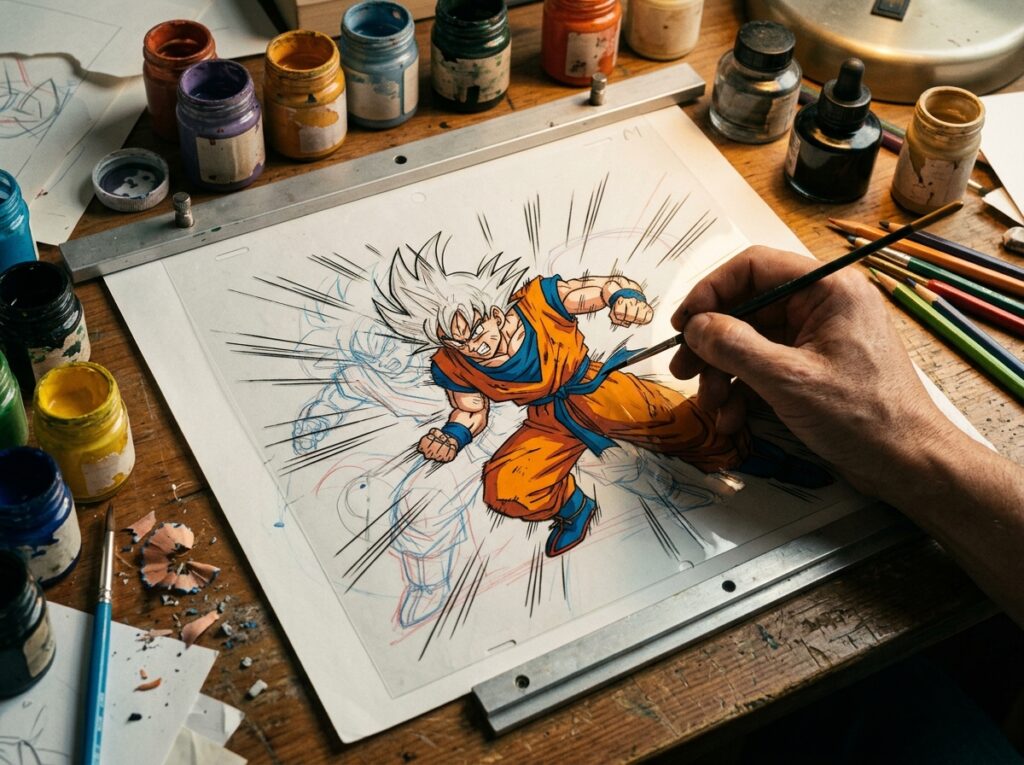
The Dragon Ball animation process turns a planned story into an episode through scripts, storyboards, drawings, color, backgrounds, sound, and editing. At Toei Animation, these stages connect artists and production teams. Each step shapes how the action, performances, and mood appear on screen.
Toei reports an average of 3,000 to 4,500 drawing sheets per TV episode across its productions. This company-wide figure is not a count for a Dragon Ball episode. Dragon Ball DAIMA offers a recent example of the creative work involved: Akira Toriyama contributed to its original concept, story, and character designs, and all 20 episodes aired between October 2024 and February 2025. From adapting a story for the screen to refining a punch, transformation, or quiet reaction, each stage involves important choices. Following the process helps explain why an episode’s look can vary and how a story on the page becomes a finished Dragon Ball adventure on screen.
Key Takeaways
- Toei’s general workflow turns a plan and screenplay into an episode through storyboards, animation, color, backgrounds, effects, recording, and editing, though the exact process can vary by project.
- Dragon Ball adaptation choices shape how a scene feels: scripts and storyboards arrange events, while shots, timing, movement, dialogue, and sound guide the audience’s attention.
- Key animation sets major poses, and in-between drawings connect them; Toei’s reported 3,000 to 4,500 drawing sheets per TV episode is a company-wide average, not a Dragon Ball-specific count.
- Dragon Ball’s look can vary across scenes and episodes because choices in movement, linework, color, backgrounds, and effects shape each moment; a different style does not necessarily mean lower animation quality.
- For Dragon Ball DAIMA, Akira Toriyama contributed to the original concept, story, and character designs, and all 20 episodes aired between October 2024 and February 2025.
How Does Toei Turn Scripts Into Episodes?
Dragon Ball episodes are made through connected stages, from planning and scripts to drawing, color, sound, and editing. We can think of Toei Animation’s published workflow as a series of handoffs. Each stage prepares material for the next, gradually turning a written story into a finished episode. The process begins with planning and a screenplay. Planning includes setting a budget and creating a business scheme for the project. The screenplay describes what happens and what characters say. Storyboards map out the shots and show how scenes and actions will appear on screen. Artists create key animation to establish important poses, such as the start and end of a character’s movement. Color designations show which colors to use for characters and objects. In-between drawings fill the gaps between key poses to make movement appear smoother. Background artists create the settings, while coloring adds the assigned colors to the drawings. Computer-generated imagery, or CG, can add digital elements. Special effects create visual details such as bursts of energy, smoke, or light. Compositing brings the visual layers together, combining characters, backgrounds, and effects into a single image. The workflow then moves to recording, where voices and other audio are captured, and editing, where the scenes and sound are arranged into the finished episode. Each stage has a different task: a storyboard plans the view, animation creates movement, and compositing combines the pieces viewers see. Toei’s workflow gives a general picture of how production moves from the initial plan through final editing, though the exact process can vary between projects.
From Manga to Screen
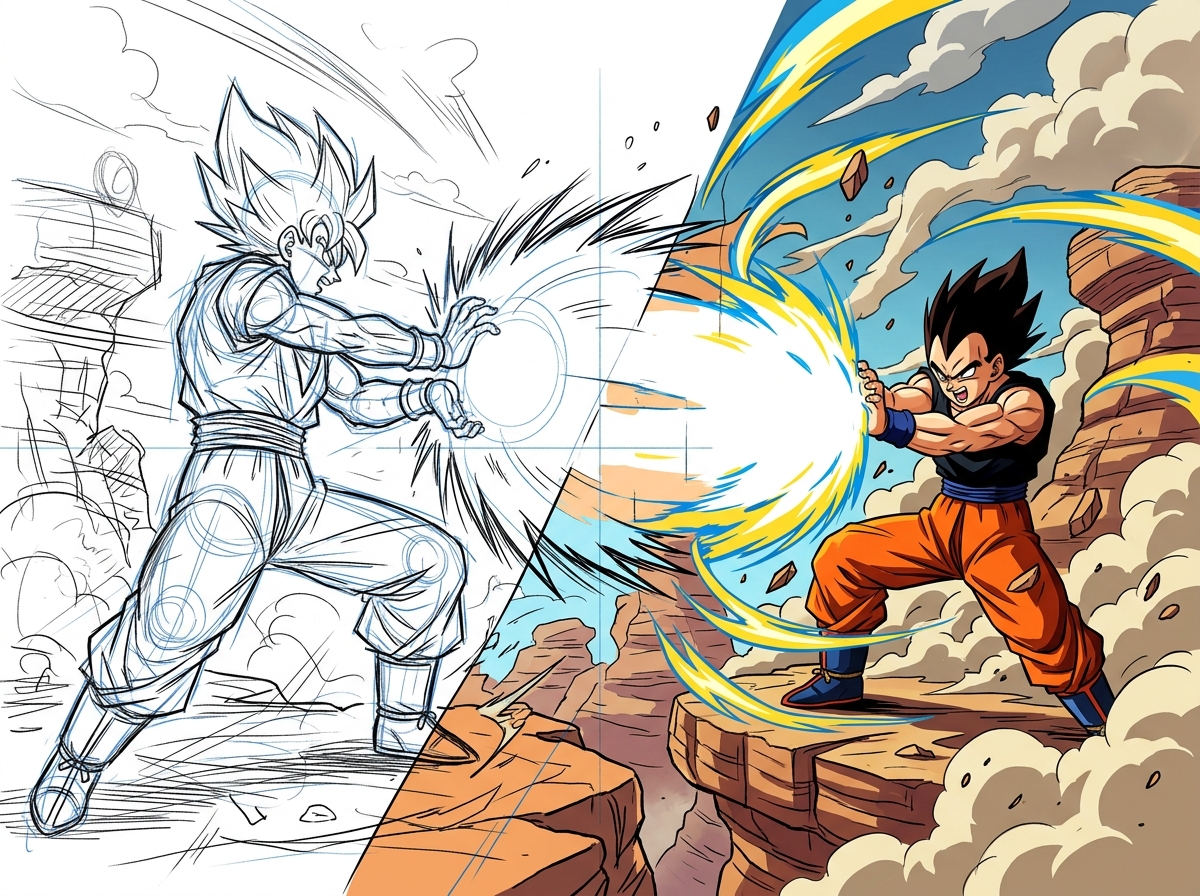
A manga page and an anime episode use different tools to tell a story. When a Dragon Ball story is adapted, the team shapes the material to fit an episode. They decide what to keep, where to add space for a reaction or exchange, and how to arrange events for the screen. The story is then divided into scenes and shots. A script sets out the action and dialogue, and storyboards turn that plan into a visual sequence, showing what the audience sees and when.
A shot can change how a moment feels. A close view of a character’s face can make a pause feel tense, while a wider view can show the distance between fighters or the scale of a setting. A quick cut can make an attack feel sudden, while holding on a pose can give the movement more weight. Choices like these shape pacing and episode structure without changing the story’s basic events.
On screen, images, timing, dialogue, and sound work together to convey action, emotion, and movement. A character’s expression can show uncertainty, while a pause before a reply gives that feeling time to register. Sound can make a movement feel forceful or help a quiet moment stand out. The script and storyboard plan these story beats, but their effect depends on how the scenes are performed and assembled.
These adaptation choices are separate from the animation work that brings planned scenes to life. Adaptation determines what a scene needs to communicate and how it is arranged. Artists and other production teams create the drawings, backgrounds, effects, and finished images. A storyboard may call for a fast burst of movement, for example, but making it easy to follow takes visual work at every stage. The balance can differ across Dragon Ball projects and episodes, so the path from manga to screen is not always the same.
What Happens During Key Animation?
Key animation establishes a scene’s major poses and actions. In-between drawings connect those poses to create smoother movement. A key animator might define the crouch before a punch, the arm’s full extension, and the fighter’s reaction. In-between artists draw the motion that links those moments. Pose, timing, camera framing, and effects all help make the action clear and exciting. A punch can feel powerful when the attacker’s body twists into it, the impact lands after a brief pause, and the shot frames both fighters. Flight can feel fast through changing poses and shifting views, while a transformation can build tension by holding on a character before the new form appears. An energy blast is easier to follow when its direction, light, and impact are clear. The amount of drawing varies across a production. Toei Animation reports a company-wide average of 3,000 to 4,500 drawing sheets for a TV-series episode, with the total varying by work and episode. Toei also says it produces more than 250 episodes a year overall. These company-wide figures reflect the scale of Toei’s work. In any single action scene, drawings work with framing and effects to guide the viewer’s eye. Clear poses show what a character is doing, and carefully timed movement makes the action feel deliberate rather than like a jumble of images.
How Did Cel Animation Shape Dragon Ball?
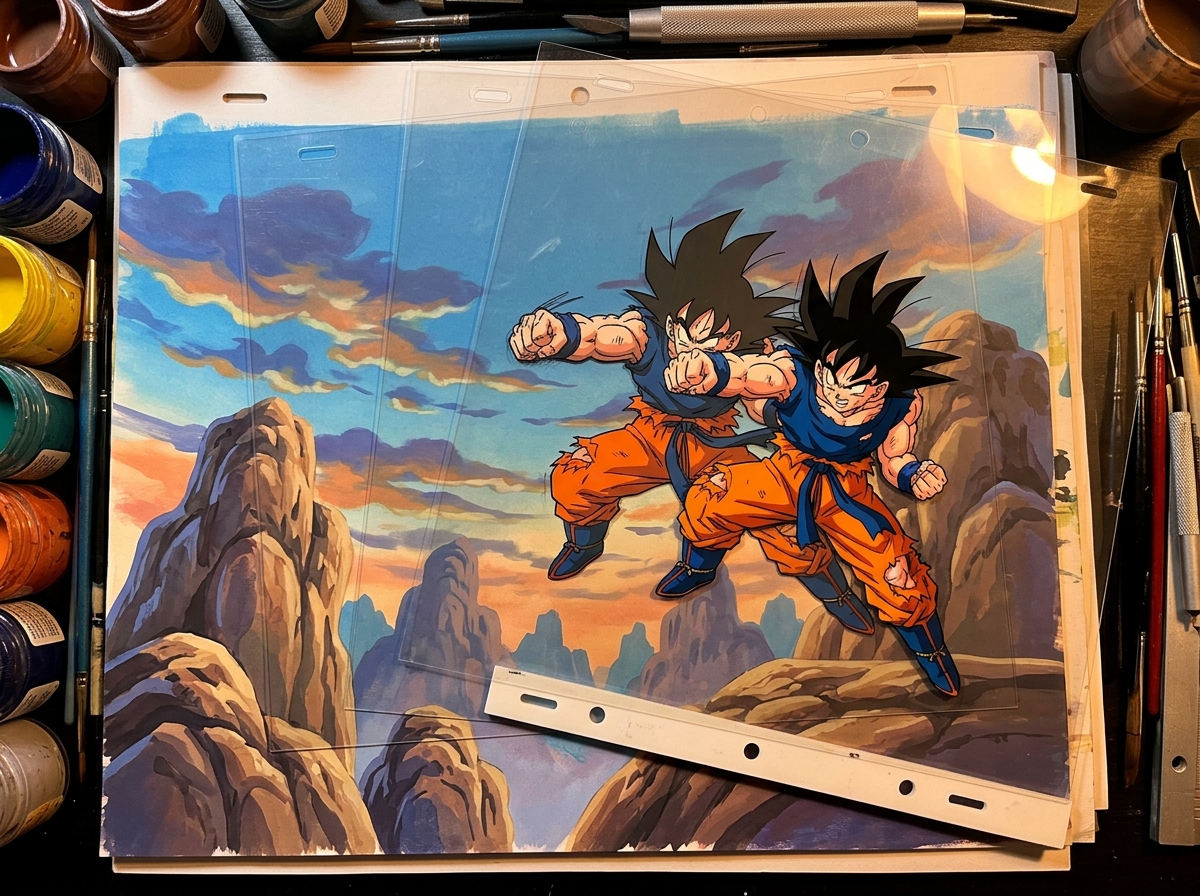
Cel animation shaped the look associated with earlier Dragon Ball and Dragon Ball Z. It used hand-drawn images and painted layers photographed together to create moving pictures. Artists drew characters, transferred the drawings onto clear sheets called cels, and painted colors onto those sheets. A camera photographed the cels over painted backgrounds, one image at a time. Each layer added something different to the finished shot. Character drawings provided the poses, expressions, and movement, while painted backgrounds established the setting, such as a rocky battlefield or a quiet room. The contrast between a sharply outlined character and a detailed background could make the action easy to follow and give the scene a sense of place. Effects added another layer of visual energy. For example, artists could draw and paint a fighter’s glowing aura separately from the character, then combine it with the other layers for the shot. Bright colors and sharp shapes made the energy stand out, while changes in the aura’s outline and position suggested movement. Camera work and other finishing effects could also change how bright or intense the glow appeared. The result was more than a set of moving character drawings. Color choices helped separate figures from their surroundings, and background painting gave locations texture and depth. Cel layers also let artists plan how effects, characters, and settings would overlap in the frame. The process could vary from shot to shot and episode to episode. Some scenes relied on simple backgrounds or limited movement, while others called for more detailed settings and layered effects. This flexibility helped give Dragon Ball’s fights, transformations, and quieter scenes distinct visual moods.
Why Does Dragon Ball’s Animation Look Different?
Dragon Ball’s animation looks different because each finished scene reflects a mix of visual choices and production work. Those choices can vary across episodes, scenes, and series. Drawings, movement, color, backgrounds, effects, and visual direction all shape what appears on screen. A change in any of these can make a scene feel distinct, even when the characters and story belong to the same series.
Animation quality and art style are related, but they are not the same. Quality often describes how clearly an action reads or how smoothly movement flows. Art style describes choices such as character proportions, line shapes, facial expressions, color palettes, and shot framing. A scene can use a different style without having less fluid movement. It can also have strong, clear drawings while using a simpler design than another scene.
For example, one scene might use sharper outlines, stronger shadows, and a dramatic background to make a fight feel intense. Another might use softer colors and simpler expressions to keep attention on a conversation. Effects such as light, smoke, or energy can also change a scene’s appearance, while timing and poses determine how the action moves. These differences can be deliberate visual choices rather than signs of a production problem.
Toei Animation’s general workflow includes work across Oizumi Studio, its Manila subsidiary, Toei Animation Phils., Inc., and 21 domestic production studios, connected through a digitized production network. This broad setup shows how Toei organizes production. The look of a finished scene depends on the creative and production choices made for that scene.
We can notice variation without reducing it to a single explanation. Changes in linework, background detail, movement, or effects can alter the feel of a scene. A series can also use different visual approaches to serve different moments.
How Has the Process Changed Over Time?
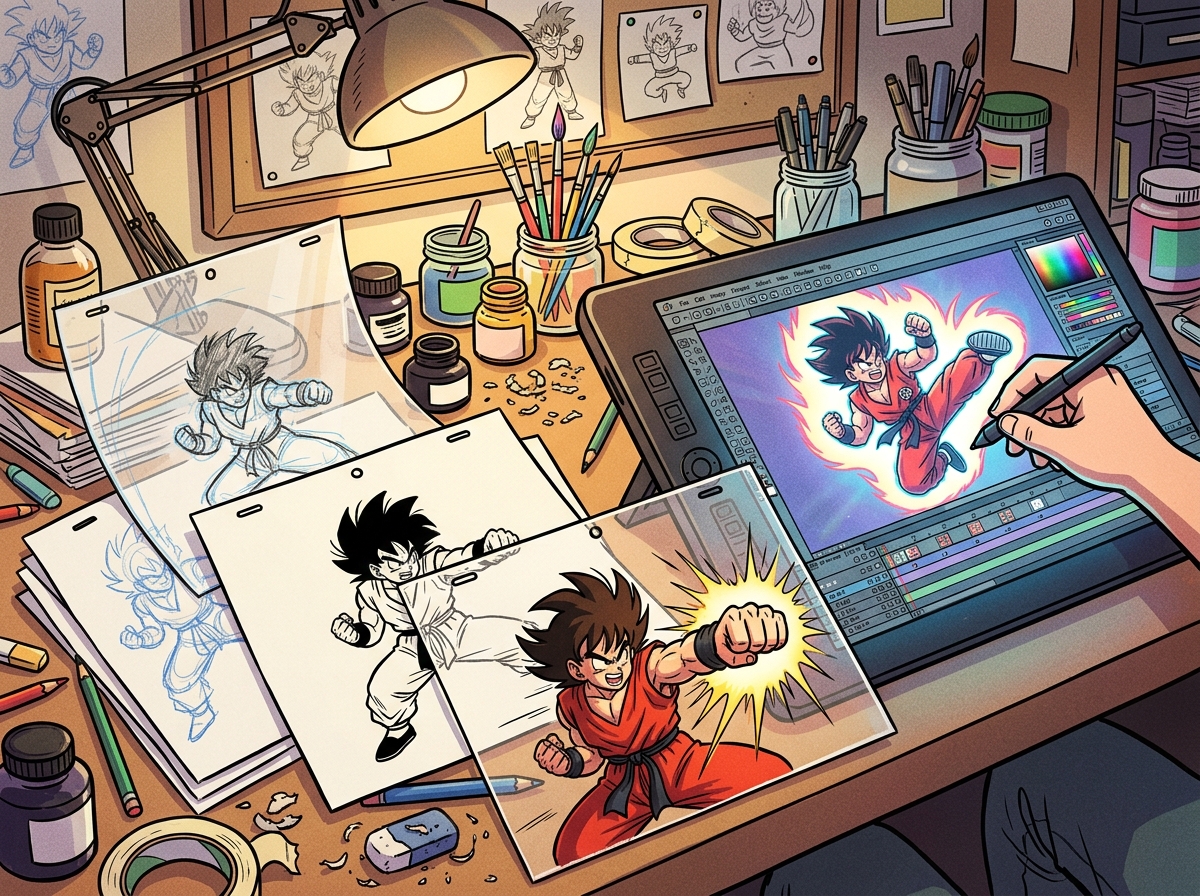
Anime production has moved from painted cels and camera-shot layers toward digital tools, but teams still need to plan scenes and create animation. Digital production can support coloring, visual effects, compositing, and coordination between people working on different parts of a project. These tools can change how artists prepare and combine images, while storyboards, key poses, and drawings still shape what happens on screen. Toei Animation describes a digitized production network linking its Oizumi Studio with Toei Animation Phils., Inc. and 21 domestic production studios. Dragon Ball DAIMA is a recent example of the franchise’s continuing production. Toei said Akira Toriyama worked on the series’ original concept, story, and character designs. The series began airing in Japan on October 11, 2024, and all 20 episodes had aired by February 2025.
Where Does Toriyama’s Input Fit?
Akira Toriyama’s confirmed contribution to Dragon Ball DAIMA was creative. He worked on the anime’s original concept, story, and character designs. DAIMA is a clear example of his role in shaping a series before it reaches the screen. Creative input differs from the production work carried out by a wider team. A creator’s concept, story, and designs help guide what an anime is about and how its characters look. Planning, storyboards, animation, backgrounds, effects, recording, and editing turn that direction into finished episodes. Each area calls for its own decisions and skills. Toriyama’s creative role and the many production roles are distinct parts of making an anime. On January 25, 2026, Toei announced that Dragon Ball Super: The Galactic Patrol was set for production.
Following Dragon Ball From Page to Screen
To study adaptation closely, choose a Dragon Ball manga scene and find the same moment in the anime. A punch or energy attack is a useful place to start because the action gives you clear details to compare. Note which events appear in both versions, whether the anime adds a pause or reaction, and how camera views, movement, color, and sound change the scene’s impact. Keep your comparison focused on a short sequence rather than trying to judge an entire series at once.
If you are most interested in what may reach the screen next, read the Dragon Ball Super manga’s Galactic Patrol storyline and mark the moments you would most like to see animated. Notice how the manga uses panel size, character expressions, and shifts between action and dialogue. If the storyline is adapted for the screen, compare those choices with the finished scenes. This gives you a practical way to notice what animation adds, how pacing changes, and which visual moments take a different shape in motion. For production news, check Toei Animation’s official Dragon Ball announcements for confirmed updates about the series rather than treating fan predictions as production details.
Frequently Asked Questions
1. How long does it take to animate one Dragon Ball episode?
The time varies with the episode’s complexity, the amount of detailed movement and effects, and how the work is scheduled. A fight-heavy episode can require different animation work from one focused on dialogue and reactions.
2. What is the difference between animation and art direction in Dragon Ball?
Animation creates the characters’ poses and movement, while art direction shapes the scene’s overall visual look. This can include choices about color, lighting, backgrounds, and how characters and settings appear together.
3. Can viewers see original Dragon Ball animation cels?
Yes, viewers can see original Dragon Ball cels when they are displayed in exhibitions or collections. These transparent sheets were drawn and painted for traditional animation, then photographed with backgrounds to create moving images.

