
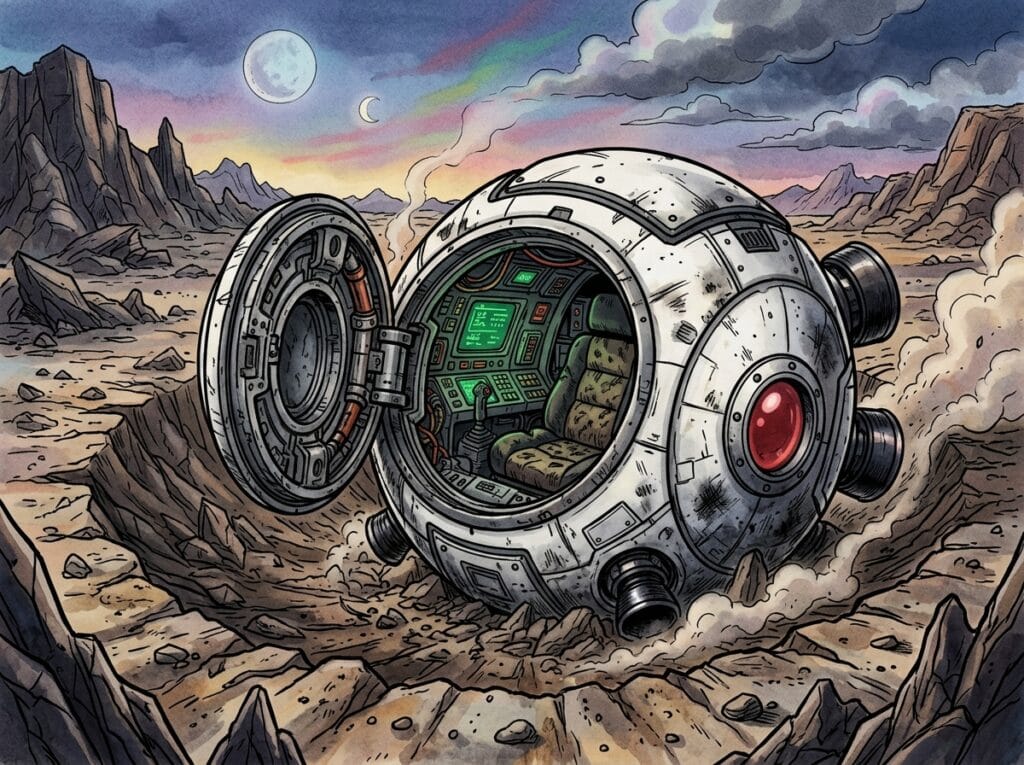
When I first saw those white spheres crash into the ground, I knew the world of Dragon Ball was changing forever. These iconic saiyan space pods are more than just round ships; they are the ultimate tools of interstellar conquest used by Frieza’s army. Despite their small size, these pods pack enough power to cross the galaxy at speeds faster than light.
I’ve always been fascinated by how a single warrior can survive inside such a cramped space for years at a time. The clever life support systems use suspended animation to keep passengers safe during the long trek between planets. It is incredible to think that these durable machines can withstand a crash landing and still be ready for the next mission.
Key Takeaways
- The Saiyan Attack Ball is a marvel of interstellar engineering, capable of traveling at speeds up to 3 light-years per hour while maintaining a compact 1.5-meter diameter.
- Integrated life support systems utilize suspended animation and atmospheric replenishment to sustain warriors for up to three years during long-distance galactic deployments.
- The pod’s high-strength armor is designed to survive high-velocity impacts, serving as a kinetic arrival tool that creates massive craters while leaving the pilot unharmed and ready for immediate combat.
- Advanced remote piloting and navigation features allow elite warriors to summon their ships via scouters or handheld controllers, ensuring a reliable extraction from any location on a target planet.
Technical Specifications Of The Saiyan Attack Ball
The Saiyan Attack Ball is a marvel of engineering that packs an incredible amount of technology into a tiny frame. These spherical ships measure only about 1.5 meters in diameter, which is just enough space to fit a single adult warrior comfortably. I find it amazing that such a small craft can survive a high-velocity impact with a planet’s surface without a single scratch. The high-strength armor is designed to withstand the extreme heat of atmospheric entry and the force of a crash landing as seen in Dragon Ball Z episode 1, The Mysterious Warrior.
These pods are built for long-distance travel across the galaxy at speeds that defy imagination. They are capable of faster-than-light travel, hitting speeds of up to 3 light-years per hour to reach distant targets quickly. To keep the pilot safe during these long trips, the ship puts the occupant into a state of suspended animation. This clever feature allows a Saiyan to survive for up to three years on a single tank of fuel. The life support systems even replenish themselves automatically if the pod flies through a habitable atmosphere for just ten minutes as shown in Dragon Ball Z episode 1, The Mysterious Warrior.
I love how the interior is designed to be purely functional for a race of conquerors. There are no fancy amenities or extra rooms, just a pilot seat and a control interface that responds to voice commands. Even though they look simple from the outside, these machines are durable enough to function as mobile headquarters once they land. The ships are so tough that they often create massive craters upon arrival while leaving the pilot completely unharmed. This durable construction ensures that a warrior is ready to fight the moment the hatch opens as seen in Dragon Ball Z episode 1, The Mysterious Warrior.
Faster Than Light Travel And Life Support Systems

I find it absolutely mind blowing that these tiny spherical ships can cross the vastness of space at speeds reaching three light-years per hour. When Nappa and Vegeta made their way to Earth, they spent a full year inside these cramped pods while traveling across the galaxy. This incredible velocity allows the Frieza Force to deploy warriors to distant planets in a fraction of the time it would take conventional spacecraft. The engineering behind the Attack Ball ensures that a Saiyan can cross an entire star system before their target even realizes they are coming Dragon Ball Z episode 7, Day 1.
Since sitting in a chair for a year would be impossible for even the toughest warrior, the pod uses a sophisticated suspended animation system. This technology puts the passenger into a deep sleep that slows down their metabolism and minimizes the need for food or water. I love how this setup allows a Saiyan to wake up feeling refreshed and ready for battle the moment they crash land on a new world. It is the ultimate way to handle long distance travel without the mental strain of being awake in a small space Dragon Ball Z episode 7, Day 1.
The life support systems are just as efficient, though they do require a quick pit stop every six months to keep the air fresh. All a pilot needs to do is dip into a habitable planet’s atmosphere for about ten minutes to replenish the onboard oxygen supply. These ships are even capable of carrying enough fuel for three years of continuous flight, making them perfect for long range scouting missions. It is fascinating to see how such a small machine provides everything a conqueror needs to survive the harsh conditions of deep space Dragon Ball Z episode 7, Day 1.
Remote Piloting And Navigation Features
One of the coolest things about the Saiyan Space Pod is how it integrates with other Frieza Force technology to make retrieval a breeze. While these ships are usually programmed for long-distance travel before launch, elite warriors like Vegeta have the ability to call their pods to their exact location using remote piloting commands. By using a handheld controller or even the interface on a scouter, a pilot can summon their ship to pick them up after a mission is complete. This remote piloting feature ensures that a warrior is never truly stranded on a planet even if they are miles away from their landing site Dragon Ball Z episode 32, Beyond the Limit.
The navigation systems inside these spherical crafts are incredibly advanced for their small size. Even when a pilot is incapacitated or in a state of suspended animation, the ship can receive new coordinates and change its flight path mid-journey. We see this level of control when Vegeta, despite being severely injured after his battle on Earth, manages to use his remote device to bring his pod directly to him for a quick escape. The ship responds instantly to these signals, proving that the technology is designed for high-stakes combat situations where every second counts Dragon Ball Z episode 32, Beyond the Limit.
These pods are more than just simple transport vehicles because they act as a lifeline for the Saiyans during their planetary invasions. The ability to control a ship from a distance means a warrior can focus entirely on the fight without worrying about where they parked their craft. Since the pods are built to withstand incredible impact and can be called at a moment’s notice, they provide a reliable way to exit a planet before it gets destroyed. It is this seamless connection between the pilot’s gear and the ship’s computer that makes the Attack Ball such a legendary piece of technology in the series Dragon Ball Z episode 32, Beyond the Limit.
Atmospheric Replenishment And Planetary Landing Impact

One of the most fascinating features of these round spacecraft is how they handle life support during long voyages across the galaxy. While a Saiyan is kept in suspended animation to save energy, the ship still needs to refresh its air supply every six months to keep the passenger safe. All the pilot has to do is dip into a habitable planet’s atmosphere for a quick ten minutes to completely replenish the oxygen levels. This efficient design allows the pods to stay operational for up to three years of continuous travel without needing a major shipyard for maintenance Dragon Ball Z episode 35, Mercy.
When you see a Saiyan arrive on a new world, they certainly don’t believe in a soft touch or a quiet entrance. These pods are built with incredibly tough armor that is designed to survive the heat of reentry and hit the ground at full speed. Because the ships lack traditional landing gear or thrusters to slow them down, they rely on their durable shells to absorb the force of the collision. This high speed impact is exactly why every arrival is marked by a massive craters that shakes the surrounding area Dragon Ball Z episode 35, Mercy.
This crash landing style is actually a deliberate part of the Saiyan invasion strategy rather than a design flaw. By slamming into the earth with such force, the pod acts as a kinetic weapon that immediately announces the warrior’s presence to the local population. It serves as a terrifying calling card that shows just how indestructible the technology and the passenger really are. The pod’s ability to remain perfectly intact after such a violent landing proves that Frieza’s military technology is built for durability over comfort Dragon Ball Z episode 35, Mercy.
The Engineering Behind Frieza’s Spherical Masterpiece
Ultimately, the Saiyan Space Pod stands as a masterpiece of functional design that perfectly captures the cold efficiency of Frieza’s empire. Its simple spherical shape might look basic at first glance, but it was specifically engineered to survive extreme atmospheric entry and deliver a lethal warrior directly from Planet Vegeta into the heart of a civilization. I find it fascinating how such a small vessel could pack enough technology to sustain a pilot in suspended animation for years while traveling at speeds far beyond the speed of light. This single piece of machinery changed the entire scale of the series, shifting our focus from a single planet to a vast, dangerous galaxy.
It is truly impressive how this round mechanical ball became a universal symbol for impending doom throughout the early sagas. Much of this advanced hardware stems from the tragic history of the Tuffle race, whose brilliant inventions were repurposed for war. The design is so recognizable because it represents the perfect blend of alien mystery and military utility without needing any flashy wings or unnecessary decorations. Looking back at the series, it is clear that these pods are more than just a way to get from point A to point B. They are an iconic piece of science fiction history that defined the aesthetic of the Saiyan race forever.
Frequently Asked Questions
1. How fast can a Saiyan space pod travel through the galaxy?
These incredible ships are capable of traveling much faster than the speed of light. They can reach speeds of up to 3 light years per hour to get warriors to their destinations quickly as seen in Dragon Ball Z episode 1, The Mysterious Warrior.
2. How do passengers survive such long trips in a tiny space?
The pods use a clever life support system that puts the passenger into a state of suspended animation. This allows a warrior to survive for up to three years inside the cramped cabin without any issues as seen in Dragon Ball Z episode 1, The Mysterious Warrior.
3. How big is a standard Saiyan Attack Ball?
These spherical ships are actually quite small and measure only about 1.5 meters in diameter. This size is just enough to fit one adult warrior comfortably for their journey as seen in Dragon Ball Z episode 1, The Mysterious Warrior.
4. Can the space pod survive a crash landing on a planet?
Yes, the pods are built with high strength armor that is designed to handle high velocity impacts. They can hit the ground hard and withstand the extreme heat of entering an atmosphere without taking any damage as seen in Dragon Ball Z episode 1, The Mysterious Warrior.
5. How does the life support system stay powered up?
The life support systems are designed to automatically replenish themselves during the journey. If the pod flies through a habitable atmosphere for just ten minutes, the systems refresh for the pilot as seen in Dragon Ball Z episode 1, The Mysterious Warrior.
6. Who originally used these space pods for interstellar travel?
While they are known as Saiyan pods, they are actually the primary tools used by Frieza and his massive army for planetary conquest. These durable machines allow his forces to spread across the galaxy efficiently to locations like Planet Frieza 79 as seen in Dragon Ball Z episode 1, The Mysterious Warrior. Reviewing the Technical Specifications of these crafts reveals just how advanced this technology truly is.